Thursday, September 07, 2006

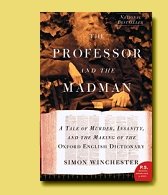
The Professor and the Madman, by Simon Winchester

Imagine that you could only have one book.

Would it be The Bible? Finnegan's Wake? The complete works of Shakespeare? What book could you imagine that would be endlessly edifying and useful, as well as dependably entertaining?

I refuse to make a choice, even hypothetically, that narrows all of literature to a single volume. However, if forced, one could do worse than to choose a really good dictionary. I love my American Heritage Dictionary of the English Language; I have copies at home and at work. But the original work that sought to define "the meaning of everything" in English was the Oxford English Dictionary.

In The Professor and the Madman, Simon Winchester has written the story of the OED, concentrating on the efforts of two men. James Murray, the professor, dedicated his life to the dictionary because he loved language, literature, and scholarship. W.C. Minor, the madman, shared those motivations, but he was also in need of an occupation to stave off the madness. His extreme dedication to the dictionary project was made possible by his incarceration in an insane asylum.

The process of creating the dictionary involved thousands of volunteers, combing through books in search of definitive and distinctive examples of words, which they sent, along with examples of their use, to the headquarters of the Oxford Press. From five million collected, 414,825 words were selected. The project took more than 68 years. (Murray was the first editor; at the time of his death the dictionary was about half finished.)

The professor and the madman were kindred spirits, despite the disparity in their social status. I felt that the defining exchange came late in their association, when Murray reached out to Minor in gratitude and friendship, offering him a distinctive gift. He sent him something only a few people on earth would recognize as a treasure (but the people who enjoy this book certainly agree it is)--the newly completed entry for the word "take." (It covered several pages and had taken months to compile.)

This is hardly a gripping adventure story. But there is drama in it, and passion. If you love words, it's worth a read. I enjoyed the feeling of being present at the creation of the great dictionary, which was an amazingly ambitious project and in its completion, a triumph of cooperative effort.

Wednesday, September 06, 2006

Coming Attractions

I think it's generally a mistake to announce plans for the future. So many things can go wrong and then you are forced to retract the announcement or revise it or just leave it hanging there, as a testament to your inability to master your environment.

However, I received an email today from Amazon.com saying the new Jonathan Franzen book has shipped, and I'm inspired by that. I fully intend to have a season of book reviews on Read-Think-Live. I have read quite a few books over the summer, so stand by, here's a list of some of the titles I'll be blogging about in the coming weeks.

The Professor and the Madman, by Simon Winchester
The Last Resort, by Alison Lurie
The Sot-Weed Factor, by John Barth
Babes in Boyland, by Gina Barreca
Until I Find You, by John Irving
Digging to America, by Anne Tyler
In a Sunburned Country, by Bill Bryson
The Moral Animal, by Robert Wright
John, by Cynthia Lennon
The Curious Incident of the Dog in the Nighttime, by Mark Haddon

. . . and, I didn't forget, I said I would review I Am Charlotte Simmons, by Tom Wolfe.

. . . and the aforementioned Franzen book, The Discomfort Zone.

Stay tuned . . .

Tuesday, September 05, 2006

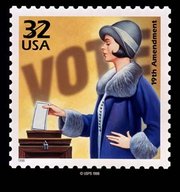
I Voted


Today was the primary for state elections in Florida. Several people are running for governor and the two leading Democrats are pretty close.

It was rainy. When I showed up at my polling place I was the only one there.

I understand apathy, I understand that people are busy. I know how they feel; it seems like just one more thing to do in a life full of duties and chores. But, it's just the right thing to do, to take the time, pay attention to the issues and candidates and make the effort to vote.

I always think of the women who worked so hard for universal suffrage--nobody just handed us the vote as a gift. And the civil rights workers who gave their lives for voting rights--that happened in my lifetime. I can't take it lightly. Voting is important.

Here's a voting rights timeline for the United States. Here's the timeline for women's suffrage, by country (Switzerland: 1971!?).

Monday, September 04, 2006

Happy Labor Day

Today's holiday served its purpose for me, gave me an opportunity to step off the treadmill of activities for a while and contemplate the condition of workers in America. It's a good occasion to salute the Service Employees' International Union, they are doing some very good work and have been reaching out to people outside their ranks. Joining their affiliate organization, Purple Ocean, is a good way to support workers' rights, and their website is a source for news about developments that affect working people.

It's also a good day to remember a great, underappreciated hero of American history, Eugene Victor Debs. I will include below some excerpts from the 1918 speech that resulted in a prison sentence for Debs; close to a century has passed, but the words still ring true, too true.

===========
June 16, 1918, Canton Ohio

...These are the gentry who are today wrapped up in the American flag, who shout their claim from the housetops that they are the only patriots, and who have their magnifying glasses in hand, scanning the country for evidence of disloyalty, eager to apply the brand of treason to the men who dare to even whisper their opposition to Junker rule in the United States. No wonder Sam Johnson declared that “patriotism is the last refuge of the scoundrel.” He must have had this Wall Street gentry in mind, or at least their prototypes, for in every age it has been the tyrant, the oppressor and the exploiter who has wrapped himself in the cloak of patriotism, or religion, or both to deceive and overawe the people.
...
Every solitary one of these aristocratic conspirators and would-be murderers claims to be an arch-patriot; every one of them insists that the war is being waged to make the world safe for democracy. What humbug! What rot! What false pretense! These autocrats, these tyrants, these red-handed robbers and murderers, the “patriots,” while the men who have the courage to stand face to face with them, speak the truth, and fight for their exploited victims—they are the disloyalists and traitors. If this be true, I want to take my place side by side with the traitors in this fight.
...
Do not worry over the charge of treason to your masters, but be concerned about the treason that involves yourselves. Be true to yourself and you cannot be a traitor to any good cause on earth.


--Eugene V. Debs

=======
Happy Labor Day, everybody.

Saturday, August 05, 2006

Vacation is a State of Mind

Early August. Everybody is on vacation, just back from vacation, or getting ready to leave for vacation. Individually their vacations may not be that much more exciting than mine, but collectively, heck, they are going to North Carolina, Colorado, Texas, France, California, Germany, Cape Cod, Hawaii, Canada... My traveling is done for the year so I might be tempted to the sin of envy.

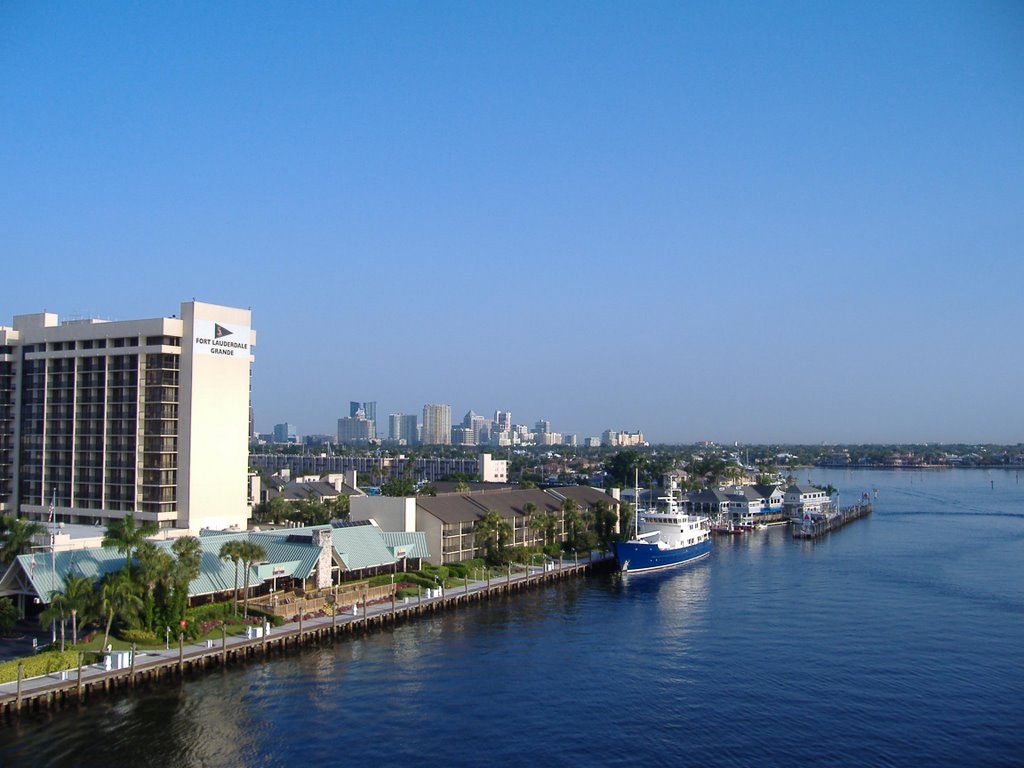
So, when I woke up this morning, I rolled out of bed, threw on some shorts and a tanktop, told my husband, "I'm going for a 'big' bike ride; don't worry about me!" and took off. It takes about 15 minutes to get to the beach, then I turned south on A1A and just kept going. I toured Fort Lauderdale beach, went past the International Swimming Hall of Fame, the Sheraton Yankee Clipper Hotel, the Bahia Mar Hotel and Marina (where the big boat show is every year), past the Jungle Queen riverboat and all the famous spring break landmarks. Eventually A1A turns west and goes across the Intracoastal Waterway on a big bridge--the highest point my one-speed bicycle has ever attained, and the biggest hill I've ever ridden up (or down) in Florida. I took this picture of the Fort Lauderdale skyline from the bridge. On the other side, the bike lane ends and it's urban biking instead of beach biking. I turned around and headed home.

With one pit stop at Dunkin Donuts for a strawberry-banana smoothie (yum, with whipped cream!), I was home by 11 a.m. or so. Expedia says I rode 36.6 miles. It was fun and it felt just like being on vacation.

Ho hum, where's my hammock, I think it's naptime.

Sunday, May 28, 2006

Tropic Magazine

The Miami Herald used to have a Sunday magazine, like the New York Times has. The Herald's magazine was called Tropic. Tropic launched some illustrious careers and provided many happy hours of intellectual stimulation for south Florida readers. The Herald stopped publishing Tropic in 1998, and I miss it. I found out that I could get the articles in digital format from the Broward County Library, so I started spending time at the library going through the files. I enjoyed reading the stories and I kept thinking I'd like to share them with other people. I emailed some, and then I emailed some more, and eventually I had the idea to construct a website. That turned into a project that I worked on in my spare time for several months, and now the site is set up and on line, and this is its official opening.

My totally unofficial Tropic fansite: www.tropicfan.com

I hope you enjoy it.

Friday, May 26, 2006

It's All Sausage

On my way to work two days ago I saw a freshly-killed possum on the side of the road. Yuck. Then I immediately passed a convenience store that was apparently selling breakfast; the smell of sausage and toast wafted out the door. It made me think about how seeing a dead animal makes me lose my appetite. But I eat dead animals almost every day. I thought, maybe it is because when you come upon a dead animal it's not a good idea to eat it--better to kill it yourself because then you know it's fresh. Okay, but seeing a live rabbit or deer or even a cow or chicken doesn't make my mouth water. Contrast that with the sight of a strawberry or a plum, or even a pecan or a peanut. I'm becoming convinced that my basic nature is vegetarian.

Now, I have to say my friend Setsuko has told me that when she goes to an aquarium the fish look yummy to her; she always thinks about eating them. But she doesn't feel that way about cows or chickens.

We use sausage as a metaphor for many things: you may enjoy the end result, but you don't want to know the details of how it was made. I see now that that applies to meat products of various kinds. To kill the animal, skin it, take out its intestines, cut it up and cook it is not at all an attractive prospect to me. I'm relatively certain that if I had to do that myself, I would be a vegetarian. As it is, I guess I'm just a species of hypocrite.

Monday, May 08, 2006

Artist Alice Comes Home

Today marks the start of the Off-Season for ReadThinkLive. The original motivation was that our daughter, who had been the recipient of my wisdom daily for eighteen years, finally escaped my immediate vicinity and went off to college. I figured I would miss reading her passages from whatever I ran across that I thought she needed to know, or sharing my thoughts with her or giving her lectures about morals and values or whatever. So the blog would be an outlet for me and also a way for her to tune in at her convenience and find out what Mom was thinking about on any given day.

But tonight Artist Alice is coming home for the summer. The phone has already begun to ring with eager suitors. I had forgotten about that ringing phone; it's been peaceful these last months.

So for the forseeable future, I'll post when I have some burning issue to rant over or when I've read something that inspires me, but not every day.

Now, I must go clean the living room.

Saturday, May 06, 2006

F. Scott Fitzgerald (1896 - 1940)

"Show me a hero, and I'll write you a tragedy."
--F. Scott Fitzgerald


Today I watched an old movie, The Last Time I Saw Paris, starring Elizabeth Taylor and Van Johnson. It is based on a short story by F. Scott Fitzgerald, and it made me remember that Fitzgerald is the most romantic literary figure I know. Somehow, the image of the young, handsome writer struggling with his demons to write stories of love and tragedy and tragic love is burned into my brain. He is the writer as tortured artist, one of those "too sensitive for this world" types. I know Lord Byron is the poster child for that, but Byron isn't as vivid to me. Plus, Fitzgerald is so American. I need to read some of his short stories again.


"Poetry is either something that lives like fire inside you -- like music to the musician or Marxism to the Communist -- or else it is nothing, an empty, formalized bore around which pedants can endlessly drone their notes and explanations."
--F. Scott Fitzgerald

Friday, May 05, 2006

Crime and Punishment

In 1981, I was teaching fifth grade at a Navy base in Key West. The news of John Lennon's murder reached me early in the morning, and I arrived at work to find the other teachers discussing the event. I was sad about Lennon's death, and hopeful that I would find other people who were sharing my feelings. Instead, what I heard was anger, and people expressing their wish for the punishment of the murderer. The death penalty would be too good for him, someone said, and there was general agreement, as people expressed their opinions about how much punishment he deserved. I had been sad before, but hearing that conversation I was heart-broken. What kind of way was this to remember John, who had worked for peace and advocated love. It was a moment of supreme alienation for me.

Now Zacarias Moussaoui has been sentenced to life in a super-maximum security prison and Americans of all kinds are expressing their sense of satisfaction that he will be denied martyrdom and instead subjected to a lifetime of harsh conditions, isolation and sensory deprivation. I am disheartened by the sentiments expressed by the people I live and work among.

From my viewpoint, the supermax prison concept might be justifiable if the total population was around 100. The 100 most dangerous criminals alive at any given moment. The unibomber, Charles Manson, people like that. But it's nothing like that. Prison construction and administration is a growth industry, and the United States has the highest per capita incarceration rate in the world. The supermax prisons are home for thousands of individuals, and many of them are not serving life sentences. That means that one day they will be out in society. The brutal conditions of solitary confinement do not produce people who can successfully rejoin the world and cope with the requirements of civilization.

I would like to see Americans let go of the idea of punishment. To lose one's freedom is punishment enough; it should be viewed as a necessary evil. We need a return to the concept of rehabilitation, education, and training for useful jobs. We need to find a way to allow inmates to remain connected to the social fabric, their families and communities. Humans are social animals. In isolation, we can never be fully human. We require communication, interaction with other people. Maybe what has gone wrong is that Americans have convinced themselves that inmates are not, in fact, people.

Thursday, May 04, 2006

The Big Read

In conjunction with the National Endowment for the Arts, some local educational and literary organizations are sponsoring this community event: The Big Read. The idea is to choose one book for "everybody" to read and discuss.

This is a national program, and the NEA selected four books for the local committees to decide among. Florida's selection is Farenheit 451, by Ray Bradbury.

Ray Bradbury was one of my favorite authors when I was young. His books, especially Dandelion Wine, Something Wicked This Way Comes, and The Illustrated Man provide some of my most vivid reading memories. For example, in Dandelion Wine, there's a scene in which three children encounter an elderly woman. She buys them ice cream, they sit on her porch, and during the course of conversation she tries to convince them that she was once young. They find the idea ludicrous. When I read the book, I was the age of those children, and the idea was as new to me as it was to them. I remain loyal to authors who introduce entirely new ideas to me.

I put Bradbury on my list of authors that everyone should read before they get too old--for most people who read, I'd say by age 25 you are likely to be too worldly, too jaded to be able to appreciate the work. I know I am. The books are almost irritating to me now--I tried to read Farenheit 451 last year when my daughter was reading it for English class, and I didn't get through it.

Other authors who share space on the read-'em-while-you're-young list include Taylor Caldwell, Ayn Rand, Howard Fast and C.S. Lewis. There are, on the other hand, some authors of "children's books" whose work I would recommend to anyone of any age. That list includes E.B. White, Laura Ingalls Wilder, and A.A. Milne.

Wednesday, May 03, 2006

Realage.com

Internet quizzes can be fun, but this is a seriously useful site, where you fill out a questionnaire about your characteristics and lifestyle and it tells you your "real age"--a backwards way of saying, your life expectancy.

What is most useful is that it is totally specific about what answers caused the number to go up or down, so you can adjust your lifestyle to see what effect that has on your "real age." I get the email newsletters--they are tailored to my specific profile, and they have been quite useful. I know enquiring minds want to know, so I'll report: my chronological age is 48.2; my "real age" is 43.2. I have healthy habits and good genes, but I could improve by eating more vegetables and whole grains. If I also started eating soy products regularly, I might live forever. Tofu burgers! I don't think I'm quite ready for that.

Tuesday, May 02, 2006

Ishmael, by Daniel Quinn

A young colleague from work gave me this book with a strong recommendation. The full title is Ishmael: An Adventure of the Mind and Spirit. A blurb on the cover quotes Jim Britell of the Whole Earth Review: "From now on I will divide the books I have read into two categories--the ones I read before Ishmael and those read after."

A telepathic gorilla is the main character. Our narrator is a young, self-styled "seeker." The book is an exposition of a philosophy that is offered as an antidote to the destructive worldview currently prevailing.

"You hear this fifty times a day. You can turn on the radio or the television and hear it every hour. Man is conquering the deserts, man is conquering the oceans, man is conquering the atom, man is conquering the elements, man is conquering outer space...and given a story to enact in which the world is a foe to be conquered, they will conquer it like a foe, and one day, inevitably, their foe will lie bleeding to death at their feet, as the world is now." (p.73, p.84)

There were no brand new ideas in the book for me, but it helped me organize some of the ideas I got from East of Eden. The content is more important than the style, but it is well-organized and engaging.

If you are interested in a quick philosophical novel about ecology, you could do worse.

Monday, May 01, 2006

Communism and Christianity

Happy May Day!

Of course, May Day is a traditional spring festival in England, and probably other places too. But it is also International Labor Day, a day to celebrate working people and support them in their attempts to improve their working conditions, everyplace except the United States of America. The U.S. has its own special Labor Day, in September, to differentiate ourselves from the Godless Communists. I say, the cold war is over now, and we should rejoin the international community and celebrate Labor Day the same day as everybody else. Then we could use September for another birthday holiday--well, Eugene Debs's birthday is November 5, maybe that's close enough.

I didn't have time to think about this blog today because I went straight from work to my Bible study group. I could think a long time and not come up with anything as good as this, from Paul's letter to the Hebrews, chapter 13, verse 1-3, labeled in the New International Bible as "Concluding Exhortations:"

Keep on loving each other as brothers. Do not forget to entertain strangers, for by so doing some people have entertained angels without knowing it. Remember those in prison as if you were their fellow prisoners, and those who are mistreated as if you yourselves were suffering.

...Grace be with you all.

Sunday, April 30, 2006

TV Turn-Off Week, Part VI: The End of the Rant

TV Turn-Off Week ends today. I have had a very good time doing something I don't get many opportunities to do: denigrating a holy icon of American culture.

In the interest of full disclosure and total candor, I want to tell you that our living room contains a 27" television set. It is not hooked up to cable or an antenna, and so it does not deliver what I call "television" into my home. We do watch movies regularly, and I occasionally get dvd's of material that was originally produced for television. I watch them on my own schedule, without commercials. Some of the shows that I have liked enough to watch entire seasons' worth of: "Friends," "Six Feet Under," "The Office" (British version), " and "Arrested Development." ("Arrested Development"--NPR says I should like it, and I have tried to like it, but I often fall asleep watching it--I think I'm done with it.) The only broadcast show that I watch more or less religiously is the Academy Awards. I watch a videotaped version of it, usually the day after the broadcast. I fast-forward through the commercials.

Coming up this week: book reviews and who knows what else...

Saturday, April 29, 2006

TV Turn-Off Week, Part VI: TV Makes us Fat

If you are sitting on a comfortable chair, staring off into space, you aren't burning very many calories. But you are burning more calories than you would be if you were watching television. When we watch tv, we become very still and our metabolism slows down. That's what the studies show, and other studies have shown a direct correlation between obesity and the number of hours spent watching television.

In addition to slowing our metabolism as we watch, of course, tv time takes away from available time to play sports or take a walk or go to the gym.

And let's not forget that while we watch we will be bombarded with messages urging us to EAT MORE JUNK FOOD!!!

Here's Dave Barry: "Maybe you are wondering, 'Am I overweight?' Well, here's an easy test to determine whether you have a weight problem. Go to the nearest window. Look out. If you see America, then you are overweight" (paraphase--I'm sure it was funnier when he wrote it.)

So Americans watch more and more television, and get more and more overweight. Of course television is not the entire cause of the obesity epidemic, but I really believe that the more tv people watch, the less inclined they are to take charge of their own lives.

Tomorrow: Full Disclosure and Disclaimers, and we say farewell to TV Turn-Off Week.

Friday, April 28, 2006

TV Turn-Off Week, Part V: Television is BAD FOR KIDS!

One time about twelve years ago, a neighbor I didn't know very well asked me to babysit her six-month old baby. When I arrived at the house, she gave me the usual run-down: the bottle is here, the diapers are there, and she said, the baby is in the bedroom. Just leave the television on and she'll be fine. Then the mom left.

I went into the bedroom to find the baby propped up in an infant seat, facing the tv, about four feet away from it. The program that happened to be on as I entered the room was some kind of lurid drama, with people yelling and threatening each other. I can't report any details about it because of course I turned it off immediately. I picked up the baby and cuddled with her while she had her bottle and went to sleep. When the mom came home, she expressed some irritation that the television wasn't on. I didn't babysit that child again, but I'll never forget that experience.

That's not an illustration of my point, just an introduction to the rant.

Television is bad for kids. The time they spend watching tv would literally be better spent making mud pies. Watching cloud formations. Playing fetch with the dog. Fishing. Building forts. Talking to a friend. Daydreaming. Drawing. ANYTHING!!

Commercials are bad for kids. They have no defense when they are young, and by the time they get a clue, their minds are already formed with a background of advertising propaganda.

TV news is bad for kids. It is violent and frightening.

Television teaches children that they have a right to be entertained. That is a direct cause of boredom. My daughter has never known boredom, and it's partly because we never had television. She had books and art supplies. She could create a whole world with sticks and leaves. As a high school student she laughed when she told me that when new friends found out she didn't have tv, they would say, "What do you do?"--presumably they couldn't imagine how they would fill all the empty hours that would result if they didn't watch television.

I was pleased when I heard Alice say something about Levi jeans, pronouncing the brand like "levee." At age 17, she had never seen a jean commercial on television. Result: she didn't "know" that she needed to spend extra money for a brand name. She decided for herself what clothes she liked to wear, what jeans were comfortable.

American parents don't agree with me. Most kids have television in their bedrooms. Toddlers have their own specially designed remote controls, and their own specially produced shows and movies. American children spend more time in front of the tube than they spend in school. I'm crazy, out of touch with reality. But I'm very glad I raised my daughter without television, and what is more, she is glad, too.

Thursday, April 27, 2006

TV Turn-Off Week, Part IV: TV News--Purveyor of Information or Corporate Shill?


Occasionally, reading the newspaper, you will run across a "news item" with a headline like "New Weight-Loss Pill Works Wonders!" and the crap detector goes off, and if you have experience with newspapers, you will look at the top of the page--sure enough, there's the small print: "Paid Advertisement." I don't know if it's a law or if it's just journalistic ethics, but it's pretty consistent. Well, guess what, television news is apparently lacking either a law or an ethic that would require the producers to notify the public when they are watching a "news item" that is actually produced by a corporation, for the benefit of that corporation. I'm assuming that it is because no money changes hands--it's a barter, the corporation gets free air time and the tv station gets free, professionally produced video that passes for news.

A study just came out from the Center for Media & Democracy called "Fake TV News: Widespread and Undisclosed," that details the ways that tv stations throughout the country, in both large and small markets, spoonfeed prepackaged information to their audiences, using various ruses to make it seem as if the station produced the segment even though they didn't even check the facts presented.

Here's the link: read it and weep.

Wednesday, April 26, 2006

TV Turn-Off Week, Part III: The News

My daughter reported this exchange in her 12th grade American Government class: Teacher: "You guys should read the news more." Student (amid laughter and agreement from others): "You can't read 'The News'"(!) (unstated intent: "The News" is a tv show, as in "The Six-O'Clock News" or "Fox News" or "CBS Evening News.")

Way too many Americans get all of their news from television. The main problem I see is the underlying message of all television news programs: that it is possible to learn everything you need to know about what's happening in the world in 15 minutes a day. A corollary is that paid professionals can be trusted to sift through the day's events and bring to your attention those items that are necessary for you to know.

Of course, the paid professionals are sifting through the day's news with quite another objective. Their objective is to get you to watch their show. They watch each other's content and viewer numbers and adjust their programming accordingly. The result: "If it bleeds, it leads." Plus, copious amounts of time devoted to weather and sports. All the actual news stories are reduced to sound bites. The result of all this: a person who forms his worldview from watching tv news tends to be a fearful, pessimistic individual. And not well-informed, either. I feel certain that the Americans--there are millions of them--who still believe that Saddam Hussein was somehow responsible for the 9/11 terrorist attacks, mainly get their information from television.

Again, the passive nature of the television experience also works against it. You have the evening news, I have a newspaper. You have to sit and wait to see what they want to tell you, pause for commercials, listen to what they choose to present in the order they choose to deliver it to you. If the phone rings, you miss part of the story.

With my newspaper, I can scan the headlines, and decide for myself what I want to find out about, based on my interests and what I consider important. I can turn directly to the celebrity news, or the business section, or local news. I can read the entire story about a high school basketball game, and skip the Olympics altogether. I can read faster if I just want the general idea, or slower to get the details of a complicated story. If my daughter wants to have a conversation, I can put the paper aside until later. I can clip a story to share or file for future reference. I can read different viewpoints from columnists, op-ed writers, editors and letter-writers. In the same time it takes you to sit through one news program, I can get 100 times as much information, tailored to my specific interests.

Tune in tomorrow, when we tie together parts II and III and explain "How Television News and Commercials Overlap."

Tuesday, April 25, 2006

TV Turn-Off Week, Part II: Commercials

"I like commercials," a co-worker once told me. "Without commercials, I wouldn't know what to buy!"

===========

The number one reason I don't have television in my house is: commercials.

We live submerged in a sea of commercial speech--advertising, marketing, images designed to catch our eyes, tunes designed to stay in our heads all day. So why is television advertising especially bad?

First of all, no other form of advertising commands our attention so totally. We are watching a show, being entertained. Maybe we are laughing, relaxed, or maybe engrossed in a mystery or on the edge of our seat with suspense. We are tuned in. And here comes a commercial. Maybe we get up during the commercial break to get a drink of water or let the dog in, but not always. And the advertising message that is presented to eyes and ears at that vulnerable time is very likely to get through.

Now, I know you think you are an adult human being with free will. You laugh at the commercials, and at the idea that they could influence your behavior. Besides, at the worst, it's only costing you money if you buy the products they sell. Right?

Not.

First of all, as a Robert Heinlein character says, "Man is not a rational animal; he is a rationalizing animal." We don't know why we do things. We do them and then we make up explanations that make sense to us in the context of our beliefs.

Second, when we follow the directions we receive from the commercials, we end up much worse off. I can't prove the extent to which television has contributed to the problems our society is facing, but I believe that there is a connection between the billions of collective hours spent passively absorbing strong, coercive messages and the collective tendency of Americans to flock together in actions that are harmful to us as individuals and as a society. Overeating, SUV's, McMansions, war, the widening gap between rich and poor, the widespread pursuit of happiness through consumerism--these are just a few examples.

It is a cycle, too, because one of the main products TV advertises is itself.

Tune in tomorrow for more ranting...

Monday, April 24, 2006

TV Turn-Off Week, Part I

April 24-30 is TV Turn-Off Week, and we are celebrating it here at Read-Think-Live.

This week, I also celebrate having my own blog, because I know from experience that anti-television sentiments don't go over well on even liberal-leaning blogs. I've been chastised every time I've expressed my television opinion in an open forum.

So here we are, I can say whatever I want, so "stay tuned" as they say. This week will be a veritable orgy of tv-bashing. It will be the virtual equivalent of what they did to the photocopy machine in Office Space.

Feel free to visit the official website. These people are even more radical than I am!

I'm actually not in a ranting mood this evening, and I'm going to let John Prine kick off the week for me, with a little song that goes something like this:


Spanish Pipe Dream
by John Prine

She was a level-headed dancer
on the road to alcohol
And I was just a soldier
on my way to Montreal
Well she pressed her chest against me
About the time the juke box broke
Yeah, she gave me a peck on the back of the neck
And these are the words she spoke

Chorus:
Blow up your T.V.
throw away your paper
Go to the country,
build you a home
Plant a little garden,
eat a lot of peaches
Try and find Jesus
on your own

Well, I sat there at the table
and I acted real naive
For I knew that topless lady
had something up her sleeve
Well, she danced around the bar room
and she did the hoochy-coo
Yeah she sang her song all night long,
tellin' me what to do

Repeat chorus:

Well, I was young and hungry
and about to leave that place
When just as I was goin',
well she looked me in the face
I said "You must know the answer."
She said, "No but I'll give it a try."
And to this day we've been livin' our way
And here is the reason why

We blew up our T.V.
threw away our paper
Went to the country,
built us a home
Had a lot of children,
fed 'em on peaches
They all found Jesus
on their own

(Woo-hoo!)

Sunday, April 23, 2006

Henry Flagler and the Overseas Railroad

I've been burning the midnight oil, finishing Last Train to Paradise, an account of Henry Flagler's greatest project, the railroad to Key West.

Essentially, Flagler was the architect of modern-day Florida. He built railroads and hotels, and towns grew up around them. Key West was the exception--it was the most developed city in Florida at the time Flagler first discovered St. Augustine and decided to embark on his development projects. But Key West could only be reached by boat, and Flagler conceived of an extension of the East Coast Railroad to connect the Southernmost City with the mainland.

It took seven years and $30 million to construct. Hundreds of workers died in the process. The effort was comparable to a contemporary engineering feat, the construction of the Panama Canal. But when it was finished, in 1912 a passenger could board a train at Pennsylvania Station in Manhattan, and three days later step off the train in Key West.

Hurricanes plagued the project in its construction phase, and in the end the devastating Labor Day Hurricane of 1935 destroyed the railroad. The Overseas Highway was able to use many of the bridges and the foundation that was created for the railroad.

Standiford's book is fascinating reading for many reasons. The narrative follows the route south from Homestead, detailing the history of the Keys and the adventures and challenges of the railroad project. My friend, Marilyn, who gave me this book, told me, "you'll never see the drive to Key West the same way after you read this." She is certainly right. It's easy to take the road for granted since I can't remember a time when it wasn't there. But now I have a greater appreciation for the effort and ingenuity that went into creating the route.

Saturday, April 22, 2006

Saturday, Saturday

I had a very nice day today, out and about.

About nine this morning I rode my bike to the bank and then to the bike shop. It needed a new back wheel. I left it at the shop and took the bus to Fort Lauderdale.

Beautiful weather, in the 80's, slightly overcast early, clearing by ten o'clock.

On the bus, first a woman got on with hospital bracelets and all her personal effects in plastic bags. Another passenger asked her if she had been in for an operation and she answered, no, she had been in the psychiatric ward. Slightly awkward pause, then the other person asked whether it was a nice hospital and they chatted for a few minutes. I helped her with her bus route planning--she needed to get off at Oakland Park Blvd. and change to the 72, I gave her a route map and showed her where the 72 goes.

Then, a homeless guy behind me went up and had an earnest conversation with the driver; when he came back he asked for a dollar from the woman who had been chatting with the mental patient. She told him no. He sat back down. I turned around and gave him a dollar. Then he was my new best friend. Shook my hand about four times, gave me some advice about my hairstyle. Wished me good health and long life, and so on. Meanwhile, a German tourist across the aisle was worried about missing the stop for Galeria Mall, so I advised her, and so did the homeless guy. He told her where to get off to walk to the mall, but the bus driver told her to stay on. He took her farther away to a place where she could connect with another bus to take her to the mall. It was a judgment call. I think, being German and in good health, she would have preferred to walk rather than wait for another bus. It's what I would have done and it's what the homeless guy would have done. Who knows.

I went to the library, was very efficient in finding the exact article I wanted for my Tropic magazine website (still a work in progress).

Walked down Las Olas, had lunch at The Floridian Restaurant (known by those "in the know" as "The Flo'"). Sat next to a family with three kids. The parents ordered healthy food for themselves (turkey wrap, turkey platter) but for the kids, hot dog, grilled cheese, chocolate milkshake, ack! I am horrified by this aspect of American culture.

Continued down Las Olas, caught the #11 bus, which goes along the beach. I felt like I was on vacation, looking out the window at the waves and sand and all the relaxed sunbathers.

Picked up my bike, pedaled home. Great day.

Friday, April 21, 2006

Fibonacci Poetry

It's catching on like wildfire, this new poetry form based on the Fibonacci sequence. In that sequence, each number is the sum of the two previous numbers. So: 0, 1, 1, 2, 3, 5, 8, 13, 21, 34, 55, 89, 144...

Any sequence that gets me to 144 is okay in my book.

The poems use the first seven numbers to designate the number of syllables in a seven-line poem. The first line has zero syllables, so it's invisible. I still count it, though, just to prove I am a geek.

The fact that Fibonacci is featured in The DaVinci Code shouldn't be enough to disqualify these poems from consideration. The fact that the form tends to attract math buffs might lead me to doubt that literary heights will be reached with this metaphorical ladder.

I just think it's fun that it spread over the internet, so I'm doing my part. I read about 35 "fibs" tonight and never found one better than the one the New York Times used to introduce its article:


Blogs
spread
gossip
and rumor
But how about a
Rare, geeky form of poetry?

That's by the originator, Gregory Pincus. He has plenty more on his website Gottabook.

Update 4/23/06: I've been corrected by the Fibber Himself--I'm honored--the fib I quoted above was apparently penned by Motoko Rich, the author of the New York Times article. That would have been clear to me if I had thought about it for a second. Sorry, Motoko. And thanks for stopping by, Gregory!

Thursday, April 20, 2006

Making Friends at Work

Portrait of alienation and affirmation via email:

----Original Message-----
From: Michelle
Sent: Thursday, April 20, 2006 12:27 PM
To: Jill; Karen
Subject: Because you are the two here who would understand why I have sent this.....

“Reduction of the ecological footprint of the consumer classes around the world is not just a matter of ecology, but also a matter of equity.”

=======================

From: Karen
Sent: Thursday, April 20, 2006 12:28 PM
To: Michelle
Subject: RE: Because you are the two here who would understand why I have sent this.....

Yep.

===================

From: Michelle
Sent: Thursday, April 20, 2006 2:18 PM
To: Jill; Karen
Subject: RE: RE: Because you are the two here who would understand why I have sent this.....

O.k. Jill's a little baffled….I’m glad you got it.

=================


Michelle's my new buddy at work. She studied linguistics in college and she likes to read actual books, imagine that. So we've traded some books and stories of books and some words and stories of words.

Michelle is also ecology-conscious, and she reformed me from my styrofoam cup habit. Now I use a mug to eat my lunchtime Special K cereal.

She's my evidence that the future is not entirely in the hands of clueless television zombies. (She's young: in her early 20's.)

This item is short and possibly lacking in interest, but I'm leaving the computer now to go read my book Last Train to Paradise, about Henry Flagler and the Overseas Railway. Report to follow.

Wednesday, April 19, 2006

Some Women I Know

Tonight I attended a discussion group with eleven other women. At the beginning of the session we went around the circle, where are you from, what is your faith tradition.

Mona is from Egypt, educated in England, a master's degree in agricultural engineering. Lived in Canada for 10 years before moving to Florida eleven years ago. She is Muslim.

Laura Sue is from a Jewish family but says she's "more of a nature-loving, goddess-worshipping, love-for-all-things" type person. She is from Pennsylvania, she is a musician and a writer; her professional name is the Silver Nightingale.

Maggie is from Syria. Her parents were from Armenia; they fled to Syria as refugees when they were children. Maggie's husband is Muslim. She is Orthodox Christian.

Michele's parents are Sephardic Jews. She is a native-born American, married to a Hindu from India.

Fauzia describes herself as a "born-again Muslim." She was born in Pakistan, attended Catholic schools as a child, then went to Ohio State University. She has a medical degree and is a professional audiologist. She was raised in a Muslim culture but never knew a lot about Islam until after 9/11/01. She started investigating her childhood religion then and became a devout Muslim as a result of her studies.

Susan is Jewish, and attends temple weekly. For the past nine years she has also attended Sunday services at a predominantly black Baptist church. She says Judaism taught her to trust in God, but she never knew what faith was until she learned it from the Baptists. She also studies the Bhagavad Gita on a regular basis.

Naheed is a Muslim, born in Pakistan. She has lived in the United States for many years, and is the owner of a successful restaurant. She likes to say that immigrants need to learn to assimilate into American culture. She doesn't need to wear hijab to feel like a Muslim.

Kathy was born in Oklahoma. Her parents were Quakers. She converted to Judaism when she married her second husband. Since he died, she has been increasingly drawn to Buddhism, although she is still active at the temple.

Setsuko was born and raised in Japan. She is Shinto, but she says Shinto is not a religion, merely a collection of customs, a way of life, a viewpoint.

Ellie is a Jewish woman in her 70's who recently "declared herself" Ba'hai.

Willie is from Cleveland, brought up "mainstream protestant" and interested in learning about all different kinds of people and cultures.

I guess Willie was in the right place tonight.

Tuesday, April 18, 2006

More Blessed to Give

"...remembering the word of the Lord Jesus, how he said, 'It is more blessed to give than to receive.'" (Acts 20:35)

I believe this, so I try to be quick to give my time, my energy, my money, my stuff. But what happens, time after time, is that the more I give away, the more I get back. And what we get from each other, freely given, is really "blessed" more than what we earn or buy for ourselves.

Concrete example from right now: I went to some effort to give away a book to a friend in Canada. The same day, someone at work gave me a book that she had enjoyed and thought I would like. And three days ago, I received, in the mail, from Cleveland, a book about Henry Flagler and the overseas railroad that my friend Marilyn wanted to share with me. So if I'm trying to give more than I get, just in that one measurable department (books) I'm behind right now. But looking at the larger picture, what a blessing it is to be part of a community of readers.

There's an old story about heaven and hell: in hell, there's a long banquet table filled with sumptuous food and hungry people are sitting all around it, but they can't bend their arms at the elbows, so as hard as they try, they can't bring the food to their mouths. So they are starving, and in agony. The scene in heaven? Just the same set-up, table, food, elbows that don't bend, but in heaven the people are feeding one another.

For a totally convoluted analysis of the "getting ahead by being behind" conundrum, I recommend John Barth's book Giles Goat Boy. It is wonderfully diabolical, almost guaranteed to tie your synapses in knots. A very good book, if you like that kind of thing.

Monday, April 17, 2006

Peace One Day

Peace One Day is a video by a young man named Jeremy Gilley. Gilley wanted to do something for world peace, so he created a job for himself so he could work full-time for peace. He conceived the idea of a world-wide Day of Peace, when there would be a cease-fire that would cover the entire planet. And then he went to work, organizing, persuading, teaching--and documenting the process on film.

He created an organization, called "Peace One Day." They worked through the United Nations. The UN already had a World Peace Day, but it was not on the same day every year. Gilley wanted to put it on the calendar in a permanent way. It took a lot of effort just to do that, but he finally got Costa Rica and the UK to co-sponsor an amendment to the original resolution. Once that resolution was passed, there was one final World Peace Day that would fall on a day other than September 21. Ironically, that day was September 11, 2001. Now, that could either be considered a very bad omen for Peace One Day's efforts or a sign that this organization is sorely needed in our violent, war-torn world.

Gilley stepped up his efforts, and today there is a world-wide network of peace workers, putting together a myriad of activities to commemorated Peace One Day every year on September 21. Unfortunately, this spirit, wonderful as it is, hasn't "trickled up" to the Presidents, the Generals, even the Ambassadors--even though the members of the UN all gave their approval, many world leaders gave verbal support, and Nobel Peace Prize winners including the Dalai Lama gave their strongest possible endorsement.

So, no cease-fire yet. But it's not a failure. It's a beginning. Here's the website; check it out.

Peace to all.

Sunday, April 16, 2006

Resurrection


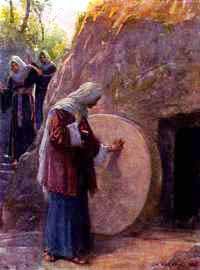
Halleluia! is the theme of the day, Easter Sunday for most Christians. Celebrating the renewal of life, in a continuation of a spring festival that goes back in history far beyond the historical Jesus.

This blog has been inactive throughout the Lenten season, and now it's back, so we're illustrating the concept of resurrection.

At my house, we're having a very quiet Easter--the man of the house had some minor surgery on Friday and he is recuperating, improving by the hour but still in need of nursing services. This is where those wedding vows ("in sickness and in health") come in.

Tuesday, February 28, 2006

Shrove Tuesday

Some people celebrate Mardi Gras by getting drunk, high, naked, wild--going to New Orleans or Rio, doing things they will regret later, or things they won't remember later.

Methodists, as a group, don't do any of that. Our idea of a wild time is getting together in the fellowship hall for a pancake supper. Woo hoo. So I volunteered to help out, and, along with the other members of my Bible study group, served lots of pancakes and sausage and juice and coffee. I was home by 7:30, and I won't have a hangover tomorrow.

What can I say--I've never really craved life on the wild side.

Monday, February 27, 2006

Hi, Mom!

I recently signed up with SiteMeter, so now I can see how many (how few) people read my blog each day. It reminds me of when I was a kid and I used to dream of putting a message in a bottle and floating it off to a distant land. Now my dream has come true and I can send messages to the other side of the world, to people I don't know, it's really cool.

One of my regular readers will never be measured by SiteMeter--that's my mom, who reads an ink-on-paper version after my dad prints it out for her at the local library. After she read the Winnie the Pooh entry of a few days ago, she wrote me a letter and said it reminded her of one of her favorite "sad" poems, written by Eugene Field. She wrote it out for me, and here it is:

Little Boy Blue

The little toy dog is covered with dust,
But sturdy and staunch he stands
And the little toy soldier is red with rust,
And his musket moulds in his hands.
Time was when the little toy dog was new
And the soldier was passing fair,
And that was the time when our Little Boy Blue
Kissed them and put them there.

"Now, don't you go till I come," he said
"And don't you make any noise!"
And toddling off to his trundle-bed,
He dreamt of his pretty toys.
And as he was dreaming, an angel song
Awakened our Little Boy Blue--
Oh, the years are many, the years are long,
But the little toy friends are true!

Ay, faithful to Little Boy Blue they stand
Each in the same old place,
Awaiting the touch of a little hand,
The smile of a little face.
And they wonder, as waiting these long years through,
In the dust of that little chair,
What has become of our Little Boy Blue,
Since he kissed them and put them there.

Saturday, February 25, 2006

Why Things Are: Achenbach's Final Answer

By way of introduction, I will say that I spent another day at the library researching ancient Key West history (relatively ancient: the Miami Herald online archive goes back to 1982 and that's good enough for my purposes). After a few hours of diligent on-task effort, my attention strayed a little bit. I did some Tropic browsing (that's the Herald's now-defunct, formerly fabulous Sunday magazine) and came up with this little gem, Joel Achenbach's final "Why Things Are" column. I lost track of Achenbach's career for a couple of years when he left Florida, but I have a vague impression that the "Why Things Are" column was reincarnated for a time in the Washington Post. I could be wrong, though--the online Post archives don't show it. At any rate, this was the swan song for "Why Things Are" in Tropic, and a case could be made that it was the beginning of the end for the magazine, too.

Date: February 4, 1996

Why are we here?

Is there a point to it? How did we get here and what are we supposed to do with ourselves? Why should we do anything? Why bother?These are some big questions, but we think we have a very good answer, bordering on the irrefutable. It may not be comprehensive, but it'll have to do, because this is our last column. At sundown we dynamite the Why bunker.

The key to the answer is: the Bering land bridge.

About 25,000 years ago, during one of the Ice Ages, sea levels dropped so dramatically that water receded from the Bering Strait. It became possible to walk from Siberia to Alaska.

And so people did. They walked to a new continent. For a while they were stymied in Alaska by a glacial ice wall, an impermeable barrier. They chilled out for about 10,000 years. Then the glaciers melted a little. Gaps appeared in the ice wall. The first Americans went south.

According to Bill Fitzhugh of the Smithsonian's Museum of Natural History, archaeologists have found tools in southernmost South America roughly as old as tools found in the Pacific Northwest. You know what that means: People rapidly explored and inhabited all of the Americas.

These Asian-American hunters went everywhere, over mountains and across deserts,
through the Isthmus of Panama, atop the Andes, down the Amazon, out to Caribbean islands -- a dramatic, but forgotten, Age of Discovery.

Why did they do it? If they were so antsy, why didn't they head south directly from Siberia and go some place warm, like Thailand?

The answer: There were animals here, and no people. The hunting was fabulous! No one told them to go away. It was doable, and so it was done. Life fills every environmental niche; humans can adapt to almost any landscape.

The Bering land bridge saga inspires us to come up with an initial, if superficial, summary of why we are here: Because we can be.

Then again, when you wake up in the morning, and are faced with another day, you don't say to yourself that you are going to fill some environmental niches. You seek something more. Your plans are grander.

We bet the first Americans felt the same way. Imagine the reaction of the first human to walk into Yosemite Valley, the first to hear the roar of Niagara Falls, the first to walk the beaches of Jamaica. They must have been awed.

Keep in mind that these hunters were, biologically, modern human beings. They had as much ability to feel wonder, reverence and fear as anyone today.

The Why staff likes to think that not so much has changed: that the world is still full of new terrain. Call us dreamers! But we think there are new Yosemites out there for all of us.

And this, we think, is ultimately why we are here: We are part of a journey. It's the journey of a single species with a weirdly large brain. (It's almost as strange as those tiny male suckerfish who disintegrate except for their testes. Remember that column?)
In a world thriving with creatures living off instinct, human beings are a bizarre and thrilling combination of intelligence and emotion. The human mind is surely one of the Seven Wonders of the Known Universe (along with the rings of Saturn, the Crab nebula, the supergiant star Betelgeuse, the black hole at the center of the Milky Way, the Automatic Teller Machine and the ready-to-eat instant salad kit).

We are going to resist the temptation to get all weepy and blubbery and quivery-chinned about this being our last column, but we have to give thanks to our immediate (and we use this term ludicrously) supervisor, Gene Weingarten, who, though a madman, is one of the great unsung geniuses in American journalism; and to the countless people who have served nobly on the Why staff or as invaluable sources, including Mary Stapp (the Why goddess), Tom Shroder, Beth Barry, Doris Mansour, Elisabeth Donovan, Brian Dickerson, Pat Myers, Mary Hadar, Katherine Wanning, David Jackson, Dana Hull, Cristina Dragomirescu, Elizabeth Schandelmeier, Bebe Gribble, Jeanne Smith, Bob Park, LeRoy Doggett.

Most of all, thanks to our readers for asking great questions, catching our mistakes, making us think. Your curiosity created a market for our little column, with its mix of fact and humor and total nonsense. You made the world safe for the question Why.
Keep reminding yourself: Every time you read a book, or take a class, or write a poem, or watch a sunset, or teach something to a child . . . every time you love someone or find something beautiful . . . every time you advance, however incrementally, the cause of intelligent civilization . . . every time you pump a little warmth into this big, cold universe . . . you illustrate the real reason why we are here.

You solve the mystery. You don't need to ask anymore.

You know the answer.

Author: JOEL ACHENBACH Herald Columnist
Section: TROPIC
Page: 4
Copyright (c) 1996 The Miami Herald
Thursday, February 23, 2006

Seasonal Affective Disorder

I was planning to return to one of my recurring themes today, Self-Loathing, because I experienced it in waves all day. But thinking about that led me to contemplate depression (specifically, how it is less painful than garden-variety self-loathing), and that led me to Seasonal Affective Disorder, and I decided to go with that instead.

Here's my S.A.D. story.

When I was nineteen years old, I spent part of my winter break from college hiking in Shenandoah National Park. I took the bus from Boston to DC, then to Front Royal, Virginia. I backpacked from Front Royal to Waynesboro, basically the length of the park, on the Appalachian Trail. It was cold, and I didn't see many people. I was alone with my thoughts for hours, days, more than a week. I observed myself, how I thought and what my personality was like, with no people around to influence it. I started to notice a pattern, and it was like this: I'd be hiking along, and feeling gloomy and pessimistic. My inner voice would be saying, "This was a stupid idea. What was I thinking. This is boring. This is hard. It's cold. I don't have enough food. I'm tired." For a long time I would just be slogging and barely motivated to put one foot in front of another. And then ... ! ... The Sun Would Come Out. And I would instantly recover--my mood would swing dramatically and I would be happy, relieved, cheerful and optimistic--and I would realize that all the negativity was just a result of the lack of sunshine. A few hours later, it would happen again, and take me by surprise again. But eventually I started to understand it and when I would start feeling negative I would take note of the cloud cover and tell myself, it's okay, the sun will come out in a while and you'll feel better.

That's how I discovered that I have Seasonal Affective Disorder, or at least a version of it, a sensitivity to sunlight that affects my mood dramatically. It fully explained the clinical depression symptoms I experienced when I was living in Boston, which disappeared instantly and completely when I moved to south Florida.

I haven't done much research on it; apparently there are special lights you can buy, but from my observations of my own symptoms, sunshine is the best remedy and after that any bright light is good. If I had to have some kind of disorder, I'm glad it's one that can be treated without money or doctors or medicine!

Wednesday, February 22, 2006

Washington's Birthday

On two occasions my dad has given copies of a book to all three of his offspring. Once: The Elements of Style, by Strunk and White, and the other time, George Washington's Rules of Civility & Decent Behaviour in Company and Conversation. These two books, taken to heart, can do a lot to help one live a decent life.

Washington's book is a list of 110 rules, beginning with
(1) Every action done in company ought to be with some sign of respect to those that are present,
and ending with
(110) Labour to keep alive in your breast that little celestial fire called conscience.

Many of Washington's rules are just as relevant to the current day as they were in his. The ones that are not relevant serve to remind us of how much better the world is than it was 250 years ago. Many of the rules concern how to act toward your "superiors" or "inferiors." I take equality for granted and it's good to be reminded how lucky we are in that regard. We also forget about how much more uncomfortable life was in a time when it was a matter of etiquette to decide how to deal with the insect life inhabiting your person and clothing, or the problem of one fireplace serving as a source of warmth and a cooking stove (you want to put your feet near the fire because they are cold, but there's meat cooking for dinner and it's not polite to put your feet near it).

Happy Birthday to George Washington, the Father of our Country.

Tuesday, February 21, 2006

A.A. Milne

The House at Pooh Corner
by A. A. Milne

Chapter X
In which
Christopher Robin and Pooh
Come to an Enchanted Place,
and We Leave Them There

Christopher Robin was going away. Nobody knew why he was going; nobody knew where he was going; indeed, nobody even knew why he knew that Chrisopher Robin was going away. But somehow or other everybody in the Forest felt that it was happening at last. Even Smallest-of-All, a friend-and-relation of Rabbit's who thought he had once seen Christopher Robin's foot, but couldn't be sure because perhaps it as something else, even S.-of-A. told himself that Things were going to be Different...

This is my favorite Pooh story, and I can't read it without crying. It is the best account I have ever read of what it is like to come to the end of childhood. Milne has special material to work with, because of the sharp demarcation in Christopher Robin's life between being a pre-school child, having long hours of freedom in the outdoors, and going to school, particularly boarding school, where everything would be supervised and all activity would be purposeful. The magic of the Pooh stories is always that they are told by an adult who is looking at the world though the eyes of the child and his stuffed animals. Milne, in a way, is saying, childhood must end and that is sad--but at the same time the story itself is proof that the enchantment of those days does not have to be forgotten. And he's also showing that even if there is sadness in childhood's end, there is also joy in the adventure of life and growing up.

...Then, suddenly again, Christopher Robin, who was stil looking at the world, with his chin in his hands, called out "Pooh!"
"Yes?" said Pooh.
"when I'm --when----Pooh!"
"Yes, Christopher Robin?"
"I'm not going to do Nothing any more."
"Never again?"
"Well, not so much. They don't let you."
Pooh waited for him to go on, but he was silent again.
"Yes, Christopher Robin?" said Pooh helpfully.
"Pooh, when I'm--you know--when I'm not doing Nothing, will you come up here sometimes?"
"Just Me?"
"Yes, Pooh."
"Will you be here too?"
"Yes, Pooh, I will be, really. I promise I will be, Pooh."
"That's good," said Pooh.
"Pooh, promise you won't forget about me, ever. Not even when I'm a hundred."
Pooh thought for a little.
"How old shall I be then?"
"Ninety-nine."
Pooh nodded.
"I promise," he said.

Still with his eyes on the world Christopher Robin put out a hand and felt for Pooh's paw.
"Pooh," said Christopher Robin earnestly, "if I--if I'm not quite----" he stopped and tried again--"Pooh, whatever happens, you will understand, won't you?"
"Understand what?"
"Oh, nothing." He laughed and jumped to his feet. "Come on!"
"Where?" said Pooh.
"Anywhere," said Christopher Robin.

Monday, February 20, 2006

Vonnegut and the Sermon on the Mount

Kurt Vonnegut does not define himself as a Christian. He is a self-professed "humanist." But he is an admirer of the Sermon on the Mount, and I'm going to let him have the podium this evening, in honor of yellojkt's comment about The Book of Revelation vs. the Beatitudes. Which is more relevant, more important, more likely to bring the Kingdom of Heaven on Earth? Here's Vonnegut:

I've said there are two radical ideas that have been introduced into human thought. One of them is that energy and matter are pretty much the same sort of stuff. That's Einstein. The other is that revenge is a bad idea. It's an enormously popular idea but, of course, Jesus came along with the radical idea of forgiveness. That was radical. If you're insulted, you have to square accounts. So this invention by Jesus is as radical as Einstein's.

===

Powers Hapgood was an official of the CIO. He was a typical Hoosier idealist. Socialism is idealistic. Think of Eugene Debs from Terre Haute. What Debs said echoes the Sermon on the Mount: "As long as there's a lower class I am in it. As long as there is a criminal element, I am of it. As long as there is a soul in prison, I am not free."

Now why can't the religious right recognize that as a paraphrase of the Sermon on the Mount? Hapgood and Debs were both middle-class people who thought there could be more economic justice in this country. They wanted a better country, that's all. Hapgood's family owned a successful cannery in Indianapolis and Hapgood turned it over to the employees, who ruined it. He led the pickets against the execution of Sacco and Vanzetti. Hapgood is testifying in court in Indianapolis about some picket-line dust-up connected with the CIO and the judge stops everything. He says, "Mr. Hapgood, here you are, you're a graduate of Harvard and you own a successful business. Why would anyone with your advantages choose to live as you have?" Powers Hapgood actually became a coal miner for a while. His answer to the judge was great: "The Sermon on the Mount, sir."

Sunday, February 19, 2006

Left Behind

The Left Behind series is a fictionalization of the end of the world, as conceived by Tim LaHaye, a non-denominational evangelical Christian, and written by Jerry Jenkins. The series is staggeringly popular among a certain type of Christian. I bought the first book in the series a couple of years ago, mainly because of a review I read on salon.com that charged LaHaye with antisemitism and other crimes related to the plot of the book. I wanted to read the source material to see for myself. I was thwarted by the low quality of the writing; I just have a very low tolerance for that. So I put it aside. My husband picked it up last week and started to read it. He doesn't have the same standards for prose; his favorite genre of book is the police procedural crime novel. He enjoyed the first Left Behind book, and is thinking of reading the second one now.

I have a lingering bad feeling about the series. My main source of discomfort at this point is the people who love it the most--the anti-intellectual contingent, the Bible-as-literal-truth crowd. As much as they claim to get their truth directly from the Bible, they are eager to read these novels instead: they are so much more accessible, written in simple prose that spells out in concrete examples exactly what will happen at the end of the world.

The books remind me of nothing so much as The DaVinci Code--a book I did manage to get through, and which made me very uneasy, because I knew as I read it that there would be thousands of people who took the fiction at face value as revelations of hidden truths. Left Behind is worse because it actually purports to be a revelation of truths.

Here's something in a similar vein, but more highbrow:

THE SECOND COMING
Turning and turning in the widening gyre
The falcon cannot hear the falconer;
Things fall apart; the centre cannot hold;
Mere anarchy is loosed upon the world,
The blood-dimmed tide is loosed, and everywhere
The ceremony of innocence is drowned;
The best lack all convictions, while the worst
Are full of passionate intensity.

Surely some revelation is at hand;
Surely the Second Coming is at hand.
The Second Coming! Hardly are those words out
When a vast image out of Spiritus Mundi
Troubles my sight: somewhere in sands of the desert
A shape with lion body and the head of a man,
A gaze blank and pitiless as the sun,
Is moving its slow thighs, while all about it
Reel shadows of the indignant desert birds.
The darkness drops again; but now I know
That twenty centuries of stony sleep
Were vexed to nightmare by a rocking cradle,
And what rough beast, its hour come round at last,
Slouches towards Bethlehem to be born?

--W.B. Yeats

Saturday, February 18, 2006

The Ruins of California

I've been reading The Ruins of California, by Martha Sherrill. It's a story of growing up in California, with imperfect parents. It's particularly a portrait of a specific time, very striking to me because it was my time, too. The main character, Inez Ruin, has the same posters on her bedroom wall that I had--James Taylor from JT and Robert Redford from Butch Cassidy and the Sundance Kid. And she pinpoints the moment when hiphugger jeans gave way to high-rise jeans and when hippy fashion was replaced with the preppie look. Inez is just a couple of years younger than I was at the same time--she is in high school during the time I was in college. But Sherrill does a great job of capturing the details that describe the cultural landscape.

Friday, February 17, 2006

"A Fool and His Money Are Soon Partying"


A Key West friend, Will Soto, is having a retirement party on April 1. Will is an entertainer and a political activist, quite well-known in busker circles ("busker: a street performer who works for donations") He even hosted the Key West Buskerfest, which had great potential but failed to evolve into a multi-million dollar annual event like Hemingway Days or Fantasy Fest or even the Key West Literary Festival (or the Powerboat Races or Old Island Days or Pirate Weekend, or...hmmm maybe there just wasn't room on the calendar for another festival).

So Will says he's starting his Farewell Tour, with Cher as his inspiration; in other words, he'll have his retirement party and go right on working.

I'm planning to drive to Key West and stay a couple of days. The better half has to work that weekend, but I have plenty of friends to visit on the island and the party will be a major event. The day after, I will try to spend some time with Will going over research I've been doing for the book he's writing about Key West and the Sunset Celebration--I've been helping him with facts and punctuation; he's supplying the imagination and imagery.

Thursday, February 16, 2006

Boca Musings


On my lunchtime walk I go by this sign; it announces the entrance to a housing development. I'm sure you can't buy one of these "estates" for less than five million dollars, and they may be more than that--I have no way to know, really. I am struck by this sign, though. First of all, the artwork is really bad. It's better than I could do, but I've seen better work by tenth graders in the public school arts magnet program. The word that springs to mind is "cheesy." The fake Greek pillars, the foliage that is just a cloud of green to save the work of painting that area of the sign, the front of the mansion with the two cypress trees, reminiscent of the famous Munch "Scream."

But above all, the dishonesty of the depiction of this acreage surrounding an English country house. For your five million plus, what are you really going to get? You're lucky if there is 12 inches between your house and your neighbor's. Those houses are packed in like sardines. It never stops surprising me that people will buy property like this, instead of buying land.

Wednesday, February 15, 2006

JAM & All Women's Group


I just returned from a three-hour discussion with a group of about forty women-- Jews, Muslims, Christians, and a few who are hard to categorize. For example, Susan was born into a Jewish family, but for the past eight years she has attended an African American Baptist church on Sunday, in addition to attending shul on Friday night. And on Wednesday afternoon she studies Hinduism. Kathy was born into a Quaker family, then married a Jew and converted to Judaism, and is now a widow who attends Jewish services and studies Buddhism.

We met at a mosque, and there were a good number of Muslim women there, representing lots of different countries--Pakistan, Egypt, Iran, Jordan--as well as one American-born convert to Islam. I may have been the only protestant there, but at least four Catholics were in attendance, and more than ten Jews, many of whom were born in the northeast U.S.

We covered a wide range in our discussions, from the cartoon controversy in Denmark to the holocaust deniers, to the allegation that the Jews killed Christ and the implication of the Pope in anti-semitism.

And a good time was had by all.

It is just great to mingle with women who care enough to come out on a weekday evening for the purpose of promoting peace through individual friendship and community-building.

Tuesday, February 14, 2006

Quoting Emerson

I'm consoling myself with R.W. Emerson this morning: "A foolish consistency is the hobgoblin of little minds."

Because I have posted every day since January 1, but last night I was too busy, and then too tired and too uninspired, so I didn't get anything online.

I could have done two entries today and dated one for yesterday, but I decided not to. I don't need to get obsessive about this cyberproject. On the contrary. It needs to fit into the spaces in my life, not displace any more important activities.

Happy Valentine's Day.

Sunday, February 12, 2006

Take the Challenge

I was steered to this site by coolsiteoftheday.com, and I'm just lazy enough to use it for my Sunday night offering here at R/T/L. I scored 80%, which is high enough to make you have to try hard to beat it, but low enough that you shouldn't be discouraged from trying. Good luck!

"Senses Challenge"

Saturday, February 11, 2006

The Lovely Fort Lauderdale Library

I spent the afternoon in the Fort Lauderdale library, doing some research that involved looking up articles that were published in the Keys section of the Miami Herald between 1982 and 1986. I started in the microfilm room but that went nowhere, and I wandered over to the reference desk to inquire. I was making friends with the reference librarian there, and he was explaining how to use the internet database to find, print and email articles, when one of his co-workers came up to him and said, "Do you want to go to lunch, I can take over here" (it was 12:20). So the first guy said, okay, and I made a joke about passing the baton, don't drop it, or something, and he said, maybe this could be an Olympic event and we were all impressed by our humor--the theme is very Pythonesque, actually, and does have some potential. At any rate, the new guy continued showing me how to look up the articles. Using the library computers, I was able to accomplish more in two hours than I would have been able to do in six months in the microfilm room. I really love the internet. And the Fort Lauderdale library is truly a wonderful environment.

Friday, February 10, 2006

How to be Alone

How to be Alone, by Jonathan Franzen, is currently at the top of my "favorite books" list, and has held that position since I read it, in the summer of 2004. I liked the book so much that I bought a spiral notebook, and began to re-read, copying down passages on the left side of the page and commenting on them on the right side. I didn't get past the first essay, but I still may go back and finish the project--I always enjoy the time I spend on it.

Here's the lead-up to the thesis of the book:

"I intend this book, in part, as a record of a movement away from an angry and frightened isolation toward an acceptance--even a celebration--of being a reader and a writer."

and here's the thesis itself:

"The local particulars of content matter less to me than the underlying investigation in all these essays: the problem of preserving individuality and complexity in a noisy and distracting mass culture: the question of how to be alone."

Franzen is a masterful writer, he turns a phrase with the best of them. I've read two of his novels and I think the essays are better than the novels. The novels tend to verge on the whimsical, the fantastic, the imaginary. The essays are firmly rooted in reality, and Franzen's reality is clear, if a little dark. He has a wonderful balance between vulnerability and clear-headed exposition.

This is the perfect book for people whose inner life (the "Read - Think") is more real to them than the outer life (the "Live"). The answer to "how to be alone" is, to me, to realize that we are participating in the culture with our reading and thinking. We are networking and creating culture, too. It's not a lonely life.

Thursday, February 09, 2006

Helter Skelter


A friend at work asked me, "Did you see McCartney last night?"

I just shrugged and gave her a friendly look because I've told her a hundred times that I don't have television, but she always forgets.

Anyway, she said, he was on the Grammys last night and he really rocked. He sang "Helter Skelter."

Then we talked about that song--how all we know about it is that Charles Manson got messages from it and they named the Manson book and the Manson movie after it. I have heard the White Album, of course, but I don't own it and I don't know what the song is about.

So I pulled up the trusty Wikipedia site and learned that a "helter skelter" is a kind of slide found in children's playgrounds in England, a spiral slide in an enclosed space, very thrilling for children. Paul had vivid memories of his childhood and often used them in his writing.

It appears that Paul was being competitive with "Helter Skelter," trying to write a very loud and cacophonous piece that would simulate (or stimulate) a psychedelic state. Being the talented artist that he is, he succeeded in creating something that had a major impact on the contemporary music culture.

Unfortunately, it was hijacked by Manson. But the words of the song do not support any kind of evil interpretation.

Manson should have used "Sympathy for the Devil" as his theme song instead.

Here are the lyrics:

[Recorded by The Beatles - 1968]

Helter Skelter
by Lennon/McCartney

When I get to the bottom
I go back to the top of the slide
Where I stop and I turn and I go for a ride
Till I get to the bottom and I see you again
Do you, don't you want me to love you
I'm coming down fast but I'm miles above you
Tell me, tell me, tell me
Come on tell me the answer
You may be a lover but you ain't no dancer
Helter skelter, helter skelter, helter skelter
Will you, won't you want me to make you
I'm coming down fast but don't let me break you
Tell me, tell me, tell me
You may be a lover but you ain't no dancer
Look out
Helter skelter, helter skelter, helter skelter
Look out, cause here she comes
When I get to the bottom
I go back to the top of the slide
Where I stop and I turn and I go for a ride
And I get to the bottom and I see you again
Well do you, don't you want me to make you
Tell me, tell me, tell me
You may be a lover but you ain't no dancer
Look out
Helter skelter, helter skelter, helter skelter
Look out helter skelter
She's coming down fast
Yes she is
Yes she is.

Wednesday, February 08, 2006

Stevie Wonder

I just got Stevie Wonder's Songs in the Key of Life on remastered cd from Amazon, and I've been listening to it for the past four days. I had never owned it before but I listened to it a lot in college. "Sir Duke" was a popular party song in those days.

Whatever happened to Michael Jackson, Stevie Wonder is evidence that it isn't inevitable. Wonder was a child prodigy who managed to grow up into a responsible adult. He is a gifted artist who keeps his message positive. His music is secular, but it has a real gospel soul. I'm feeling inspired by his Songs.

Tuesday, February 07, 2006

The Achenblog Word Cloud


Thanks to yellojkt for the link to Snapshirts that enabled me to create this word cloud of Achenblog. The more I look at it, the more I like it. "One people," indeed.

Monday, February 06, 2006

I Wish I Still Had Them

Back in about 1984, as I was moving from a small apartment to an even smaller one in Key West, and vinyl records were already on the way out, and my stereo wasn't working very well, I sold all my records at a yard sale. Many of the good ones have been replaced over the years on cassette and then on cd. But there are three record albums that have turned out to be irreplaceable and/or untranslatable, and if I had them today, they would be among my treasured possessions.

I. Monty Python, Matching Tie and Handkerchief
The marketing concept here was that you would get a free record if you bought the tie and handkerchief, but it was a blatant rip-off since the merchandise was just a cardboard cutout, very sleazy, ha ha. The record itself apparently had two "B" sides, visually identical, so you couldn't tell until it started playing which side you were listening to. Then of course if you turned it over you would be listening to the other side. But after listening to one side and then the other a few times, or possibly even the second time, you would suddenly realize you were listening to something you hadn't heard before. The record actually had three sides. One side was double-grooved. The cleverness of that was just a bonus, since the contents of the record was extremely funny. I have it on cd now, but it is Not the Same.

II. Jimmy Thudpucker's Greatest Hits
Jimmy Thudpucker is a Doonesbury character, kind of a satire of a Jackson Browne type California folk-rock singer/songwriter. I bought the album because I have always been a Doonesbury fan, not expecting much in the way of musical quality. I was surprised to find that the songs were very good, and it became one of my favorite records. I guess it is a rare collector's item today. Wish I still had it.

III. Tim Weisburg, Hurtwood Edge
Tim Weisburg's instrument is the electric flute. His music is a sort of jazz that flirts with easy listening, but, in my opinion, never crosses that line. He's had some success--I saw him on the Tonight Show more than once, in the late 70's, and he made an album with Dan Fogelberg in 1976 called Twin Sons of Different Mothers, followed up about 20 years later with one called No Resemblance Whatsoever. Hurtwood Edge is out of print and was probably never recorded on cd, but I can still hear the melodies in my head, at least parts of them. What I can't remember, is lost forever.

Sunday, February 05, 2006

Super Bowl Sunday

Gosh, I would watch the Super Bowl, but...

--I've got to read this book, Wicked, because I've got three other books on my list that I need to get to next
--I have to write my blog
--I have to do laundry
--Got to wash my hair tonight
--Don't have television
--Don't like commercials
--Don't know anything about professional football
--Don't like the Rolling Stones
--It's All-Beatles Weekend on my oldies station (Now playing: "Penny Lane")
--Can't help thinking football encourages violence
--I'm sick of the commercialization of entertainment
--I'll probably be in bed by 8:45
--I do not care who wins

...but otherwise, I would be watching the Super Bowl right now.

Saturday, February 04, 2006

Enron

I watched Enron: The Smartest Guys in the Room today, and I am just about paralyzed with disgust.

A portrait of a true Free Market Economy at work. Libertarians and Republicans, I guess they see what happened and say, yeah? what's wrong with that? Who got hurt, only the people who weren't smart enough or aggressive enough to protect themselves. It's their own fault.

My tipping point in the movie was when Enron bought power plants in California and then called them and told them to shut down operations for a few hours to drive the prices up so they could make more money. That is so easy to understand, not complicated at all. They didn't have to be so smart to figure that out, they just had to be ruthless, and think of it as nothing but a game that uses money to keep score.

The film included a clip of Ronald Reagan saying, "government won't solve our problems. Government is the problem." And with the kind of laissez-faire economic policy he was advocating, I just about have to agree with him. But good government can solve problems. Otherwise, we might as well all be libertarians. We'll stock up on food and amunition and just try to survive long enough to breed so that our genes will be part of the future gene pool--is that all life is about?

I have never believed in a kind of intelligence that is asocial, or anti-social. Even though I'm kind of a loner myself, I've always been able to apply my intelligence to interpersonal situations. The portrait of the eccentric genius who can't function in society, I don't recognize that person as being truly intelligent. Talented, okay, maybe. But a truly intelligent person is capable of appreciating the effect his actions have on other people. Extreme intelligence, I believe, is best exemplified by someone like Mahatma Gandhi. He understood the human world that he lived in, and was able to act to make it better.

Actually, that phrase, "the smartest guy in the room" is one of my favorites, although I don't often say it out loud. I think about it, though: In any room, there is bound to be one person who is the smartest one there. And by my definition, that person always knows who he is. There are probably several others who believe they are the smartest, as well. But they are wrong, and just don't know it. There's a lot to think about in that situation. Potential for irony abounds.

Bottom line: those Enron guys, they were not so smart as they thought.

Friday, February 03, 2006

My Favorite Pet

When I was very young my family had a German shepherd, Rena. Rena was kind of mean, at least that's how it seemed to me, but in hindsight maybe she was just rowdy and I was very small at the time. She did chase and nip me. Nevertheless, I was sad to leave her behind when we moved to another town, when I was five. The new house had no fence, so we couldn't take her with us. She was given away to the proverbial "place in the country, with lots of room to run around." Not my favorite all-time pet.

At the new house, we had a mixed breed terrier, Peanuts. He was a good dog, no trouble at all, liked to lie under the coffee table. When he wanted to go out, we let him out, and when he felt like coming back, he would whine at the door and we would let him in. Best thing about Peanuts was, early summer mornings when I went for my nature walks, he always wanted to go too. In some ways, he was my favorite, but he wasn't my dog, he was a family dog.

I've never had another dog--now they are too much work. We've had cats. None of the cats is qualified to be my favorite pet. We've had fish. Eh. I had a snake once, when I was about 10, but that was just an adventure, and it was way more trouble than it was worth.

My favorite pet was Hammie the Hamster. Hammie was easy to take care of--we could leave him alone for a long weekend by getting the right kind of food and water dispensers. Just clean out the cage once a week or so. He was obviously warm-blooded, unlike the fish or the snake. Hammie was cute and kind of cuddly. He didn't mind being picked up and petted, but he wasn't pining for company if we left him alone for days at a time. He didn't make any noise at all, unless his exercise wheel got squeaky, and then we did hear that all night, every night, but I didn't mind it--in a way it was inspiring. How am I going to complain about getting up for my morning jog, when Hammie's been on the treadmill all night.

Overall, I'd say a hamster is my ideal pet. And the very best thing about them is that the typical hamster lifespan is about two years. So just about the time I started to get tired of cleaning the cage: sayonara, Hammie, R.I.P.

Thursday, February 02, 2006

Less Than Three

This is a nerd joke. It will make my daughter laugh. She likes to laugh at my nerdiness. I don't mind, because we both know she has inherited a lot from me and she can't deny it.

I admire people who are naturally funny, or who are willing to put in the effort to be humorous. Those people make a real contribution to the world by increasing the amount of laughter and smiles.

I'm not naturally funny, and I'm usually not willing to try. But I do see the humor in everyday situations, and sometimes I'm able to point it out when other people have missed it. My specialty is knowing how to make a particular person laugh. The secret is in referring back to a previous remark or situation. That's partly what makes it easy to make my husband or my daughter laugh, because I know what they are thinking most of the time, and I remember so many things they have said or done.

My daughter likes to communicate through "instant messages." She is very conscientious about using correct punctuation and spelling, and almost never says ROTFL or IMHO. But she does use one shortcut a lot. Instead of "love" or even "heart" she types "<3". So the joke is, whenever I'm seeing her off at the airport or she's leaving with friends for a night out, I will say "less than three! less than three!"

I warned you.

Wednesday, February 01, 2006

Groundhog Day Eve


Almost everything I know about Groundhog Day, I learned from watching the movie Groundhog Day, starring Bill Murray and Andie MacDowell. I really like that movie, and as I watched it the first time I kept thinking, "I like this movie, but I don't know anybody I would recommend it to." The kind of person who, like me, prefers to sit in on a rehearsal than to see the finished show, who likes to watch dancers work on one move over and over with someone helping them become a little closer to perfection each time, who would rather attend batting practice than watch a baseball game--that's who really enjoys Groundhog Day. It's a glimpse of the creative process. It's funny, too.

So tomorrow is Groundhog Day, and here in South Florida the sun is bound to be shining. The Florida version of a groundhog may be something like an iguana; when it sees its shadow and returns to its burrow or tree or whatever, we'll have six more weeks of winter and we'll be glad of it. It's summer that's the endurance contest here. Winter is Easy Street.

Happy Groundhog Day!