Thursday, November 23, 2006

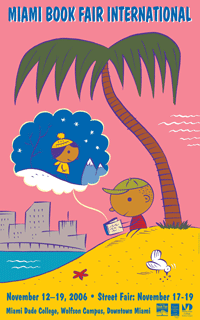
Miami Book Fair 2006

Authors I met:

* Kurt Andersen
* George Kalogerakis
* Jonathan Franzen
* Dave Barry
* Ridley Pearson
* Carl Hiaasen

Books I either bought in advance specifically for the fair, bought at the fair, or had signed at the fair:

* The Discomfort Zone, by Jonathan Franzen
* How to Be Alone, by Jonathan Franzen
* Nature Girl, by Carl Hiaasen
* Spy: The Funny Years, by Kurt Andersen, Graydon Carter, and George Kalogerakis
* The Partly Cloudy Patriot, by Sarah Vowell
* The Real Thing, by Kurt Andersen
* Surviving Justice, compiled by Lola Vollen & Dave Eggers
* Turn of the Century, by Kurt Andersen
* The Republican Playbook, by Andy Borowitz

Free merchandise from the fair:

* CD: Attaining the Worlds Beyond (ref. www.kabbalah.info)
* Orange kazoo from Don't Quit Your Day Job Records

Pre-fair activities: Meeting my imaginary friend!

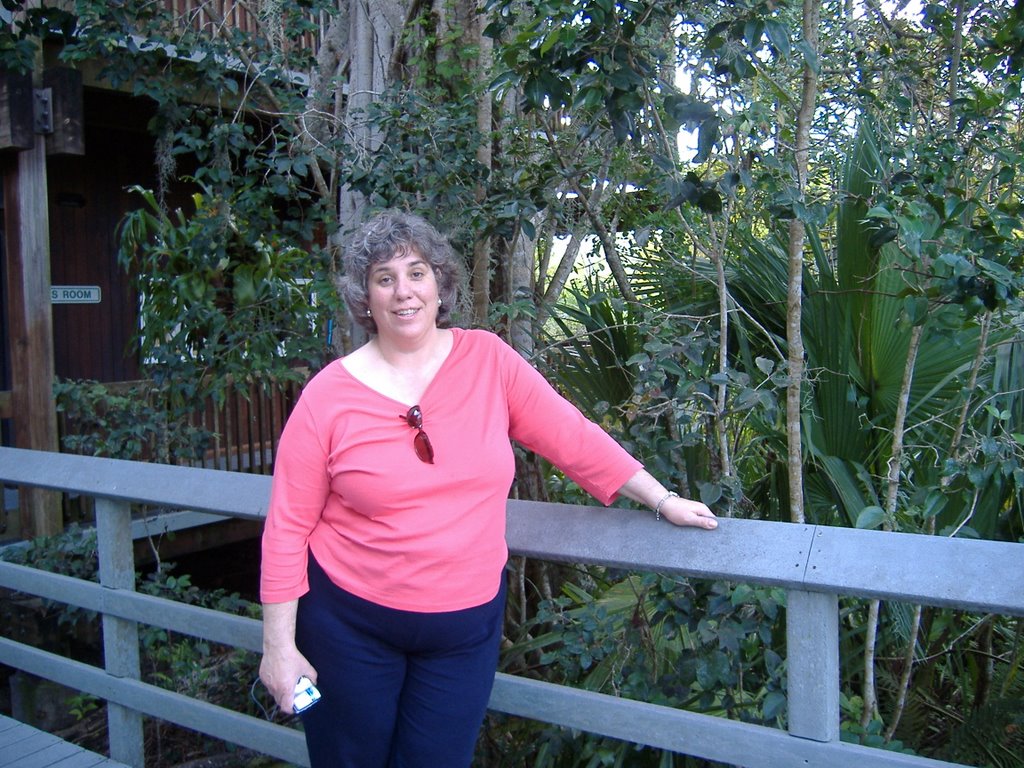
Tina (aka "TBG") and I met some months ago on Achenblog and became email-pals. Despite the cynicism of her children ("Stranger Danger, Mom!!") she took the risk of flying to Florida to meet me and go to the book fair. She turned out to be just as nice in person as she was in her emails, and we got along perfectly. Tina is very smart (and brought plenty of electronic gadgetry), and we navigated various challenges (finding parking! renting beach chairs with no cash or credit card! negotiating the hopelessly mismarked streets of Miami!) with panache. At one point I remarked, "The two of us together make one extremely intelligent person." It was an unmitigated pleasure to share the book fair experience with my new friend.

Tina arrived at the Fort Lauderdale airport at 1:00 Friday. After a quick lunch we continued to Fern Forest Nature Center for some acclimation. Welcome to Florida, Tina!



Saturday, 11/17/06: Book Fair, Day One

11:00 a.m. Kurt Andersen and George Kalogerakis
Introduced as the "Lennon and McCartney of magazine publishing," Kurt and George were appropriately witty and humble--actually, I believe the introduction implied that Andersen and Graydon Carter were like John and Paul, so George, ironically, claimed, "I'm Ringo." Utilizing the latest in electronic audio-visual technology, they showed covers from Spy magazine and talked about some of their adventures producing same. Spy never shrank from a story because it might offend; on the contrary, the editors delighted in skewering sacred cows (e.g. The New York Times), socialites, moguls and so on. They were regularly threatened, harangued, and despised. The staff at The Times denied that they ever read the magazine (harumph!) Maybe the best lawsuit-threatening letter came from Gore Vidal, who took umbrage at having been characterized as "litigious," closed his letter, "See you in Federal Court," and according to Andersen, "completely missed the irony." Donald Trump was a favorite target and also a frequent correspondent; they would post his letters on a centrally located bulletin board for the enjoyment of all the staff at Spy.

At the end of their presentation, I followed them down the hall and around a few corners to the signing location. However, most (well, virtually all) of the other audience members, including Tina, stayed behind to hear Dave Barry and Ridley Pearson. I had expected to have some time standing in line to compose my remarks but that didn't happen, and I'm afraid I blurted out some less than intelligible explanation of my experience with Andersen's first book, The Real Thing. But I did produce the artifacts: the ancient, yellowed and battered copy of the book and the letter Kurt wrote me back in 1980. I got all my books signed, and there was a huge opportunity to just hang out and chat that I basically just squandered. However, this is where the cyberevent happened. Me: "This letter is evidence that I am your 'first fan.'" Kurt: "You blogged about this, didn't you? Somebody sent it to me." That rearranged my world in a half-second.

Kurt was very nice. He said he has a new book--a novel--coming out in March. It's called Heyday; I have pre-ordered it from Amazon and hope it will arrive by my birthday.

[Aside to Kurt Andersen, in case you're reading this: Hi, it was amazingly wonderful to meet you! I'm looking forward to reading the new novel.]

I went up to the second floor and I was looking out into space, still smiling from my encounter with Andersen. I looked over to the escalator; I caught the eye of someone coming up the escalator, and he smiled back at me, then I focussed, and did a double-take, like in the movies: it was Andy Borowitz. Hi, Andy.

1:00 p.m. Jonathan Franzen

The line for Franzen was long, but I was near the front. I had about a half hour to wait, and I watched the other people, looking for clues as to what sort of person is a Franzen enthusiast. I turned to a young man near me and said, "which do you read, the novels or the essays?" His face lit up and he said, "Oh, both! I'm a fan!" We talked about the books and about how we imagined the author would be in person. A few minutes later, he turned to his friend and said, indicating an older woman who had just walked by, "Look who that is!" and then he went up to the woman and said, "Ms. ----- You were my fifth grade teacher! and his too! You were great, I remember that class so well. I am a teacher now, and (friend's name) is a middle school counselor!" The woman was so happy to see her former students--she called over her friend and told her all about it, and we were just having a total love-fest there in the line. The guys continued to talk about how important fifth grade is, and I was tempted to tell them: my fifth grade teacher was the most inspirational teacher I ever had, too, to the point that my first career goal was to be a fifth grade teacher, and I actually achieved it in a very short-term way. So maybe, in a strange way, this explains what a characteristic Franzen fan is like. Or maybe I was just caught up in a coincidence eddy.

Franzen was great, not at all nervous; although he seemed to be trying to come across as neurotic and tortured, really it was clear that he was glad to be there and he was an excellent reader and speaker. He said that he worked on The Corrections from 1993 until 2000, but did most of the writing in the last year. So during the six years of chronic writer's block, he said he "took small breaks from the punishing failure of that endeavor" to write short pieces about his life, and those pieces are part of his latest publication, The Discomfort Zone. He said he had learned from that writer's block experience that it is better to not write a novel for five or six years and then actually write the novel in that last productive year.

After he read the opening passages from his book, we had Q&A; the questions were incisive and thoughtful. Someone asked about his portrayal of his family, and he said he hates the term "dysfunctional." "If you saw the movie Little Miss Sunshine," he said, "that family is not dysfunctional. That family is very functional. They may be strange, but..." He then characterized his role in his own family as being analogous to a U.N. special envoy who arrives late on the scene in a bloody war zone--his parents being "two strong and mutually hostile personalities."

The line for the book signing was pretty long, too, but Franzen was perfectly nice and friendly. I told him that How to Be Alone is "my favorite book" and he smiled and said he appreciated my saying so. I gave him my copy of the Believer magazine because it has an article in it by a woman from his home town who has a lot in common with him and has felt beleagered because he keeps writing all her best stories before she can get to them--and writing them better than she ever could. It's a witty story; I hope he enjoys reading it.
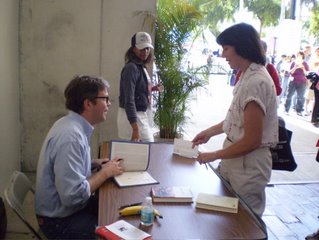
As we were walking back from Franzen's signing area, Tina spotted Dave Barry's guitar on the other side of a glass wall. We went downstairs, and as we were crossing the plaza I saw the man himself, walking towards us with his co-author, Ridley Pearson. I alerted Tina; she was the one who said, "Hey, Dave!" and stopped him in his tracks. He was as gracious as he could possibly be, and we chatted him up, explained about the Achengirls Gone Wild weekend, and Ridley took our picture. Big thrill. If we'd had any regrets about missing Barack Obama's talk they were gone now; no question we were going to be sitting up front for the Rock Bottom Remainders concert Saturday night.

========

Book Fair, Day Two: 11/19/06

10:00 a.m. Carl Hiaasen

Carl's presentation was excellent. He didn't read from his book, but instead gave a verbal "treatment" of it that amounted to a great advertisement; I don't think anyone could listen to him describe the characters and outline the plot and not want to read this book. Nature Girl. I whole-heartedly recommend it, even though I haven't read it yet.

I won't try to describe the book other than to say it is vintage Hiaasen and will no doubt be a movie eventually.

Tina and I both stood in line to get our books signed, and it was a long line. Carl was very charming. We spread the Achenblog word there too and even presented him with a souvenir A-blog business card. I'm sure he'll treasure it. I took a bunch of them to the fair but that was the only time I remembered to give one away.

After one last swoop through the booksellers' stalls, we left downtown Miami and headed for the beach, where we (yes...) read our books for a couple of hours and decompressed (yes, later in the evening we did hang out at the hotel bar; no, we did not pick up any stray conventioneers.)

Too soon, the weekend was over, but the memories are still making me smile. Tina's account was much more timely (it was posted over a week ago...) She's quicker and more technologically up to date than I am.

Hey, it's only about 11 1/2 months until the 2007 Miami Book Fair. Mark your calendar, come on down.

Sunday, November 05, 2006

Robert Wright

Robert Wright was brought into focus for me when he invited Joel Achenbach to participate in his "diavlog" at Bloggingheads.tv (check him out this week: he's interviewing Arianna Huffington.) Soon after the diavlog aired, I came across a reference to Wright in one of the Why Things Are books; Joel refers to him as an "auxiliary Why staffer" and then adds that he is "one of the best science writers around." I had seen references to The Moral Animal and meant to read it years ago, but hadn't gotten around to it.
Finally, a few weeks ago, I gathered up Wright's three books and read them. I was very impressed and enjoyed learning some new ways to look at the world and putting together some old concepts in new ways.

The first book Wright wrote was called Three Scientists and Their Gods; the subtitle is Looking for Meaning in an Age of Information." Before the book starts, Wright inserts the following:

A NOTE TO READERS

I don't want to alarm you, but this book is about--

1. the concept of information;

2. the concepts of meaning and purpose, in both their mundane and cosmic senses;

3.the function of information at various levels of organic organization (in bacteria, ant colonies, human brains, and supermarket chains, for example), with particular emphasis on its role in reconciling life with the second law of thermodynamics;

4. the meaning of the information age, viewed in light of the role information has played throughout evolution;

5. the meaning of life; and

6. a couple of other issues at the intersection of religion and science.

Now for the good news: this book is also about three living, breathing, and, I think, unusually interesting human beings. In fact, they are what the book is mainly about. So, for the most part, all you have to do is read about them--about their personal histories, their ways of living, and their very ambitious ways of thinking about the universe and our place in it--and let the above subjects emerge in the process. It will be fairly painless, as these things go.2
Wright uses the same mitigation method in The Moral Animal, to very good effect: in that book, he uses the life of Charles Darwin to illustrate the principles of evolutionary psychology. In early chapters, he uses examples of various primates and their social structures to show how genes and environment interact to influence the development of culture. Later, when he is discussing Charles Darwin's marriage, he says, "The Darwins lived, gibbon-like, on an eighteen-acre parcel, two hours by coach from London..."3

Throughout the book the details of Darwin's life are analyzed in light of the ideas that are being explored. It humanizes the concepts and illuminates Darwin's biography at the same time.

Nonzero returns to an idea that was introduced in the first book, that is "the logic of human destiny." The essential concept is that ever more sophisticated methods of communication are facilitating more and more complex social structures. One possible conclusion, which is explored in both books, is that the next step in human cultural development will be an all-encompassing network of communication that essentially becomes a super-organism in itself. A version of this certainly exists already, made up of humans interacting with the internet and phone lines and television and other mass media. But the more mystical thinkers that Wright cites envision a time when the network becomes aware of itself in a way that we would define as consciousness.

Speaking about Pierre Teilhard de Chardin, who wrote about this idea in a book called The Phenomenon of Man which was published in 1955, Wright emphasizes that Teilhard is not just talking about individual people having "sympathy" for each other:

If this were all Teilhard meant by universal consciousness, his mystic vision would be, if not exactly convincing, at least conceivable. Maybe middle-class Americans will come to empathize with the refugees and earthquake victims whose images they see on the evening news. Maybe millions of copies of the album We are the World will forge lasting international bonds. Maybe the Russians will be able to muster some sympathy for Americans once they've seen twenty or thirty episodes of Gilligan's Island.

But Teilhard had something more than this in mind. At times he spoke more expansively about the meaning of universal consciousness, and made it clear that he wasn't referring to the sort of sympathy conveyed by Hallmark cards. He was really talking about love, the kind of altruistic diffusion of identity tradionally reserved for kin. Indeed, he was talking about even more than that. Love was not, in Teilhard's scheme of things, a mere by-product of human evolution, an emotion programmed into the brain to ensure the survival of the DNA. Rather, it was a manifestation, the most importatnt manifestation, of the "spiritual energy" that had been growing in the "within" of ever-more-complex matter since before the creation of life, and that continued to grow not just through genetic evolution but through cultural, or noogenetic, evolution and the "complexification" of human society.4
As he notes here, Wright is skeptical about this notion, but he is obviously fascinated by it and believes it is an important idea. His approach makes me look forward to his next book, which reportedly is "about God"--I've seen enough of Wright's work to believe he won't be writing a theology text; more likely it will be, as these three books are, enlightened, open-minded science.

1. Joel Achenbach, Why Things Are & Why Things Aren't (New York: Ballantine Books, 1996), 93.

2. Robert Wright, Three Scientists and Their Gods (New York: Times Books, 1988), xi.

3. Robert Wright, The Moral Animal (New York: Pantheon Books, 1994), 129.

4. Robert Wright, Three Scientists and Their Gods, 270.


[*These footnotes are dedicated to The Achenblogger Known as College Parkian.]

Saturday, October 28, 2006

Captured by Aliens


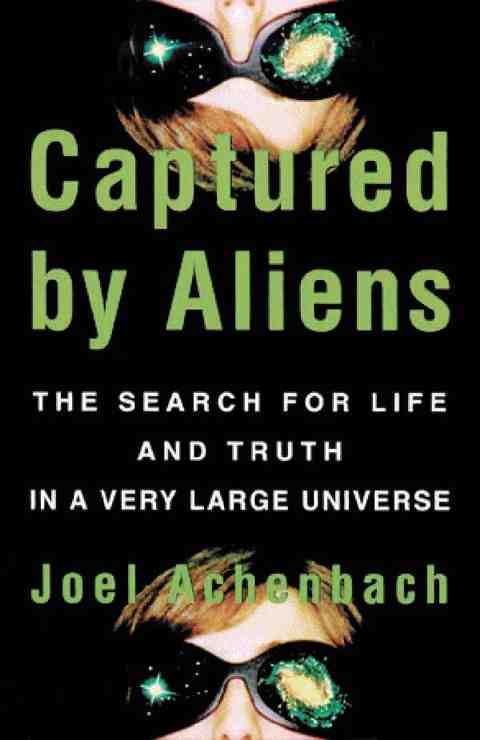
In this book, Joel Achenbach goes looking for aliens. Captured by Aliens is a survey of the science of space exploration and an earnest attempt to uncover any evidence (a clue, a hint, a sliver, a slim hope!) of extraterrestrial life. The attempt is vain, but Achenbach leaves no stone unturned. Eventually he even reaches the point of exploring (briefly) the concept of God. There's your extraterrestrial life.

From a scientific point of view, the search for life in outer space comes up empty. What Achenbach does find is a bunch of human beings who are strongly invested in the idea of alien life forms. Very likely, these people are banding together and creating mythologies about space creatures because they are human, and because they are alienated from the larger culture.

Humans are social animals. We are hard-wired to form kin groups and affinity groups, age-based groups and mutual benefit societies. We can't help ourselves. At the same time, we have an awareness of our individual existence, and for some of us that individuality is so fragile, or so satisfying, that we avoid the group experience, or it avoids us. Sometimes our modern post-industrial society makes it difficult for people to create meaningful communities. Kurt Vonnegut, in his novel Slapstick, refers to people who "have had to believe all their lives that they were perhaps sent to the wrong Universe..." That goes a long way towards explaining the alien-o-philes. Captured by Aliens quotes a member of the Heaven's Gate suicide cult: "Maybe they're crazy for all I know. But I don't have any choice but to go for it, because I've been on this planet for thirty-one years and there's nothing here for me." (p. 211) Hi ho. (as Vonnegut would say...)

What's a little ironic is that, although Achenbach makes it clear that he is humoring the pseudo-scientific folks without being tempted to their point of view, he is very sympathetic to them, acknowledging that they are engaged in the same sort of search that he is, just with different rules. And they recognize him, too. It's really not surprising to find that some of the UFO-believers become convinced that the author is one of them, that he is an alien himself. In effect, he is "captured" by "aliens" in the course of writing the book. (But he escapes and lives to tell the tale, luckily for us.)

Fast forward a few years, to the birth of the Achenblog. The blog has collected, nay, captured a seemingly diverse accumulation of individuals. Looking for the common thread is tricky. People describe themselves as gnomes, geeks, nerds, mutants. Apparently the group contains a disproportionate number of high school valedictorians, and a relative dearth of prom queens and football team captains. If you want to fit in there, a sense of humor is essential--but it can be warped, or dark, or goofy. It's all right if you have memorized Monty Python and the Holy Grail or The Princess Bride. A community has formed, albeit a fluid one with ever-changing participants. It's an artificial extended family, very much in the spirit of the ones Vonnegut imagined in Slapstick ("Lonesome No More!" is that book's subtitle) This time it's Achenbach who has captured the aliens, or at least the alienated.

===========================================
Test your alienation level here:

Here are my scores:
Meaninglessness = 5
Cultural Estrangement = 23
Powerlessness = 10
Normlessness = 13
Estrangement from Work = 12
Social Isolation = 16

Scores from 5 to 11 could be considered "low,"
from 12 to 18 "moderate,"
and from 19 to 25 "high."

===========================================
===========================================

...and another thing:

Jonathan Franzen says being a nerd/geek/mutant is not the only path to alienation; there's also the literary route. Here he quotes Stanford professor Shirley Brice Heath:

"...the social isolate--the child who from an early age felt very different from everyone around him. This is very, very difficult to uncover in an interview. People don't like to admit that they were social isolates as children. What happens is you take that sense of being different into an imaginary world. But that world, then is a world you can't share with the people around you--because it's imaginary. And so the important dialogue in your life is with the authors of the books you read. Though they aren't present, they become your community."

Franzen expands on this idea: "...simply being a 'social isolate' as a child does not...doom you to bad breath and poor party skills as an adult. In fact, it can make you hypersocial. It's just that at some point you'll begin to feel a gnawing, almost remorseful need to be alone and do some reading--to reconnect to that community.

"...readers of the social-isolate variety are much more likely to become writers than those of the modeled-habit variety. If writing was the medium of communication within the community of childhood, it makes sense that when writers grow up they continue to find writing vital to their sense of connectedness. What's perceived as the antisocial nature of 'substantive' authors, whether it's James Joyce's exile or J.D. Salinger's reclusion, derives in large part from the social isolation that's necessary for inhabiting an imagined world."

How to be Alone, pp.77-78

Monday, October 23, 2006

(Wo)Man vs. Nature

I was sleeping soundly, about 2:00 this morning, when I was gradually awakened by a scrabbling sort of noise on the corrugated plastic roof of the sunporch. Assuming it was the neighbor’s cat, with whom we have a running battle of wits, I went over to the porch and rattled the roof to scare him away. Returning to bed, I looked out the window in time to see what looked like a gigantic rat crawling down the side of the house. Not a cat. I repaired to the backyard to investigate. Yep, a big ol’ raccoon, that’s what it was, and I confronted him coming around the corner of the house. Waved my arms. Hissed at him. Stomped my foot. He was completely unfazed. I returned to the house for the flashlight. Raccoons are nocturnal. Light freaks them out, right? No. I shined the flashlight in his eyes and he had no reaction whatsoever. Meanwhile, more rustling in the bushes, now there are two of them. I looked around for rocks to throw; the only one I found was pretty big. I heaved it over in the direction of one of the critters, it landed right next to him with a thud. He nonchalantly turned his head and sniffed it to see if it might be food. So there we were. I wasn’t afraid of these animals. But they weren’t afraid of me, either! They weren’t likely to attack, but I had no urge to attack them, either. I was in my backyard in my nightshirt at 2:00 in the morning, and I felt pretty stupid. Finally I got fed up and ran towards one of them. That had some effect, and with repeated charging rhino tactics I was able to convince them to leave my yard. Belatedly, I thought of the garden hose which had been available to me as a weapon. Next time.

My brave he-man husband slept through the entire drama. He had had a hard weekend, two days of 8 hours working and 5 hours driving. Our feisty little cat woke up when I first went outside, and watched the whole show, with great interest. This morning it was evident that when I came back to bed and went to sleep until the alarm woke me, the kitty must have stayed awake the rest of the night to keep watch—she was completely exhausted this morning, didn’t wake up even when I put food in her dish, and was still sleeping when I left for work.

Thursday, October 19, 2006

Kurt Andersen & Co. -- Spy Magazine

Kurt Andersen is from Nebraska. He attended Harvard University, where he was an editor of the Harvard Lampoon. In my mind, this combination means something, although I am still struggling to complete the picture. Johnny Carson was from Nebraska. I always thought that was important.

Back in 1980, Andersen wrote a book called The Real Thing. It's a smart-aleck book, a know-it-all book. He names a category, for instance, Breakfast Cereals, and then tells which is "The Real Thing" of breakfast cereals, the one that most fully exhibits the quintessential qualities of Breakfast Cereal (the answer is: Kellogg's Corn Flakes). Here's a footnote from that chapter: "*Mr. Graham, of cracker fame, was also a fin de siècle resident of Battle Creek and health-food fanatic. Battle Creek was to cereal what Paris, at the same moment, was to modern art. They get Cezanne, we get Sugar Smacks." But quoting out of context doesn't do Andersen justice. His wonderfully even tone is sustained throughout: he is just on the edge of insufferable but delightfully balances there and never goes over. His photo on the back of the book shows an unsmiling prepster posing, I was certain at the time, outside Boston's Quincy Market. He seemed very familiar and I loved the book, so I sat down and wrote him a letter.

A few weeks later, I received a letter from him. He said he was impressed to get mail from Key West. He said, "Yours was the first appreciative correspondence I received, and it warms me still." And at the end of the letter, he said (apparently in answer to a question I had asked, though I don't remember anything about the letter I wrote) "...And yes, I am writing fiction."

Well, we both went on with our lives, but that book and his letter have traveled with me through all my domiciles and lifestyle changes. I waited 20 years for the promised novel; it was finally published in 1999: Turn of the Century. Bought it. Read it. Not a bad book, nicely futuristic in a moderate way.

One of the projects Andersen did while he was not writing the novel was Spy magazine; his partner in the venture was Graydon Carter, whom I know from Vanity Fair. And now they've written a book about the experience of creating Spy. I started reading the book last night and just got sucked into it and almost never came up for air. It's a fun read--that is, as long as I can forget how irritating these people seem--they are all so clever and so superior; the world exists so they can mock it. But they are, in fact, extremely intelligent and most of their targets are pretty much fair game. The first article that is reproduced in the book is called "Too Thin AND Too Rich" and features hideous photos of skinny socialites and celebrities. What's not to like.

Here's the punchline that I've been making you wait so long for: on page 28, the book discusses how they put together the staff of the magazine. "There were freelance copy editors, headed up by the peerless Joanne Gruber, who got her job by sending a fan letter to Kurt several years earlier, and whose career at Spy would outlast everyone else's; within a year she was managing editor and even before that was the unofficial moral compass of the magazine."

So THAT'S who has been living my REAL LIFE all these years. Joanne Gruber. I won't forget that name.

Seriously, I would have to have more than one life in order to spend one in New York. But publishing...that would be a career I would enjoy. Hey, here I am on the internet--now in the 21st Century, everybody is a publisher, everyone is an author, and unfortunately, I have only myself to look to for copy editing.

This has been a supremely self-indulgent post and I hereby dedicate it to Mr. Kurt Andersen and all his fabulous friends.

Wednesday, October 18, 2006

The USA versus International Law

I was going through some papers last weekend and came across this historical document: a news release from the Pentagon dated May 6, 2002. The remarks in blue italics are my reactions, which I had scribbled in the margins when I first read it.

SECRETARY RUMSFELD STATEMENT ON THE ICC TREATY

Earlier today, this administration announced the president's decision to formally notify the United Nations that the United States will not become a party to International Criminal Court treaty. The U.S. declaration, which was delivered to the secretary general this morning, effectively reverses the previous U.S. government decision to become a signatory.

The ICC's entry into force on July 1st means that our men and women in uniform--as well as current and future U.S. officials--could be at risk of prosecution by the ICC. [Secretary Rumsfeld, along with every other U.S. resident/citizen, is subject to prosecution by U.S. law enforcement, but he doesn't advocate disbanding police/highway patrol/FBI/criminal justice system of the U.S.] We intend to make clear, in several ways, that the United States rejects the jurisdictional claims of the ICC. The United States will regard as illegitimate any attempt by the court or state parties to the treaty to assert the ICC's jurisdiction over American citizens.

The U.S. has a number of serious objections to the ICC--among them, the lack of adequate checks and balances on powers of the ICC prosecutors and judges; the dilution of the U.N. Security Council's authority over international criminal prosecutions; and the lack of an effective mechanism to prevent politicized prosecutions of American servicemembers and officials. [What are the chances that all the other countries in the world are just too stupid to see the ICC's shortcomings?] [Why should U.S. servicemembers have special status?]

These flaws would be of concern at any time, but they are particularly troubling in the midst of a difficult, dangerous war [as defined where?] on terrorism. there is the risk that the ICC could attempt to assert jurisdiction over U.S. servicemembers, as well as civilians, involved in counter-terrorist and other military operations--something we cannot allow. [Why? because you know that those operations will be in violation of the proposed international laws?]

Notwithstanding these objections to the treaty, the United States respects the decision of those nations that have chosen to joint the ICC. But they, in turn, will need to respect our decision not to join the ICC or to place our citizens under the jurisdiction of the court.

Unfortunately, the ICC will not respect the U.S. decision to stay out of the treaty. To the contrary, the ICC provisions claim the authority to detain and try American citizens--U.S. soldiers, sailors, airmen and Marines, as well as current and future officials--even thought the United States has not given its consent to be bound by the treaty. When the ICC treaty enters into force this summer, U.S. citizens will be exposed to the risk of prosecution by a court that is unaccountable to the American people, and that has no obligation to respect the Constitutional rights of our citizens. [The International Criminal Court recognizes the U.N. Universal Declaration of Human Rights.] The United States understandably finds that troubling and unacceptable. [The Government of the U.S., that is, including the officials who are contemplating actions that they know to be in violation of international law.]

Clearly the existence of an International Criminal Court, which attempts to claim jurisdiction over our men and women in uniform stationed around the world [This is a problem--what other country has the level of military presence that the U.S. has, worldwide?] will necessarily complicate U.S. military cooperation with countries that are parties to the ICC treaty [dictatorship and "might makes right" is the less complicated way!]--because those countries may now incur a treaty obligation to hand over U.S. nationals to the court, even over U.S. objections. The United States would consider any such action to be illegitimate.

We obviously intend to avoid such actions. Fortunately there may be mechanisms within the treaty by which we can work bilaterally with friends and allies, to the extent they are willing, to prevent the jurisdiction of the treaty and thus avoid complications in our military cooperation. Obviously, countries that have not ratified the treaty would be under no such obligation to cooperate with the court. [U.S. will continue to use its diplomatic influence and military might to work against the ICC treaty.]

By putting U.S. men and women in uniform at risk of politicized prosecutions, the ICC could well create a powerful disincentive for U.S. military engagement in the world. [Maybe those other countries aren't so stupid after all.] If so, it could be a recipe for isolationism--something that would be unfortunate for the world, given that our country is committed to engagement in the world and to contributing to a more peaceful and stable world. [Peace through war? or "The War on Peace?"]

For a strong deterrent, it is critical that the U.S. be leaning forward, not back. We must be ready to defend our people, our interests, and our way of life [...and the best defense is a good offense...] We have an obligation to protect our men and women in uniform from thi court and to preserve America's ability to remain engaged in the world. [i.e., to attack anybody anywhere at any time for any reason, as we see fit] And we intend to do so.

http://www.defenselink.mil/news/May2002/b065062002_bt233-02.html

Saturday, October 14, 2006

Gina Barreca


Let us now praise strong women...

Joel Achenbach's column in Sunday's Washington Post starts by discussing the recent Newsweek cover story about "Powerful Women" and then goes on to Arianna Huffington's latest book, Becoming Fearless, which is aimed at helping women reach their potential and be more powerful.

Since Joel has covered those two, I will approach this subject with reference to Gina Barreca, a professor of English literature and feminist studies; a woman with a very strong personality and presence. Gina came to my attention as a co-writer with Gene Weingarten--he contacted her with the intent of ridiculing her and making her look stupid because she was an "expert" on feminist studies and humor. He thought those two subjects were incompatible, and he challenged her to see who could be funnier in print. That's his specialty, writing humor, not hers, but she was funnier than he was every time. They went on to write a book together, and I saw them last year at the Miami Book Fair. They were both funny, but Gina was by far the more impressive--she is beautiful, brilliant, bold and witty. I couldn't take my eyes off of her.

I bought Barreca's book Babes in Boyland and read it this summer. It's a memoir about what it was like to be one of the first female students at Dartmouth College. Here's what it was like, at first:

"Classes begin, and once again Good Girl Gina sits up front. The American lit. professor appears to be a bulky, middle-aged, heavy-set, tweedy, standard-issue type. Wire-rim glasses perched on a long patrician nose, sparse white hair, broad chest, and deep voice all add to the sense that he's straight out of central casting. Gina feels this is what college is all about.

"Then the professor opens his mouth.

"He announces at the start, "My name is MANN, I am teaching a book about a sperm whale named Moby Dick. anybody who has a
problem with that can leave right now. I have been teaching here for thirty years and I am not about to change my ways because there might suddenly be in my classroom a delicate flower whose feminine sensibilities I might offend." He pauses, and walks over to a large, beefy guy in the first row and puts his hand on the young man's shoulder. "And I'm not referring only to Pemberton here, either, although he is known to be sensitive."

"Applause breaks out, whoops and hollers...

"Gina buries herself as far as possible into her seat. How can you be a Good Girl in a place that doesn't want any kind of girl whatsoever?"


Barreca was from a working class family in Brooklyn; being female wasn't the only, or even the most difficult, barrier she faced. But it was the trait that she found could be turned to her advantage, the one that she finally derived her identity from. She has a great voice. Here is what she wrote recently when she found that her column was being dropped from the Hartford Courant: "Long Cool Woman in a Pink Slip" It ends, "I hope I won't be out of circulation long." And I'm sure she won't.

Saturday, October 07, 2006

Nothing to Say

I have been trying to post at least once a week--last year I posted every day for a long time; how did I do that?

I had nothing in particular to say today, and it struck me that the main purpose of a blog is that when you have nothing to say, you have someplace to say it.

It's a quiet Saturday. I've been in the house most of the day, only venturing out on a walk to Walmart to buy ribbons for a project. The weather is lovely, in the low 80's and sunny. I've been straightening up closets and so I had to look at all my photo albums. I'm not very good about putting photos in albums, so it didn't take long. Most of my pictures are in boxes.

All the highlights are there, though. The milestones, the trips, the loved ones. Pictures are good.

I'm extremely unmotivated. Now the question is, will this non-blog be enough to satisfy my one-a-week requirement, or will I still feel like I didn't blog yet this week?

Here's an interesting article about how hard it can be to make ends meet on $150,000 a year. We do love to read about other people's money and especially other people's money problems, don't we? I'm sure it's human nature.

Friday, September 29, 2006

John, by Cynthia Lennon

It's about time we heard Cynthia's side of the story...

She knew him when. She was a Liverpool girl when he was just a Liverpool bloke. They fell in love, she got pregnant, they got married. The Beatles got famous, Brian died, the Maharishi disappointed. John discovered LSD, Yoko, heroin. Cynthia tells the story well; with or without a ghost writer, her voice comes through. This book doesn't break any new ground, but anyone who wants to know everything about the Beatles needs to read it. It sent me back to the Anthology to review the official version of how Cynthia was replaced by Yoko.

Not trying too hard to tie everything together, I will mention two other things.

(1) Today I watched The Lake House, a nice PG love story with Keanu Reeves and Sandra Bullock. It features a beautiful song by Paul McCartney, "This Never Happened Before"--my husband recognized Paul's voice before I did, which shocked me.

(2) Today at work, Sarah, a former co-worker visited the office with her 6-month-old baby. Fun times. Sarah lives in Las Vegas now, and her husband is an executive at one of the big hotels there. There was some event at the hotel recently (I didn't get the details of the event, it's the nature of conversation when a 6-month-old is present, the dialog tends to be fragmented) At any rate, Paul McCartney was performing or appearing at the hotel, and Sarah and her husband attended the after-party. She said she was just standing around, chatting, and she looked up and There. He. Was. Paul freakin' McCartney, right in front of her. She's a level-headed type, not easily rattled; she's Swiss, very sophisticated, not some teeny-bopper. But she was, in this case, non-plussed, at a loss, verklempt. Paul and she "locked eyes" she said, and then he reached over and touched her on the arm and said, "'s'all right." Her impulse was to reach and touch his arm in return, but when she made that gesture, the bodyguards moved in, and the moment was over. So today, I touched someone who recently touched and was touched by Paul McCartney.

I've thought about this before: what must it be like to live your entire adult life as someone to whom everyone reacts with awe. It's like being the Dalai Lama, but nobody annointed you, there's nothing official, you're just one of the 10 most popular people on the planet. Amazing. In my opinion, Paul handles it very well. He will always be my favorite Beatle. And that's not just because John dumped Cynthia for Yoko.

Saturday, September 23, 2006

Achenboodle Book Drive

Cassandra S. is a frequent commenter on Joel Achenbach's Washington Post blog. She lives in rural North Carolina. She's a grandma who faces hardships every day, but works to make the world a better place. She works with the local kids, tutoring in math and reading during the school year. Some of the commenters on Achenblog (colloquially known as "boodlers") have decided to help Cassandra's kids by sending books for her to use in the program. Yellojkt wrote it all up on his blog, including book lists, in case any of my readers want to jump on this bandwagon. Information on where to send the books is available by emailing me (kbertocci at hotmail.com) or yellojkt (see the link).

The Last Resort, by Alison Lurie


I bought this book last spring at a bookstore in Key West--a lovely small bookstore the likes of which cannot be sustained by any normal American town. But being located a half block off Duval Street means that thousands of pedestrians pass by every week and also that the real estate prices are too high for Borders to even think about staking out the necessary square footage to establish one of their cookie-cutter superstores, so there it is, the Key West Island Bookstore, at 513 Fleming Street.

It's no secret I am a book snob, and I don't usually read "beach books"--my feeling is, that's why there are magazines. But I was in a light reading mood, looking over the pile of books in the "Key West section" of the store, and Alison Lurie is a Pulitzer Prize winner (albeit one I was unfamiliar with) so I picked up The Last Resort.

Lurie's tale of a New England professor and his wife who relocate to Key West in hopes of ameliorating their lives turned out to be the kind of book I usually don't read, but it was enjoyable anyway. Key West is its own reality and it is hopeless to try to convey its essence. If you are not there, you won't understand, and if you are there, you don't need anybody to describe it to you. Nevertheless, Lurie, who has been a part-time Key West resident for many years, makes a brave effort at describing the kind of disconnect people experience when they arrive on the island and establish residence.

I like this passage, that deals with the bright yellow multicar tram that tours the island, the Conch Tour Train.

Molly...had never been on the train, though it passed her house continually. The day she and her husband first moved in, the loudspeaker had called the tourists' attention to a large tropical tree with loose, flaky bark that grew in their side yard. "On your left, just ahead, you will see a fine specimen of one of Key West's native trees. It is a gumbo limbo, but natives call it the tourist tree, because it is always red and peeling."

The first time Molly and her husband heard this joke they laughed. They heard it again soon afterward, and then at regular intervals until sunset. It did no good to shut the windows; the loudspeaker was clearly audible through the uninsulated walls of the house. Polite calls to the Conch Train office over the next few weeks accomplished nothing; the woman who answered the phone appeared to think that Molly should feel honored to have her tree noticed.

After hearing the joke approximately every twenty minutes for two weeks, Molly and her husband discussed having the tree removed. But it turned out that the gumbo limbo was a protected species; any tree service that destroyed it would lose its license and be liable for heavy damages, as would the Hopkinses. An acquaintance suggested pouring bleach into the roots, but the gumbo limbo appeared to like bleach.

Finally, after getting permission from the Historical Prservation Society (a lengthy process), Molly and her husband put up a fence which cut off their view and darkened the yard, but concealed the trunk of the tree. On one memorable day at the end of the season, the Conch Train passed in silence.


Now, that is funny, and it does express the typical reaction a northerner would have in that situation. But here's the problem: if you have that reaction, you don't belong in Key West. You will have to change or leave. These characters have a small victory over the island but they will lose the war. You can be whoever you want to be in Key West but you can't change the culture. I remember the apartment I lived in for two and a half years where the Conch Train was always saying, "...Key West was discovered in 1544 by Ponce de Leon..." [According to more reliable sources, the date was 1513, but this is something else you can't get worked up about: in Key West, people make up stories. Get over it.] I loved having the Conch Train going by--I liked waving to the tourists and smiling at them.

The Last Resort is an uncomplicated book with mostly two-dimensional characters. The plot is a straight line. The writing is skillful and the setting is suitably exotic. It's a perfect "beach read"--if you like that sort of thing.

Sunday, September 17, 2006

Until I Find You, by John Irving

One day this summer, I was in the Memphis airport, passing time in a bookstore while waiting for my flight. I already had magazines to read on the plane and I had no intention of buying a book. When I saw John Irving's latest, it was a pleasant surprise; I hadn't heard anything about it. I picked it up, fanned through the pages. I reminded myself that I had no plans to buy any books. I put it down and walked away, out of the store. I sat down in the waiting area--for maybe five minutes. Then I went back, as if driven by forces outside my control, and bought it. It's a lovely book, 824 pages long. The cover is flesh colored on the bottom half and the title is "tattooed" on it, "Until I find you," on a banner across a broken heart.

John Irving is one of my favorite authors, although this book didn't do anything to move him higher in my esteem. His place in my writer pantheon is cemented by two things: Cider House Rules, which I think is one of the best novels of the 20th century, and Irving's love and respect for Charles Dickens, which may be even as great as my own. I've read all of Irving's books. They have disappointed me, more often than not, but when he's good, he's really delightful, so I'll continue to read whatever he publishes.

Until I Find You is interesting in its use of point of view: much of the story is told as remembered by the main character, Jack Burns. Over and over the narrator emphasizes the unreliability of the narrative, so that makes everything a mystery all the time. Quite often the reader learns that something presented earlier was not true, and then the correction may be corrected further later on. That could be irritating, but I didn't mind because the story wasn't all that emotionally engaging--possibly because of the repeated warnings, I didn't feel betrayed.

What I will remember about this book is the seediness of it, the creepy way Irving presents the theme of child sexual abuse. He manages to convey the events almost without moral content. Everything is told from Jack's point of view, and he doesn't really know that he's being abused. The psychological repercussions are shown but not really discussed. I was reminded of the theme in A Widow for One Year, when the middle-aged woman who has lost her two teenaged sons in an accident seduces a young man because he reminds her of one of her sons. It's presented as reasonable, but it's not, it's really sick. Similar themes run through Until I Find You--Jack is victimized by a series of older girls and women, all with weird rationalizations that he has no defense against.

The story line rambles--800+ pages is long enough to have the characters tour Canada, Europe, and California, for Jack to go from age four to all grown up, and to finally find his father, after searching for him, literally, spiritually, and metaphorically, throughout the book. I'd say the storyline doesn't merit all those pages. Les Miserables, Don Quixote, War and Peace--some books deserve that much paper. This one should probably spent a little more time in the editing process, and saved some trees.

Sunday, September 10, 2006

The New Wheels

First off, I have to say that starting this blog back up has not gone very smoothly. It turns out that reading, thinking and living all interfere in a major way with blogging. I'll have to cut down somewhere.

Anyway, I got a new bicycle last week (new to me, anyway)--it's red and it says "Key West" on the frame; I guess that's the model, like my car is a Toyota Tercel and my bike is a Sun Key West. Love it. It has 8 speeds, and some of them are fairly fast if the appropriate amount of muscle power is applied.

I celebrated the new vehicle by taking it out Saturday and riding to Boynton Beach and back--according to Expedia, that's 42 miles roundtrip. And it is a beautiful ride, along the beach, with lots of views of sand and surf, as well as glimpses of multi-million dollar mansions.

Here's the view from the beach where I decided to turn around and head for home.

Looking north:


Looking south:


Oops, see that rain? I ran into it on my way home, so I ducked into a shelter at a different beach.


It was raining, but the sun was still shining, just like in the Nilsson song:


I'm going where the sun keeps shining
Through the pouring rain
Going where the weather suits my clothes

Backing off of the northeast wind
Sailing on a summer breeze
Skipping over the ocean like a stone

So I sang that song for a while as I pedaled the rest of the way home.

Thursday, September 07, 2006

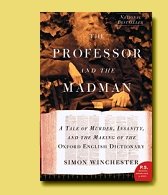
The Professor and the Madman, by Simon Winchester

Imagine that you could only have one book.

Would it be The Bible? Finnegan's Wake? The complete works of Shakespeare? What book could you imagine that would be endlessly edifying and useful, as well as dependably entertaining?

I refuse to make a choice, even hypothetically, that narrows all of literature to a single volume. However, if forced, one could do worse than to choose a really good dictionary. I love my American Heritage Dictionary of the English Language; I have copies at home and at work. But the original work that sought to define "the meaning of everything" in English was the Oxford English Dictionary.

In The Professor and the Madman, Simon Winchester has written the story of the OED, concentrating on the efforts of two men. James Murray, the professor, dedicated his life to the dictionary because he loved language, literature, and scholarship. W.C. Minor, the madman, shared those motivations, but he was also in need of an occupation to stave off the madness. His extreme dedication to the dictionary project was made possible by his incarceration in an insane asylum.

The process of creating the dictionary involved thousands of volunteers, combing through books in search of definitive and distinctive examples of words, which they sent, along with examples of their use, to the headquarters of the Oxford Press. From five million collected, 414,825 words were selected. The project took more than 68 years. (Murray was the first editor; at the time of his death the dictionary was about half finished.)

The professor and the madman were kindred spirits, despite the disparity in their social status. I felt that the defining exchange came late in their association, when Murray reached out to Minor in gratitude and friendship, offering him a distinctive gift. He sent him something only a few people on earth would recognize as a treasure (but the people who enjoy this book certainly agree it is)--the newly completed entry for the word "take." (It covered several pages and had taken months to compile.)

This is hardly a gripping adventure story. But there is drama in it, and passion. If you love words, it's worth a read. I enjoyed the feeling of being present at the creation of the great dictionary, which was an amazingly ambitious project and in its completion, a triumph of cooperative effort.

Wednesday, September 06, 2006

Coming Attractions

I think it's generally a mistake to announce plans for the future. So many things can go wrong and then you are forced to retract the announcement or revise it or just leave it hanging there, as a testament to your inability to master your environment.

However, I received an email today from Amazon.com saying the new Jonathan Franzen book has shipped, and I'm inspired by that. I fully intend to have a season of book reviews on Read-Think-Live. I have read quite a few books over the summer, so stand by, here's a list of some of the titles I'll be blogging about in the coming weeks.

The Professor and the Madman, by Simon Winchester
The Last Resort, by Alison Lurie
The Sot-Weed Factor, by John Barth
Babes in Boyland, by Gina Barreca
Until I Find You, by John Irving
Digging to America, by Anne Tyler
In a Sunburned Country, by Bill Bryson
The Moral Animal, by Robert Wright
John, by Cynthia Lennon
The Curious Incident of the Dog in the Nighttime, by Mark Haddon

. . . and, I didn't forget, I said I would review I Am Charlotte Simmons, by Tom Wolfe.

. . . and the aforementioned Franzen book, The Discomfort Zone.

Stay tuned . . .

Tuesday, September 05, 2006

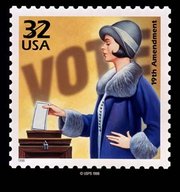
I Voted


Today was the primary for state elections in Florida. Several people are running for governor and the two leading Democrats are pretty close.

It was rainy. When I showed up at my polling place I was the only one there.

I understand apathy, I understand that people are busy. I know how they feel; it seems like just one more thing to do in a life full of duties and chores. But, it's just the right thing to do, to take the time, pay attention to the issues and candidates and make the effort to vote.

I always think of the women who worked so hard for universal suffrage--nobody just handed us the vote as a gift. And the civil rights workers who gave their lives for voting rights--that happened in my lifetime. I can't take it lightly. Voting is important.

Here's a voting rights timeline for the United States. Here's the timeline for women's suffrage, by country (Switzerland: 1971!?).

Monday, September 04, 2006

Happy Labor Day

Today's holiday served its purpose for me, gave me an opportunity to step off the treadmill of activities for a while and contemplate the condition of workers in America. It's a good occasion to salute the Service Employees' International Union, they are doing some very good work and have been reaching out to people outside their ranks. Joining their affiliate organization, Purple Ocean, is a good way to support workers' rights, and their website is a source for news about developments that affect working people.

It's also a good day to remember a great, underappreciated hero of American history, Eugene Victor Debs. I will include below some excerpts from the 1918 speech that resulted in a prison sentence for Debs; close to a century has passed, but the words still ring true, too true.

===========
June 16, 1918, Canton Ohio

...These are the gentry who are today wrapped up in the American flag, who shout their claim from the housetops that they are the only patriots, and who have their magnifying glasses in hand, scanning the country for evidence of disloyalty, eager to apply the brand of treason to the men who dare to even whisper their opposition to Junker rule in the United States. No wonder Sam Johnson declared that “patriotism is the last refuge of the scoundrel.” He must have had this Wall Street gentry in mind, or at least their prototypes, for in every age it has been the tyrant, the oppressor and the exploiter who has wrapped himself in the cloak of patriotism, or religion, or both to deceive and overawe the people.
...
Every solitary one of these aristocratic conspirators and would-be murderers claims to be an arch-patriot; every one of them insists that the war is being waged to make the world safe for democracy. What humbug! What rot! What false pretense! These autocrats, these tyrants, these red-handed robbers and murderers, the “patriots,” while the men who have the courage to stand face to face with them, speak the truth, and fight for their exploited victims—they are the disloyalists and traitors. If this be true, I want to take my place side by side with the traitors in this fight.
...
Do not worry over the charge of treason to your masters, but be concerned about the treason that involves yourselves. Be true to yourself and you cannot be a traitor to any good cause on earth.


--Eugene V. Debs

=======
Happy Labor Day, everybody.

Saturday, August 05, 2006

Vacation is a State of Mind

Early August. Everybody is on vacation, just back from vacation, or getting ready to leave for vacation. Individually their vacations may not be that much more exciting than mine, but collectively, heck, they are going to North Carolina, Colorado, Texas, France, California, Germany, Cape Cod, Hawaii, Canada... My traveling is done for the year so I might be tempted to the sin of envy.

So, when I woke up this morning, I rolled out of bed, threw on some shorts and a tanktop, told my husband, "I'm going for a 'big' bike ride; don't worry about me!" and took off. It takes about 15 minutes to get to the beach, then I turned south on A1A and just kept going. I toured Fort Lauderdale beach, went past the International Swimming Hall of Fame, the Sheraton Yankee Clipper Hotel, the Bahia Mar Hotel and Marina (where the big boat show is every year), past the Jungle Queen riverboat and all the famous spring break landmarks. Eventually A1A turns west and goes across the Intracoastal Waterway on a big bridge--the highest point my one-speed bicycle has ever attained, and the biggest hill I've ever ridden up (or down) in Florida. I took this picture of the Fort Lauderdale skyline from the bridge. On the other side, the bike lane ends and it's urban biking instead of beach biking. I turned around and headed home.

With one pit stop at Dunkin Donuts for a strawberry-banana smoothie (yum, with whipped cream!), I was home by 11 a.m. or so. Expedia says I rode 36.6 miles. It was fun and it felt just like being on vacation.

Ho hum, where's my hammock, I think it's naptime.

Sunday, May 28, 2006

Tropic Magazine

The Miami Herald used to have a Sunday magazine, like the New York Times has. The Herald's magazine was called Tropic. Tropic launched some illustrious careers and provided many happy hours of intellectual stimulation for south Florida readers. The Herald stopped publishing Tropic in 1998, and I miss it. I found out that I could get the articles in digital format from the Broward County Library, so I started spending time at the library going through the files. I enjoyed reading the stories and I kept thinking I'd like to share them with other people. I emailed some, and then I emailed some more, and eventually I had the idea to construct a website. That turned into a project that I worked on in my spare time for several months, and now the site is set up and on line, and this is its official opening.

My totally unofficial Tropic fansite: www.tropicfan.com

I hope you enjoy it.

Friday, May 26, 2006

It's All Sausage

On my way to work two days ago I saw a freshly-killed possum on the side of the road. Yuck. Then I immediately passed a convenience store that was apparently selling breakfast; the smell of sausage and toast wafted out the door. It made me think about how seeing a dead animal makes me lose my appetite. But I eat dead animals almost every day. I thought, maybe it is because when you come upon a dead animal it's not a good idea to eat it--better to kill it yourself because then you know it's fresh. Okay, but seeing a live rabbit or deer or even a cow or chicken doesn't make my mouth water. Contrast that with the sight of a strawberry or a plum, or even a pecan or a peanut. I'm becoming convinced that my basic nature is vegetarian.

Now, I have to say my friend Setsuko has told me that when she goes to an aquarium the fish look yummy to her; she always thinks about eating them. But she doesn't feel that way about cows or chickens.

We use sausage as a metaphor for many things: you may enjoy the end result, but you don't want to know the details of how it was made. I see now that that applies to meat products of various kinds. To kill the animal, skin it, take out its intestines, cut it up and cook it is not at all an attractive prospect to me. I'm relatively certain that if I had to do that myself, I would be a vegetarian. As it is, I guess I'm just a species of hypocrite.