By way of introduction, I will say that I spent another day at the library researching ancient Key West history (relatively ancient: the Miami Herald online archive goes back to 1982 and that's good enough for my purposes). After a few hours of diligent on-task effort, my attention strayed a little bit. I did some Tropic browsing (that's the Herald's now-defunct, formerly fabulous Sunday magazine) and came up with this little gem, Joel Achenbach's final "Why Things Are" column. I lost track of Achenbach's career for a couple of years when he left Florida, but I have a vague impression that the "Why Things Are" column was reincarnated for a time in the Washington Post. I could be wrong, though--the online Post archives don't show it. At any rate, this was the swan song for "Why Things Are" in Tropic, and a case could be made that it was the beginning of the end for the magazine, too.
Date: February 4, 1996
Why are we here?
Is there a point to it? How did we get here and what are we supposed to do with ourselves? Why should we do anything? Why bother?These are some big questions, but we think we have a very good answer, bordering on the irrefutable. It may not be comprehensive, but it'll have to do, because this is our last column. At sundown we dynamite the Why bunker.
The key to the answer is: the Bering land bridge.
About 25,000 years ago, during one of the Ice Ages, sea levels dropped so dramatically that water receded from the Bering Strait. It became possible to walk from Siberia to Alaska.
And so people did. They walked to a new continent. For a while they were stymied in Alaska by a glacial ice wall, an impermeable barrier. They chilled out for about 10,000 years. Then the glaciers melted a little. Gaps appeared in the ice wall. The first Americans went south.
According to Bill Fitzhugh of the Smithsonian's Museum of Natural History, archaeologists have found tools in southernmost South America roughly as old as tools found in the Pacific Northwest. You know what that means: People rapidly explored and inhabited all of the Americas.
These Asian-American hunters went everywhere, over mountains and across deserts,
through the Isthmus of Panama, atop the Andes, down the Amazon, out to Caribbean islands -- a dramatic, but forgotten, Age of Discovery.
Why did they do it? If they were so antsy, why didn't they head south directly from Siberia and go some place warm, like Thailand?
The answer: There were animals here, and no people. The hunting was fabulous! No one told them to go away. It was doable, and so it was done. Life fills every environmental niche; humans can adapt to almost any landscape.
The Bering land bridge saga inspires us to come up with an initial, if superficial, summary of why we are here: Because we can be.
Then again, when you wake up in the morning, and are faced with another day, you don't say to yourself that you are going to fill some environmental niches. You seek something more. Your plans are grander.
We bet the first Americans felt the same way. Imagine the reaction of the first human to walk into Yosemite Valley, the first to hear the roar of Niagara Falls, the first to walk the beaches of Jamaica. They must have been awed.
Keep in mind that these hunters were, biologically, modern human beings. They had as much ability to feel wonder, reverence and fear as anyone today.
The Why staff likes to think that not so much has changed: that the world is still full of new terrain. Call us dreamers! But we think there are new Yosemites out there for all of us.
And this, we think, is ultimately why we are here: We are part of a journey. It's the journey of a single species with a weirdly large brain. (It's almost as strange as those tiny male suckerfish who disintegrate except for their testes. Remember that column?)
In a world thriving with creatures living off instinct, human beings are a bizarre and thrilling combination of intelligence and emotion. The human mind is surely one of the Seven Wonders of the Known Universe (along with the rings of Saturn, the Crab nebula, the supergiant star Betelgeuse, the black hole at the center of the Milky Way, the Automatic Teller Machine and the ready-to-eat instant salad kit).
We are going to resist the temptation to get all weepy and blubbery and quivery-chinned about this being our last column, but we have to give thanks to our immediate (and we use this term ludicrously) supervisor, Gene Weingarten, who, though a madman, is one of the great unsung geniuses in American journalism; and to the countless people who have served nobly on the Why staff or as invaluable sources, including Mary Stapp (the Why goddess), Tom Shroder, Beth Barry, Doris Mansour, Elisabeth Donovan, Brian Dickerson, Pat Myers, Mary Hadar, Katherine Wanning, David Jackson, Dana Hull, Cristina Dragomirescu, Elizabeth Schandelmeier, Bebe Gribble, Jeanne Smith, Bob Park, LeRoy Doggett.
Most of all, thanks to our readers for asking great questions, catching our mistakes, making us think. Your curiosity created a market for our little column, with its mix of fact and humor and total nonsense. You made the world safe for the question Why.
Keep reminding yourself: Every time you read a book, or take a class, or write a poem, or watch a sunset, or teach something to a child . . . every time you love someone or find something beautiful . . . every time you advance, however incrementally, the cause of intelligent civilization . . . every time you pump a little warmth into this big, cold universe . . . you illustrate the real reason why we are here.
You solve the mystery. You don't need to ask anymore.
You know the answer.
Author: JOEL ACHENBACH Herald Columnist
Section: TROPIC
Page: 4
Copyright (c) 1996 The Miami Herald
Saturday, February 25, 2006


Thursday, February 23, 2006
Seasonal Affective Disorder
I was planning to return to one of my recurring themes today, Self-Loathing, because I experienced it in waves all day. But thinking about that led me to contemplate depression (specifically, how it is less painful than garden-variety self-loathing), and that led me to Seasonal Affective Disorder, and I decided to go with that instead.
Here's my S.A.D. story.
When I was nineteen years old, I spent part of my winter break from college hiking in Shenandoah National Park. I took the bus from Boston to DC, then to Front Royal, Virginia. I backpacked from Front Royal to Waynesboro, basically the length of the park, on the Appalachian Trail. It was cold, and I didn't see many people. I was alone with my thoughts for hours, days, more than a week. I observed myself, how I thought and what my personality was like, with no people around to influence it. I started to notice a pattern, and it was like this: I'd be hiking along, and feeling gloomy and pessimistic. My inner voice would be saying, "This was a stupid idea. What was I thinking. This is boring. This is hard. It's cold. I don't have enough food. I'm tired." For a long time I would just be slogging and barely motivated to put one foot in front of another. And then ... ! ... The Sun Would Come Out. And I would instantly recover--my mood would swing dramatically and I would be happy, relieved, cheerful and optimistic--and I would realize that all the negativity was just a result of the lack of sunshine. A few hours later, it would happen again, and take me by surprise again. But eventually I started to understand it and when I would start feeling negative I would take note of the cloud cover and tell myself, it's okay, the sun will come out in a while and you'll feel better.
That's how I discovered that I have Seasonal Affective Disorder, or at least a version of it, a sensitivity to sunlight that affects my mood dramatically. It fully explained the clinical depression symptoms I experienced when I was living in Boston, which disappeared instantly and completely when I moved to south Florida.
I haven't done much research on it; apparently there are special lights you can buy, but from my observations of my own symptoms, sunshine is the best remedy and after that any bright light is good. If I had to have some kind of disorder, I'm glad it's one that can be treated without money or doctors or medicine!
Here's my S.A.D. story.
When I was nineteen years old, I spent part of my winter break from college hiking in Shenandoah National Park. I took the bus from Boston to DC, then to Front Royal, Virginia. I backpacked from Front Royal to Waynesboro, basically the length of the park, on the Appalachian Trail. It was cold, and I didn't see many people. I was alone with my thoughts for hours, days, more than a week. I observed myself, how I thought and what my personality was like, with no people around to influence it. I started to notice a pattern, and it was like this: I'd be hiking along, and feeling gloomy and pessimistic. My inner voice would be saying, "This was a stupid idea. What was I thinking. This is boring. This is hard. It's cold. I don't have enough food. I'm tired." For a long time I would just be slogging and barely motivated to put one foot in front of another. And then ... ! ... The Sun Would Come Out. And I would instantly recover--my mood would swing dramatically and I would be happy, relieved, cheerful and optimistic--and I would realize that all the negativity was just a result of the lack of sunshine. A few hours later, it would happen again, and take me by surprise again. But eventually I started to understand it and when I would start feeling negative I would take note of the cloud cover and tell myself, it's okay, the sun will come out in a while and you'll feel better.
That's how I discovered that I have Seasonal Affective Disorder, or at least a version of it, a sensitivity to sunlight that affects my mood dramatically. It fully explained the clinical depression symptoms I experienced when I was living in Boston, which disappeared instantly and completely when I moved to south Florida.
I haven't done much research on it; apparently there are special lights you can buy, but from my observations of my own symptoms, sunshine is the best remedy and after that any bright light is good. If I had to have some kind of disorder, I'm glad it's one that can be treated without money or doctors or medicine!
Wednesday, February 22, 2006
Washington's Birthday
On two occasions my dad has given copies of a book to all three of his offspring. Once: The Elements of Style, by Strunk and White, and the other time, George Washington's Rules of Civility & Decent Behaviour in Company and Conversation. These two books, taken to heart, can do a lot to help one live a decent life.
Washington's book is a list of 110 rules, beginning with
(1) Every action done in company ought to be with some sign of respect to those that are present,
and ending with
(110) Labour to keep alive in your breast that little celestial fire called conscience.
Many of Washington's rules are just as relevant to the current day as they were in his. The ones that are not relevant serve to remind us of how much better the world is than it was 250 years ago. Many of the rules concern how to act toward your "superiors" or "inferiors." I take equality for granted and it's good to be reminded how lucky we are in that regard. We also forget about how much more uncomfortable life was in a time when it was a matter of etiquette to decide how to deal with the insect life inhabiting your person and clothing, or the problem of one fireplace serving as a source of warmth and a cooking stove (you want to put your feet near the fire because they are cold, but there's meat cooking for dinner and it's not polite to put your feet near it).
Happy Birthday to George Washington, the Father of our Country.
Washington's book is a list of 110 rules, beginning with
(1) Every action done in company ought to be with some sign of respect to those that are present,
and ending with
(110) Labour to keep alive in your breast that little celestial fire called conscience.
Many of Washington's rules are just as relevant to the current day as they were in his. The ones that are not relevant serve to remind us of how much better the world is than it was 250 years ago. Many of the rules concern how to act toward your "superiors" or "inferiors." I take equality for granted and it's good to be reminded how lucky we are in that regard. We also forget about how much more uncomfortable life was in a time when it was a matter of etiquette to decide how to deal with the insect life inhabiting your person and clothing, or the problem of one fireplace serving as a source of warmth and a cooking stove (you want to put your feet near the fire because they are cold, but there's meat cooking for dinner and it's not polite to put your feet near it).
Happy Birthday to George Washington, the Father of our Country.
Tuesday, February 21, 2006
A.A. Milne
The House at Pooh Corner
by A. A. Milne
Christopher Robin was going away. Nobody knew why he was going; nobody knew where he was going; indeed, nobody even knew why he knew that Chrisopher Robin was going away. But somehow or other everybody in the Forest felt that it was happening at last. Even Smallest-of-All, a friend-and-relation of Rabbit's who thought he had once seen Christopher Robin's foot, but couldn't be sure because perhaps it as something else, even S.-of-A. told himself that Things were going to be Different...
This is my favorite Pooh story, and I can't read it without crying. It is the best account I have ever read of what it is like to come to the end of childhood. Milne has special material to work with, because of the sharp demarcation in Christopher Robin's life between being a pre-school child, having long hours of freedom in the outdoors, and going to school, particularly boarding school, where everything would be supervised and all activity would be purposeful. The magic of the Pooh stories is always that they are told by an adult who is looking at the world though the eyes of the child and his stuffed animals. Milne, in a way, is saying, childhood must end and that is sad--but at the same time the story itself is proof that the enchantment of those days does not have to be forgotten. And he's also showing that even if there is sadness in childhood's end, there is also joy in the adventure of life and growing up.
...Then, suddenly again, Christopher Robin, who was stil looking at the world, with his chin in his hands, called out "Pooh!"
"Yes?" said Pooh.
"when I'm --when----Pooh!"
"Yes, Christopher Robin?"
"I'm not going to do Nothing any more."
"Never again?"
"Well, not so much. They don't let you."
Pooh waited for him to go on, but he was silent again.
"Yes, Christopher Robin?" said Pooh helpfully.
"Pooh, when I'm--you know--when I'm not doing Nothing, will you come up here sometimes?"
"Just Me?"
"Yes, Pooh."
"Will you be here too?"
"Yes, Pooh, I will be, really. I promise I will be, Pooh."
"That's good," said Pooh.
"Pooh, promise you won't forget about me, ever. Not even when I'm a hundred."
Pooh thought for a little.
"How old shall I be then?"
"Ninety-nine."
Pooh nodded.
"I promise," he said.
Still with his eyes on the world Christopher Robin put out a hand and felt for Pooh's paw.
"Pooh," said Christopher Robin earnestly, "if I--if I'm not quite----" he stopped and tried again--"Pooh, whatever happens, you will understand, won't you?"
"Understand what?"
"Oh, nothing." He laughed and jumped to his feet. "Come on!"
"Where?" said Pooh.
"Anywhere," said Christopher Robin.
by A. A. Milne
Chapter X
In which
Christopher Robin and Pooh
Come to an Enchanted Place,
and We Leave Them There
Christopher Robin was going away. Nobody knew why he was going; nobody knew where he was going; indeed, nobody even knew why he knew that Chrisopher Robin was going away. But somehow or other everybody in the Forest felt that it was happening at last. Even Smallest-of-All, a friend-and-relation of Rabbit's who thought he had once seen Christopher Robin's foot, but couldn't be sure because perhaps it as something else, even S.-of-A. told himself that Things were going to be Different...
This is my favorite Pooh story, and I can't read it without crying. It is the best account I have ever read of what it is like to come to the end of childhood. Milne has special material to work with, because of the sharp demarcation in Christopher Robin's life between being a pre-school child, having long hours of freedom in the outdoors, and going to school, particularly boarding school, where everything would be supervised and all activity would be purposeful. The magic of the Pooh stories is always that they are told by an adult who is looking at the world though the eyes of the child and his stuffed animals. Milne, in a way, is saying, childhood must end and that is sad--but at the same time the story itself is proof that the enchantment of those days does not have to be forgotten. And he's also showing that even if there is sadness in childhood's end, there is also joy in the adventure of life and growing up.
...Then, suddenly again, Christopher Robin, who was stil looking at the world, with his chin in his hands, called out "Pooh!"
"Yes?" said Pooh.
"when I'm --when----Pooh!"
"Yes, Christopher Robin?"
"I'm not going to do Nothing any more."
"Never again?"
"Well, not so much. They don't let you."
Pooh waited for him to go on, but he was silent again.
"Yes, Christopher Robin?" said Pooh helpfully.
"Pooh, when I'm--you know--when I'm not doing Nothing, will you come up here sometimes?"
"Just Me?"
"Yes, Pooh."
"Will you be here too?"
"Yes, Pooh, I will be, really. I promise I will be, Pooh."
"That's good," said Pooh.
"Pooh, promise you won't forget about me, ever. Not even when I'm a hundred."
Pooh thought for a little.
"How old shall I be then?"
"Ninety-nine."
Pooh nodded.
"I promise," he said.
Still with his eyes on the world Christopher Robin put out a hand and felt for Pooh's paw.
"Pooh," said Christopher Robin earnestly, "if I--if I'm not quite----" he stopped and tried again--"Pooh, whatever happens, you will understand, won't you?"
"Understand what?"
"Oh, nothing." He laughed and jumped to his feet. "Come on!"
"Where?" said Pooh.
"Anywhere," said Christopher Robin.
Monday, February 20, 2006
Vonnegut and the Sermon on the Mount
Kurt Vonnegut does not define himself as a Christian. He is a self-professed "humanist." But he is an admirer of the Sermon on the Mount, and I'm going to let him have the podium this evening, in honor of yellojkt's comment about The Book of Revelation vs. the Beatitudes. Which is more relevant, more important, more likely to bring the Kingdom of Heaven on Earth? Here's Vonnegut:
I've said there are two radical ideas that have been introduced into human thought. One of them is that energy and matter are pretty much the same sort of stuff. That's Einstein. The other is that revenge is a bad idea. It's an enormously popular idea but, of course, Jesus came along with the radical idea of forgiveness. That was radical. If you're insulted, you have to square accounts. So this invention by Jesus is as radical as Einstein's.
===
Powers Hapgood was an official of the CIO. He was a typical Hoosier idealist. Socialism is idealistic. Think of Eugene Debs from Terre Haute. What Debs said echoes the Sermon on the Mount: "As long as there's a lower class I am in it. As long as there is a criminal element, I am of it. As long as there is a soul in prison, I am not free."
Now why can't the religious right recognize that as a paraphrase of the Sermon on the Mount? Hapgood and Debs were both middle-class people who thought there could be more economic justice in this country. They wanted a better country, that's all. Hapgood's family owned a successful cannery in Indianapolis and Hapgood turned it over to the employees, who ruined it. He led the pickets against the execution of Sacco and Vanzetti. Hapgood is testifying in court in Indianapolis about some picket-line dust-up connected with the CIO and the judge stops everything. He says, "Mr. Hapgood, here you are, you're a graduate of Harvard and you own a successful business. Why would anyone with your advantages choose to live as you have?" Powers Hapgood actually became a coal miner for a while. His answer to the judge was great: "The Sermon on the Mount, sir."
I've said there are two radical ideas that have been introduced into human thought. One of them is that energy and matter are pretty much the same sort of stuff. That's Einstein. The other is that revenge is a bad idea. It's an enormously popular idea but, of course, Jesus came along with the radical idea of forgiveness. That was radical. If you're insulted, you have to square accounts. So this invention by Jesus is as radical as Einstein's.
===
Powers Hapgood was an official of the CIO. He was a typical Hoosier idealist. Socialism is idealistic. Think of Eugene Debs from Terre Haute. What Debs said echoes the Sermon on the Mount: "As long as there's a lower class I am in it. As long as there is a criminal element, I am of it. As long as there is a soul in prison, I am not free."
Now why can't the religious right recognize that as a paraphrase of the Sermon on the Mount? Hapgood and Debs were both middle-class people who thought there could be more economic justice in this country. They wanted a better country, that's all. Hapgood's family owned a successful cannery in Indianapolis and Hapgood turned it over to the employees, who ruined it. He led the pickets against the execution of Sacco and Vanzetti. Hapgood is testifying in court in Indianapolis about some picket-line dust-up connected with the CIO and the judge stops everything. He says, "Mr. Hapgood, here you are, you're a graduate of Harvard and you own a successful business. Why would anyone with your advantages choose to live as you have?" Powers Hapgood actually became a coal miner for a while. His answer to the judge was great: "The Sermon on the Mount, sir."
Sunday, February 19, 2006
Left Behind
The Left Behind series is a fictionalization of the end of the world, as conceived by Tim LaHaye, a non-denominational evangelical Christian, and written by Jerry Jenkins. The series is staggeringly popular among a certain type of Christian. I bought the first book in the series a couple of years ago, mainly because of a review I read on salon.com that charged LaHaye with antisemitism and other crimes related to the plot of the book. I wanted to read the source material to see for myself. I was thwarted by the low quality of the writing; I just have a very low tolerance for that. So I put it aside. My husband picked it up last week and started to read it. He doesn't have the same standards for prose; his favorite genre of book is the police procedural crime novel. He enjoyed the first Left Behind book, and is thinking of reading the second one now.
I have a lingering bad feeling about the series. My main source of discomfort at this point is the people who love it the most--the anti-intellectual contingent, the Bible-as-literal-truth crowd. As much as they claim to get their truth directly from the Bible, they are eager to read these novels instead: they are so much more accessible, written in simple prose that spells out in concrete examples exactly what will happen at the end of the world.
The books remind me of nothing so much as The DaVinci Code--a book I did manage to get through, and which made me very uneasy, because I knew as I read it that there would be thousands of people who took the fiction at face value as revelations of hidden truths. Left Behind is worse because it actually purports to be a revelation of truths.
Here's something in a similar vein, but more highbrow:
THE SECOND COMING
Turning and turning in the widening gyre
The falcon cannot hear the falconer;
Things fall apart; the centre cannot hold;
Mere anarchy is loosed upon the world,
The blood-dimmed tide is loosed, and everywhere
The ceremony of innocence is drowned;
The best lack all convictions, while the worst
Are full of passionate intensity.
Surely some revelation is at hand;
Surely the Second Coming is at hand.
The Second Coming! Hardly are those words out
When a vast image out of Spiritus Mundi
Troubles my sight: somewhere in sands of the desert
A shape with lion body and the head of a man,
A gaze blank and pitiless as the sun,
Is moving its slow thighs, while all about it
Reel shadows of the indignant desert birds.
The darkness drops again; but now I know
That twenty centuries of stony sleep
Were vexed to nightmare by a rocking cradle,
And what rough beast, its hour come round at last,
Slouches towards Bethlehem to be born?
--W.B. Yeats
I have a lingering bad feeling about the series. My main source of discomfort at this point is the people who love it the most--the anti-intellectual contingent, the Bible-as-literal-truth crowd. As much as they claim to get their truth directly from the Bible, they are eager to read these novels instead: they are so much more accessible, written in simple prose that spells out in concrete examples exactly what will happen at the end of the world.
The books remind me of nothing so much as The DaVinci Code--a book I did manage to get through, and which made me very uneasy, because I knew as I read it that there would be thousands of people who took the fiction at face value as revelations of hidden truths. Left Behind is worse because it actually purports to be a revelation of truths.
Here's something in a similar vein, but more highbrow:
THE SECOND COMING
Turning and turning in the widening gyre
The falcon cannot hear the falconer;
Things fall apart; the centre cannot hold;
Mere anarchy is loosed upon the world,
The blood-dimmed tide is loosed, and everywhere
The ceremony of innocence is drowned;
The best lack all convictions, while the worst
Are full of passionate intensity.
Surely some revelation is at hand;
Surely the Second Coming is at hand.
The Second Coming! Hardly are those words out
When a vast image out of Spiritus Mundi
Troubles my sight: somewhere in sands of the desert
A shape with lion body and the head of a man,
A gaze blank and pitiless as the sun,
Is moving its slow thighs, while all about it
Reel shadows of the indignant desert birds.
The darkness drops again; but now I know
That twenty centuries of stony sleep
Were vexed to nightmare by a rocking cradle,
And what rough beast, its hour come round at last,
Slouches towards Bethlehem to be born?
--W.B. Yeats
Saturday, February 18, 2006
The Ruins of California
I've been reading The Ruins of California, by Martha Sherrill. It's a story of growing up in California, with imperfect parents. It's particularly a portrait of a specific time, very striking to me because it was my time, too. The main character, Inez Ruin, has the same posters on her bedroom wall that I had--James Taylor from JT and Robert Redford from Butch Cassidy and the Sundance Kid. And she pinpoints the moment when hiphugger jeans gave way to high-rise jeans and when hippy fashion was replaced with the preppie look. Inez is just a couple of years younger than I was at the same time--she is in high school during the time I was in college. But Sherrill does a great job of capturing the details that describe the cultural landscape.
Friday, February 17, 2006
"A Fool and His Money Are Soon Partying"
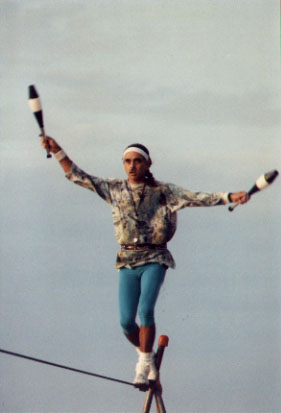
A Key West friend, Will Soto, is having a retirement party on April 1. Will is an entertainer and a political activist, quite well-known in busker circles ("busker: a street performer who works for donations") He even hosted the Key West Buskerfest, which had great potential but failed to evolve into a multi-million dollar annual event like Hemingway Days or Fantasy Fest or even the Key West Literary Festival (or the Powerboat Races or Old Island Days or Pirate Weekend, or...hmmm maybe there just wasn't room on the calendar for another festival).
So Will says he's starting his Farewell Tour, with Cher as his inspiration; in other words, he'll have his retirement party and go right on working.
I'm planning to drive to Key West and stay a couple of days. The better half has to work that weekend, but I have plenty of friends to visit on the island and the party will be a major event. The day after, I will try to spend some time with Will going over research I've been doing for the book he's writing about Key West and the Sunset Celebration--I've been helping him with facts and punctuation; he's supplying the imagination and imagery.
Thursday, February 16, 2006
Boca Musings
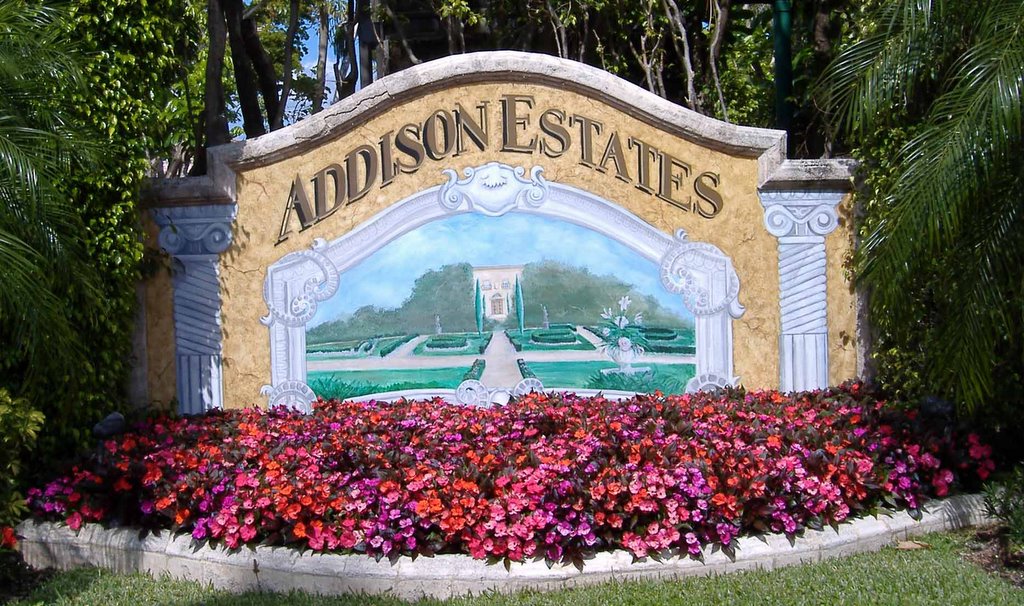
On my lunchtime walk I go by this sign; it announces the entrance to a housing development. I'm sure you can't buy one of these "estates" for less than five million dollars, and they may be more than that--I have no way to know, really. I am struck by this sign, though. First of all, the artwork is really bad. It's better than I could do, but I've seen better work by tenth graders in the public school arts magnet program. The word that springs to mind is "cheesy." The fake Greek pillars, the foliage that is just a cloud of green to save the work of painting that area of the sign, the front of the mansion with the two cypress trees, reminiscent of the famous Munch "Scream."
But above all, the dishonesty of the depiction of this acreage surrounding an English country house. For your five million plus, what are you really going to get? You're lucky if there is 12 inches between your house and your neighbor's. Those houses are packed in like sardines. It never stops surprising me that people will buy property like this, instead of buying land.

Wednesday, February 15, 2006
JAM & All Women's Group

I just returned from a three-hour discussion with a group of about forty women-- Jews, Muslims, Christians, and a few who are hard to categorize. For example, Susan was born into a Jewish family, but for the past eight years she has attended an African American Baptist church on Sunday, in addition to attending shul on Friday night. And on Wednesday afternoon she studies Hinduism. Kathy was born into a Quaker family, then married a Jew and converted to Judaism, and is now a widow who attends Jewish services and studies Buddhism.
We met at a mosque, and there were a good number of Muslim women there, representing lots of different countries--Pakistan, Egypt, Iran, Jordan--as well as one American-born convert to Islam. I may have been the only protestant there, but at least four Catholics were in attendance, and more than ten Jews, many of whom were born in the northeast U.S.
We covered a wide range in our discussions, from the cartoon controversy in Denmark to the holocaust deniers, to the allegation that the Jews killed Christ and the implication of the Pope in anti-semitism.
And a good time was had by all.
It is just great to mingle with women who care enough to come out on a weekday evening for the purpose of promoting peace through individual friendship and community-building.
Tuesday, February 14, 2006
Quoting Emerson
I'm consoling myself with R.W. Emerson this morning: "A foolish consistency is the hobgoblin of little minds."
Because I have posted every day since January 1, but last night I was too busy, and then too tired and too uninspired, so I didn't get anything online.
I could have done two entries today and dated one for yesterday, but I decided not to. I don't need to get obsessive about this cyberproject. On the contrary. It needs to fit into the spaces in my life, not displace any more important activities.
Happy Valentine's Day.
Because I have posted every day since January 1, but last night I was too busy, and then too tired and too uninspired, so I didn't get anything online.
I could have done two entries today and dated one for yesterday, but I decided not to. I don't need to get obsessive about this cyberproject. On the contrary. It needs to fit into the spaces in my life, not displace any more important activities.
Happy Valentine's Day.
Sunday, February 12, 2006
Take the Challenge
I was steered to this site by coolsiteoftheday.com, and I'm just lazy enough to use it for my Sunday night offering here at R/T/L. I scored 80%, which is high enough to make you have to try hard to beat it, but low enough that you shouldn't be discouraged from trying. Good luck!
"Senses Challenge"
"Senses Challenge"
Saturday, February 11, 2006
The Lovely Fort Lauderdale Library
 I spent the afternoon in the Fort Lauderdale library, doing some research that involved looking up articles that were published in the Keys section of the Miami Herald between 1982 and 1986. I started in the microfilm room but that went nowhere, and I wandered over to the reference desk to inquire. I was making friends with the reference librarian there, and he was explaining how to use the internet database to find, print and email articles, when one of his co-workers came up to him and said, "Do you want to go to lunch, I can take over here" (it was 12:20). So the first guy said, okay, and I made a joke about passing the baton, don't drop it, or something, and he said, maybe this could be an Olympic event and we were all impressed by our humor--the theme is very Pythonesque, actually, and does have some potential. At any rate, the new guy continued showing me how to look up the articles. Using the library computers, I was able to accomplish more in two hours than I would have been able to do in six months in the microfilm room. I really love the internet. And the Fort Lauderdale library is truly a wonderful environment.
Friday, February 10, 2006
How to be Alone
How to be Alone, by Jonathan Franzen, is currently at the top of my "favorite books" list, and has held that position since I read it, in the summer of 2004. I liked the book so much that I bought a spiral notebook, and began to re-read, copying down passages on the left side of the page and commenting on them on the right side. I didn't get past the first essay, but I still may go back and finish the project--I always enjoy the time I spend on it.
Here's the lead-up to the thesis of the book:
"I intend this book, in part, as a record of a movement away from an angry and frightened isolation toward an acceptance--even a celebration--of being a reader and a writer."
and here's the thesis itself:
"The local particulars of content matter less to me than the underlying investigation in all these essays: the problem of preserving individuality and complexity in a noisy and distracting mass culture: the question of how to be alone."
Franzen is a masterful writer, he turns a phrase with the best of them. I've read two of his novels and I think the essays are better than the novels. The novels tend to verge on the whimsical, the fantastic, the imaginary. The essays are firmly rooted in reality, and Franzen's reality is clear, if a little dark. He has a wonderful balance between vulnerability and clear-headed exposition.
This is the perfect book for people whose inner life (the "Read - Think") is more real to them than the outer life (the "Live"). The answer to "how to be alone" is, to me, to realize that we are participating in the culture with our reading and thinking. We are networking and creating culture, too. It's not a lonely life.
Here's the lead-up to the thesis of the book:
"I intend this book, in part, as a record of a movement away from an angry and frightened isolation toward an acceptance--even a celebration--of being a reader and a writer."
and here's the thesis itself:
"The local particulars of content matter less to me than the underlying investigation in all these essays: the problem of preserving individuality and complexity in a noisy and distracting mass culture: the question of how to be alone."
Franzen is a masterful writer, he turns a phrase with the best of them. I've read two of his novels and I think the essays are better than the novels. The novels tend to verge on the whimsical, the fantastic, the imaginary. The essays are firmly rooted in reality, and Franzen's reality is clear, if a little dark. He has a wonderful balance between vulnerability and clear-headed exposition.
This is the perfect book for people whose inner life (the "Read - Think") is more real to them than the outer life (the "Live"). The answer to "how to be alone" is, to me, to realize that we are participating in the culture with our reading and thinking. We are networking and creating culture, too. It's not a lonely life.
Thursday, February 09, 2006
Helter Skelter

A friend at work asked me, "Did you see McCartney last night?"
I just shrugged and gave her a friendly look because I've told her a hundred times that I don't have television, but she always forgets.
Anyway, she said, he was on the Grammys last night and he really rocked. He sang "Helter Skelter."
Then we talked about that song--how all we know about it is that Charles Manson got messages from it and they named the Manson book and the Manson movie after it. I have heard the White Album, of course, but I don't own it and I don't know what the song is about.
So I pulled up the trusty Wikipedia site and learned that a "helter skelter" is a kind of slide found in children's playgrounds in England, a spiral slide in an enclosed space, very thrilling for children. Paul had vivid memories of his childhood and often used them in his writing.
It appears that Paul was being competitive with "Helter Skelter," trying to write a very loud and cacophonous piece that would simulate (or stimulate) a psychedelic state. Being the talented artist that he is, he succeeded in creating something that had a major impact on the contemporary music culture.
Unfortunately, it was hijacked by Manson. But the words of the song do not support any kind of evil interpretation.
Manson should have used "Sympathy for the Devil" as his theme song instead.
Here are the lyrics:
[Recorded by The Beatles - 1968]
Helter Skelter
by Lennon/McCartney
When I get to the bottom
I go back to the top of the slide
Where I stop and I turn and I go for a ride
Till I get to the bottom and I see you again
Do you, don't you want me to love you
I'm coming down fast but I'm miles above you
Tell me, tell me, tell me
Come on tell me the answer
You may be a lover but you ain't no dancer
Helter skelter, helter skelter, helter skelter
Will you, won't you want me to make you
I'm coming down fast but don't let me break you
Tell me, tell me, tell me
You may be a lover but you ain't no dancer
Look out
Helter skelter, helter skelter, helter skelter
Look out, cause here she comes
When I get to the bottom
I go back to the top of the slide
Where I stop and I turn and I go for a ride
And I get to the bottom and I see you again
Well do you, don't you want me to make you
Tell me, tell me, tell me
You may be a lover but you ain't no dancer
Look out
Helter skelter, helter skelter, helter skelter
Look out helter skelter
She's coming down fast
Yes she is
Yes she is.
Wednesday, February 08, 2006
Stevie Wonder
I just got Stevie Wonder's Songs in the Key of Life on remastered cd from Amazon, and I've been listening to it for the past four days. I had never owned it before but I listened to it a lot in college. "Sir Duke" was a popular party song in those days.
Whatever happened to Michael Jackson, Stevie Wonder is evidence that it isn't inevitable. Wonder was a child prodigy who managed to grow up into a responsible adult. He is a gifted artist who keeps his message positive. His music is secular, but it has a real gospel soul. I'm feeling inspired by his Songs.
Whatever happened to Michael Jackson, Stevie Wonder is evidence that it isn't inevitable. Wonder was a child prodigy who managed to grow up into a responsible adult. He is a gifted artist who keeps his message positive. His music is secular, but it has a real gospel soul. I'm feeling inspired by his Songs.
Tuesday, February 07, 2006
The Achenblog Word Cloud
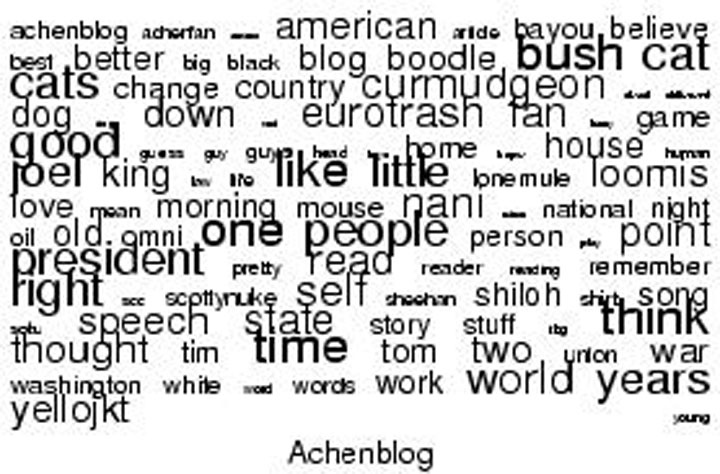
Thanks to yellojkt for the link to Snapshirts that enabled me to create this word cloud of Achenblog. The more I look at it, the more I like it. "One people," indeed.
Monday, February 06, 2006
I Wish I Still Had Them
Back in about 1984, as I was moving from a small apartment to an even smaller one in Key West, and vinyl records were already on the way out, and my stereo wasn't working very well, I sold all my records at a yard sale. Many of the good ones have been replaced over the years on cassette and then on cd. But there are three record albums that have turned out to be irreplaceable and/or untranslatable, and if I had them today, they would be among my treasured possessions.
I. Monty Python, Matching Tie and Handkerchief
The marketing concept here was that you would get a free record if you bought the tie and handkerchief, but it was a blatant rip-off since the merchandise was just a cardboard cutout, very sleazy, ha ha. The record itself apparently had two "B" sides, visually identical, so you couldn't tell until it started playing which side you were listening to. Then of course if you turned it over you would be listening to the other side. But after listening to one side and then the other a few times, or possibly even the second time, you would suddenly realize you were listening to something you hadn't heard before. The record actually had three sides. One side was double-grooved. The cleverness of that was just a bonus, since the contents of the record was extremely funny. I have it on cd now, but it is Not the Same.
II. Jimmy Thudpucker's Greatest Hits
Jimmy Thudpucker is a Doonesbury character, kind of a satire of a Jackson Browne type California folk-rock singer/songwriter. I bought the album because I have always been a Doonesbury fan, not expecting much in the way of musical quality. I was surprised to find that the songs were very good, and it became one of my favorite records. I guess it is a rare collector's item today. Wish I still had it.
III. Tim Weisburg, Hurtwood Edge
Tim Weisburg's instrument is the electric flute. His music is a sort of jazz that flirts with easy listening, but, in my opinion, never crosses that line. He's had some success--I saw him on the Tonight Show more than once, in the late 70's, and he made an album with Dan Fogelberg in 1976 called Twin Sons of Different Mothers, followed up about 20 years later with one called No Resemblance Whatsoever. Hurtwood Edge is out of print and was probably never recorded on cd, but I can still hear the melodies in my head, at least parts of them. What I can't remember, is lost forever.
I. Monty Python, Matching Tie and Handkerchief
The marketing concept here was that you would get a free record if you bought the tie and handkerchief, but it was a blatant rip-off since the merchandise was just a cardboard cutout, very sleazy, ha ha. The record itself apparently had two "B" sides, visually identical, so you couldn't tell until it started playing which side you were listening to. Then of course if you turned it over you would be listening to the other side. But after listening to one side and then the other a few times, or possibly even the second time, you would suddenly realize you were listening to something you hadn't heard before. The record actually had three sides. One side was double-grooved. The cleverness of that was just a bonus, since the contents of the record was extremely funny. I have it on cd now, but it is Not the Same.
II. Jimmy Thudpucker's Greatest Hits
Jimmy Thudpucker is a Doonesbury character, kind of a satire of a Jackson Browne type California folk-rock singer/songwriter. I bought the album because I have always been a Doonesbury fan, not expecting much in the way of musical quality. I was surprised to find that the songs were very good, and it became one of my favorite records. I guess it is a rare collector's item today. Wish I still had it.
III. Tim Weisburg, Hurtwood Edge
Tim Weisburg's instrument is the electric flute. His music is a sort of jazz that flirts with easy listening, but, in my opinion, never crosses that line. He's had some success--I saw him on the Tonight Show more than once, in the late 70's, and he made an album with Dan Fogelberg in 1976 called Twin Sons of Different Mothers, followed up about 20 years later with one called No Resemblance Whatsoever. Hurtwood Edge is out of print and was probably never recorded on cd, but I can still hear the melodies in my head, at least parts of them. What I can't remember, is lost forever.
Sunday, February 05, 2006
Super Bowl Sunday
Gosh, I would watch the Super Bowl, but...
--I've got to read this book, Wicked, because I've got three other books on my list that I need to get to next
--I have to write my blog
--I have to do laundry
--Got to wash my hair tonight
--Don't have television
--Don't like commercials
--Don't know anything about professional football
--Don't like the Rolling Stones
--It's All-Beatles Weekend on my oldies station (Now playing: "Penny Lane")
--Can't help thinking football encourages violence
--I'm sick of the commercialization of entertainment
--I'll probably be in bed by 8:45
--I do not care who wins
...but otherwise, I would be watching the Super Bowl right now.
--I've got to read this book, Wicked, because I've got three other books on my list that I need to get to next
--I have to write my blog
--I have to do laundry
--Got to wash my hair tonight
--Don't have television
--Don't like commercials
--Don't know anything about professional football
--Don't like the Rolling Stones
--It's All-Beatles Weekend on my oldies station (Now playing: "Penny Lane")
--Can't help thinking football encourages violence
--I'm sick of the commercialization of entertainment
--I'll probably be in bed by 8:45
--I do not care who wins
...but otherwise, I would be watching the Super Bowl right now.
Saturday, February 04, 2006
Enron
I watched Enron: The Smartest Guys in the Room today, and I am just about paralyzed with disgust.
A portrait of a true Free Market Economy at work. Libertarians and Republicans, I guess they see what happened and say, yeah? what's wrong with that? Who got hurt, only the people who weren't smart enough or aggressive enough to protect themselves. It's their own fault.
My tipping point in the movie was when Enron bought power plants in California and then called them and told them to shut down operations for a few hours to drive the prices up so they could make more money. That is so easy to understand, not complicated at all. They didn't have to be so smart to figure that out, they just had to be ruthless, and think of it as nothing but a game that uses money to keep score.
The film included a clip of Ronald Reagan saying, "government won't solve our problems. Government is the problem." And with the kind of laissez-faire economic policy he was advocating, I just about have to agree with him. But good government can solve problems. Otherwise, we might as well all be libertarians. We'll stock up on food and amunition and just try to survive long enough to breed so that our genes will be part of the future gene pool--is that all life is about?
I have never believed in a kind of intelligence that is asocial, or anti-social. Even though I'm kind of a loner myself, I've always been able to apply my intelligence to interpersonal situations. The portrait of the eccentric genius who can't function in society, I don't recognize that person as being truly intelligent. Talented, okay, maybe. But a truly intelligent person is capable of appreciating the effect his actions have on other people. Extreme intelligence, I believe, is best exemplified by someone like Mahatma Gandhi. He understood the human world that he lived in, and was able to act to make it better.
Actually, that phrase, "the smartest guy in the room" is one of my favorites, although I don't often say it out loud. I think about it, though: In any room, there is bound to be one person who is the smartest one there. And by my definition, that person always knows who he is. There are probably several others who believe they are the smartest, as well. But they are wrong, and just don't know it. There's a lot to think about in that situation. Potential for irony abounds.
Bottom line: those Enron guys, they were not so smart as they thought.
A portrait of a true Free Market Economy at work. Libertarians and Republicans, I guess they see what happened and say, yeah? what's wrong with that? Who got hurt, only the people who weren't smart enough or aggressive enough to protect themselves. It's their own fault.
My tipping point in the movie was when Enron bought power plants in California and then called them and told them to shut down operations for a few hours to drive the prices up so they could make more money. That is so easy to understand, not complicated at all. They didn't have to be so smart to figure that out, they just had to be ruthless, and think of it as nothing but a game that uses money to keep score.
The film included a clip of Ronald Reagan saying, "government won't solve our problems. Government is the problem." And with the kind of laissez-faire economic policy he was advocating, I just about have to agree with him. But good government can solve problems. Otherwise, we might as well all be libertarians. We'll stock up on food and amunition and just try to survive long enough to breed so that our genes will be part of the future gene pool--is that all life is about?
I have never believed in a kind of intelligence that is asocial, or anti-social. Even though I'm kind of a loner myself, I've always been able to apply my intelligence to interpersonal situations. The portrait of the eccentric genius who can't function in society, I don't recognize that person as being truly intelligent. Talented, okay, maybe. But a truly intelligent person is capable of appreciating the effect his actions have on other people. Extreme intelligence, I believe, is best exemplified by someone like Mahatma Gandhi. He understood the human world that he lived in, and was able to act to make it better.
Actually, that phrase, "the smartest guy in the room" is one of my favorites, although I don't often say it out loud. I think about it, though: In any room, there is bound to be one person who is the smartest one there. And by my definition, that person always knows who he is. There are probably several others who believe they are the smartest, as well. But they are wrong, and just don't know it. There's a lot to think about in that situation. Potential for irony abounds.
Bottom line: those Enron guys, they were not so smart as they thought.
Friday, February 03, 2006
My Favorite Pet
When I was very young my family had a German shepherd, Rena. Rena was kind of mean, at least that's how it seemed to me, but in hindsight maybe she was just rowdy and I was very small at the time. She did chase and nip me. Nevertheless, I was sad to leave her behind when we moved to another town, when I was five. The new house had no fence, so we couldn't take her with us. She was given away to the proverbial "place in the country, with lots of room to run around." Not my favorite all-time pet.
At the new house, we had a mixed breed terrier, Peanuts. He was a good dog, no trouble at all, liked to lie under the coffee table. When he wanted to go out, we let him out, and when he felt like coming back, he would whine at the door and we would let him in. Best thing about Peanuts was, early summer mornings when I went for my nature walks, he always wanted to go too. In some ways, he was my favorite, but he wasn't my dog, he was a family dog.
I've never had another dog--now they are too much work. We've had cats. None of the cats is qualified to be my favorite pet. We've had fish. Eh. I had a snake once, when I was about 10, but that was just an adventure, and it was way more trouble than it was worth.
My favorite pet was Hammie the Hamster. Hammie was easy to take care of--we could leave him alone for a long weekend by getting the right kind of food and water dispensers. Just clean out the cage once a week or so. He was obviously warm-blooded, unlike the fish or the snake. Hammie was cute and kind of cuddly. He didn't mind being picked up and petted, but he wasn't pining for company if we left him alone for days at a time. He didn't make any noise at all, unless his exercise wheel got squeaky, and then we did hear that all night, every night, but I didn't mind it--in a way it was inspiring. How am I going to complain about getting up for my morning jog, when Hammie's been on the treadmill all night.
Overall, I'd say a hamster is my ideal pet. And the very best thing about them is that the typical hamster lifespan is about two years. So just about the time I started to get tired of cleaning the cage: sayonara, Hammie, R.I.P.
At the new house, we had a mixed breed terrier, Peanuts. He was a good dog, no trouble at all, liked to lie under the coffee table. When he wanted to go out, we let him out, and when he felt like coming back, he would whine at the door and we would let him in. Best thing about Peanuts was, early summer mornings when I went for my nature walks, he always wanted to go too. In some ways, he was my favorite, but he wasn't my dog, he was a family dog.
I've never had another dog--now they are too much work. We've had cats. None of the cats is qualified to be my favorite pet. We've had fish. Eh. I had a snake once, when I was about 10, but that was just an adventure, and it was way more trouble than it was worth.
My favorite pet was Hammie the Hamster. Hammie was easy to take care of--we could leave him alone for a long weekend by getting the right kind of food and water dispensers. Just clean out the cage once a week or so. He was obviously warm-blooded, unlike the fish or the snake. Hammie was cute and kind of cuddly. He didn't mind being picked up and petted, but he wasn't pining for company if we left him alone for days at a time. He didn't make any noise at all, unless his exercise wheel got squeaky, and then we did hear that all night, every night, but I didn't mind it--in a way it was inspiring. How am I going to complain about getting up for my morning jog, when Hammie's been on the treadmill all night.
Overall, I'd say a hamster is my ideal pet. And the very best thing about them is that the typical hamster lifespan is about two years. So just about the time I started to get tired of cleaning the cage: sayonara, Hammie, R.I.P.
Thursday, February 02, 2006
Less Than Three
This is a nerd joke. It will make my daughter laugh. She likes to laugh at my nerdiness. I don't mind, because we both know she has inherited a lot from me and she can't deny it.
I admire people who are naturally funny, or who are willing to put in the effort to be humorous. Those people make a real contribution to the world by increasing the amount of laughter and smiles.
I'm not naturally funny, and I'm usually not willing to try. But I do see the humor in everyday situations, and sometimes I'm able to point it out when other people have missed it. My specialty is knowing how to make a particular person laugh. The secret is in referring back to a previous remark or situation. That's partly what makes it easy to make my husband or my daughter laugh, because I know what they are thinking most of the time, and I remember so many things they have said or done.
My daughter likes to communicate through "instant messages." She is very conscientious about using correct punctuation and spelling, and almost never says ROTFL or IMHO. But she does use one shortcut a lot. Instead of "love" or even "heart" she types "<3". So the joke is, whenever I'm seeing her off at the airport or she's leaving with friends for a night out, I will say "less than three! less than three!"
I warned you.
I admire people who are naturally funny, or who are willing to put in the effort to be humorous. Those people make a real contribution to the world by increasing the amount of laughter and smiles.
I'm not naturally funny, and I'm usually not willing to try. But I do see the humor in everyday situations, and sometimes I'm able to point it out when other people have missed it. My specialty is knowing how to make a particular person laugh. The secret is in referring back to a previous remark or situation. That's partly what makes it easy to make my husband or my daughter laugh, because I know what they are thinking most of the time, and I remember so many things they have said or done.
My daughter likes to communicate through "instant messages." She is very conscientious about using correct punctuation and spelling, and almost never says ROTFL or IMHO. But she does use one shortcut a lot. Instead of "love" or even "heart" she types "<3". So the joke is, whenever I'm seeing her off at the airport or she's leaving with friends for a night out, I will say "less than three! less than three!"
I warned you.
Wednesday, February 01, 2006
Groundhog Day Eve

Almost everything I know about Groundhog Day, I learned from watching the movie Groundhog Day, starring Bill Murray and Andie MacDowell. I really like that movie, and as I watched it the first time I kept thinking, "I like this movie, but I don't know anybody I would recommend it to." The kind of person who, like me, prefers to sit in on a rehearsal than to see the finished show, who likes to watch dancers work on one move over and over with someone helping them become a little closer to perfection each time, who would rather attend batting practice than watch a baseball game--that's who really enjoys Groundhog Day. It's a glimpse of the creative process. It's funny, too.
So tomorrow is Groundhog Day, and here in South Florida the sun is bound to be shining. The Florida version of a groundhog may be something like an iguana; when it sees its shadow and returns to its burrow or tree or whatever, we'll have six more weeks of winter and we'll be glad of it. It's summer that's the endurance contest here. Winter is Easy Street.
Happy Groundhog Day!
Tuesday, January 31, 2006
Tyger, Tyger, by William Blake
Feeling like I didn't have anything to say today, I thought I'd share a favorite poem. So I had to think of one. And the first one I thought of, I couldn't find a copy of it. This is the second one. This is actually not a poem that I love for itself, but I have a great deal of respect for it. That's because when I read it to a class of restless fifth graders, just average 10-year-olds, they stayed quiet and were mesmerized by it. So I know it's got something special, and I'll keep trying to see what it is.
Tyger, Tyger
by William Blake (1757-1827)
Tyger Tyger burning bright,
In the forests of the night;
What immortal hand or eye,
Could frame thy fearful symmetry?
In what distant deeps or skies,
Burnt the fire of thine eyes?
On what wings dare he aspire?
What the hand dare sieze the fire?
And what shoulder & what art,
Could twist the sinews of thy heart?
And when thy heart began to beat,
What dread hand?& what dread feet?
What the hammer? What the chain?
In what furnace was thy brain?
What the anvil? What dread grasp
Dare its deadly terrors clasp!
When the stars threw down their spears
And water’d heaven with their tears:
Did he smile his work to see?
Did he who made the lamb make thee?
Tyger Tyger burning bright,
In the forests of the night:
What immortal hand or eye,
Dare frame thy fearful symmetry?
Tyger, Tyger
by William Blake (1757-1827)
Tyger Tyger burning bright,
In the forests of the night;
What immortal hand or eye,
Could frame thy fearful symmetry?
In what distant deeps or skies,
Burnt the fire of thine eyes?
On what wings dare he aspire?
What the hand dare sieze the fire?
And what shoulder & what art,
Could twist the sinews of thy heart?
And when thy heart began to beat,
What dread hand?& what dread feet?
What the hammer? What the chain?
In what furnace was thy brain?
What the anvil? What dread grasp
Dare its deadly terrors clasp!
When the stars threw down their spears
And water’d heaven with their tears:
Did he smile his work to see?
Did he who made the lamb make thee?
Tyger Tyger burning bright,
In the forests of the night:
What immortal hand or eye,
Dare frame thy fearful symmetry?
Monday, January 30, 2006
Exxon Mobil
The Washington Post reports today that Exxon-Mobil broke the record for corporate profits in 2005: $36.13 billion. Profits were up 43 percent from the year before. Hurricanes Rita and Katrina helped the oil companies' bottom line by contributing to higher prices. Can you spell R-E-G-U-L-A-T-I-O-N? Surely we could tax these companies a little more without danger of the slippery slope to socialism?
I remember when "my generation" understood the evil that the oil companies represented. I remember when it was taken for granted that they were the enemy. And I say that advisedly, knowing that oil company profits paid for my piano lessons and the food I ate as a child. Still, oil is a natural resource, like air or water, and there really is no reason why it shouldn't belong to everyone. At the very least, the government (that is, the people) should not tolerate profiteering of the type that allows oil companies to benefit from natural disaster. It's just common sense.
I remember when "my generation" understood the evil that the oil companies represented. I remember when it was taken for granted that they were the enemy. And I say that advisedly, knowing that oil company profits paid for my piano lessons and the food I ate as a child. Still, oil is a natural resource, like air or water, and there really is no reason why it shouldn't belong to everyone. At the very least, the government (that is, the people) should not tolerate profiteering of the type that allows oil companies to benefit from natural disaster. It's just common sense.
Sunday, January 29, 2006
Humor
I was thinking about "gay humor" the other day--what got me started was a New Yorker article that I thought was really funny, but Danielle didn't really get it, and then she said, "oh, is it that they are supposed to be gay?" and that made me consciously realize that the humor depended on thinking that the way gay men act--that is, the stereotype of the way flamboyantly gay men act--is inherently funny. And I thought, why does that seem wrong, because gay men themselves are the ones who created this genre of humor. It's gay humor.
Then I thought of minstrel shows. And Spike Lee's fabulous and underrated movie, Bamboozled, which is so brilliant I can't really sum it up, except to say that it explored the subject of the minstrel show in a very original way. And my thoughts on minstrel shows were, not only were they funny, but black people thought they were funny, and in fact, black people themselves invented the genre, it was "black" entertainment. And today it is pretty much universally accepted that minstrel shows are offensive and degrading to blacks.
Then I thought about Stepin Fetchit, and I was interested to find my brain compartmentalized to this extent: I know that the character is offensive and racist, but if I am honest, he is also very funny. And I realized with a start that I have said "There's nobody in here but us chickens!" within the past week, and people recognize the line and it is still funny, after more than 50 years and all the water under the bridge.
So back to gay humor. I am afraid that all the self-deprecation and stereotype exaggeration is a version of the minstrel show, especially when it is copied by people who are not gay (are white people in blackface more offensive than Stepin Fetchit?) and I think that in the future when gay people are finally accepted into society in an equal way, the face of humor will change.
But I need to think about this some more. And I will take this opportunity to recommend Bamboozled, with this caveat: watch it with an open mind. I honestly don't think Spike Lee is trying to offend anybody, although I guess he thinks if you are offended, it's your problem, not his.
Then I thought of minstrel shows. And Spike Lee's fabulous and underrated movie, Bamboozled, which is so brilliant I can't really sum it up, except to say that it explored the subject of the minstrel show in a very original way. And my thoughts on minstrel shows were, not only were they funny, but black people thought they were funny, and in fact, black people themselves invented the genre, it was "black" entertainment. And today it is pretty much universally accepted that minstrel shows are offensive and degrading to blacks.
Then I thought about Stepin Fetchit, and I was interested to find my brain compartmentalized to this extent: I know that the character is offensive and racist, but if I am honest, he is also very funny. And I realized with a start that I have said "There's nobody in here but us chickens!" within the past week, and people recognize the line and it is still funny, after more than 50 years and all the water under the bridge.
So back to gay humor. I am afraid that all the self-deprecation and stereotype exaggeration is a version of the minstrel show, especially when it is copied by people who are not gay (are white people in blackface more offensive than Stepin Fetchit?) and I think that in the future when gay people are finally accepted into society in an equal way, the face of humor will change.
But I need to think about this some more. And I will take this opportunity to recommend Bamboozled, with this caveat: watch it with an open mind. I honestly don't think Spike Lee is trying to offend anybody, although I guess he thinks if you are offended, it's your problem, not his.
Saturday, January 28, 2006
Guest Blogger, ArtistAlice

People say that there are no seasons in Florida, but that’s simply not true. The unbroken summer grows to fit its own seasons: rainy season, hurricane season, tourist season, and off-season. It was during the off-season, a particularly dry month, that I first visited the Loxahachee River. My father and I woke up before the sun, packed a mass of egg salad sandwiches and seltzer water cans into a cooler and headed out west, hitting the highway that soon disappeared into a paved strip lost among swamp. The sun had risen by the time we reached the Canoe Outpost. There were peacocks, strutting and elusive, dotting the grounds around the low buildings and racks of weathered canoes. I found a feather that was fated to be lost in the murky river depths later in the day. We wrestled our canoe into the water, watched by creatures hidden behind the submerged logs and spindly cypress knees. It was not unusual to see a lazy alligator slide from the deep shade into the mossy brown-green water, minding its own business. The scene was reverent; choruses of insects droned content and far away from the shore. We launched the canoe, struggling to figure out the complexities of balancing strokes and rhythm of paddles against the swirling, sluggish water. Left, right, more on the left, quick!
Over the years, since that first visit, I have returned over and over again--when the river was high and violent, with friends in tow. The things I love about the river are always the same: the thrill of an adventure, the sheer beauty of nature, and the joy of sharing the experience with someone. There are two sections to the bit of Loxahatchee that is readily accessible from the canoe outpost. The slow, winding section, passing leisurely through shady depths, and the wide open rushing half, under the bright sun. We opted, the first time, with the water tame and the downstream current mild, to travel to the edge of the wooded section, turn around, and come back. Leaving was easy enough – the water is deep and the river a decent width. But it was a dry month, and we were soon to realize it would not be all simple paddling. We reached the first submerged log with some bewilderment and cautious debate. Attempted to surge over, and failed. Attempted to pull back and maneuver around, and failed. It took chest-deep wading, precarious balance and a great deal of levering and shoving. That was the first of many. We were suddenly early explorers, forging through dangerous wilds, pitting our wits against the landscape and trying to keep the water out of our trusty canoe and out of our egg-salad sandwiches.
But the fallen logs were not the last challenge. It was the dam that did us in. It was a sudden drop, a miniature man-made waterfall made of slanted logs. There was a place to hoist your canoe and carry it on one side, and down a dry ramp to the other side. Ramps, surely, were for those other canoers. We were daring explorers. We capsized. We had to dive for our supplies and hats. The sandwiches, thankfully, survived in the ark of our blue plastic cooler. A few hours later, we took a break, and fished, tying hooks to fishing line, to long scavenged sticks, and casting out. We didn’t catch much. I jumped into deep parts of the river from a fallen tree, exalted at the danger and thrill of falling through the air into murky uncertain water, the cool slimy caress of underwater growth or a fish making me jump.
I have always felt a grand affinity for having adventures, and the river certainly always proved itself to be one. I am a city girl. Even growing up in the small, artsy island village of Key West, I am unaccustomed to landscape without hotels or McDonalds, or litter on the sidelines. The Loxahachee is always perfectly maintained. Maybe once or twice, during all of my visits, have I seen a soda can, or a piece of discarded paper. It is a wonderful setting to lose oneself in fantasy. Sometimes, through the stretch, we would pass houses. And once or twice, a highway would stretch out an overpass across the river, throwing a bar of shadow over the shimmering water, and adding the sound of automobiles to the drone of too many insects. Nothing is untouched by the modern world, anymore, not completely. But I do remember that it was so close I barely even noticed.
The Loxahachee River is protected by the government as a natural reserve. It is cleaned, protected, preserved in its current state. My memories, along with the thoughts and experiences of thousands of other humans, canoers, explorers, children and parents all nestle in the shady bends and wide stretches of green water. My father and I are both a lot older now, than we were then. He doesn’t have as much paddling strength, and I haven’t as much of my old spirit of adventure. But we both faithfully attempt – and try to avoid going when it is too dry, or too overflowing and wild. We leave our city life behind and bask in nature. I remember my adventures, I remember the trees and cypress knees and alligators, even if we only go for a few hours now, not the whole day. In the end, it is not about how much of the river we conquer. After all, the point really is the time spent with my dad and the memories we created together.
Friday, January 27, 2006
The Cat
I'm not what you would call a cat-lover, or even an animal-lover. I like dogs when they are well-trained, but I wouldn't have one because I don't want to commit to The Daily Walk--even though I habitually exercise early in the morning, I like to think it's because I choose to do it, not because I have to.
My daughter really likes cats. She was much too young (2 1/2) when my husband brought home the first kitten. But she not only loved that kitten, she really became convinced that she was a cat herself. Maybe the way birds think the first large moving object they see is their mother, she saw that cat as a sibling on some elemental level. That kitten was given away after about 6 months when we moved out of state, but the idea was firmly planted in Danielle's mind.
I never supported the idea of having a cat, because I was always the one buying the catfood, changing the litter box, paying for the shots, etc. But Danielle always wanted one, and at some point during middle school I told her if she got straight A's she could have one. She achieved that goal about halfway through high school. She was thrilled to have her own cat at last, and was pretty good about taking care of her. Now, while Danielle is at college, the cat is all mine.
Lily. She's all black except for the tips of her paws and her whiskers, and a little white bib. She is a small cat, she's energetic but serene, independent but also cuddly. She's the perfect cat. She's on my lap right now while I'm typing this. But if I needed to get up, she would jump down and go on with her life, with no whining.
I give Danielle full credit for choosing Lily out of all the possible candidates at the animal shelter. I've known different cats--some are all over you all the time, waking you up when you want to sleep, getting between your feet when you want to cross the room, climbing the curtains, undecorating the Christmas tree. Some are shy and standoffish, won't let anyone pet them, disappear for days at a time. Some do nothing but eat and sleep. Danielle picked the right one. I wouldn't miss Lily if she weren't here, but I don't mind having her hanging around. She's a good cat.
My daughter really likes cats. She was much too young (2 1/2) when my husband brought home the first kitten. But she not only loved that kitten, she really became convinced that she was a cat herself. Maybe the way birds think the first large moving object they see is their mother, she saw that cat as a sibling on some elemental level. That kitten was given away after about 6 months when we moved out of state, but the idea was firmly planted in Danielle's mind.
I never supported the idea of having a cat, because I was always the one buying the catfood, changing the litter box, paying for the shots, etc. But Danielle always wanted one, and at some point during middle school I told her if she got straight A's she could have one. She achieved that goal about halfway through high school. She was thrilled to have her own cat at last, and was pretty good about taking care of her. Now, while Danielle is at college, the cat is all mine.
Lily. She's all black except for the tips of her paws and her whiskers, and a little white bib. She is a small cat, she's energetic but serene, independent but also cuddly. She's the perfect cat. She's on my lap right now while I'm typing this. But if I needed to get up, she would jump down and go on with her life, with no whining.
I give Danielle full credit for choosing Lily out of all the possible candidates at the animal shelter. I've known different cats--some are all over you all the time, waking you up when you want to sleep, getting between your feet when you want to cross the room, climbing the curtains, undecorating the Christmas tree. Some are shy and standoffish, won't let anyone pet them, disappear for days at a time. Some do nothing but eat and sleep. Danielle picked the right one. I wouldn't miss Lily if she weren't here, but I don't mind having her hanging around. She's a good cat.
Thursday, January 26, 2006
I'm Sorry
An article in today's paper includes a picture of two U.S. Naval officers bowing to their Japanese counterparts in apology for some crimes committed by American servicemen in Japan. The article says, "it is hard to overstate" the importance of the apology in Japanese culture. My friend Setsuko and I may not agree about polar bears and penguins, but we do agree about the importance of apologies. A few years ago, the U.S. bombed a Chinese embassy in Yugoslavia, then said it was a mistake. The reports I'm reading now all say the U.S. issued a full apology. But the way I remember it, there was some delay while NATO/U.S. considered their options, and there seemed to be some doubt as to whether an apology would be forthcoming. I remember this because I wrote my own apology and sent it to the Chinese embassy the day after the bombing.
This afternoon, I crossed a street in a crosswalk in front of a truck that was at a red light waiting to turn right. As I started in front of him, he started to go, and for a second it looked like he would hit me. Luckily, he stopped in time, and as I continued on, I said, "Sorry!" Anytime somebody bumps into me, I always apologize. In English, I'm sorry can mean, I regret my actions, or I regret the situation. In French, I would say, "Je suis désolée"--I am very sad. In Spanish, it's "lo siento"--I feel it, it hurts me. Anyway, it's not an absolute statement that the person apologizing is guilty of something. It's just courtesy, and I think it's the right thing to do, apologize right away, and you can always argue later about whose fault the situation was.
This afternoon, I crossed a street in a crosswalk in front of a truck that was at a red light waiting to turn right. As I started in front of him, he started to go, and for a second it looked like he would hit me. Luckily, he stopped in time, and as I continued on, I said, "Sorry!" Anytime somebody bumps into me, I always apologize. In English, I'm sorry can mean, I regret my actions, or I regret the situation. In French, I would say, "Je suis désolée"--I am very sad. In Spanish, it's "lo siento"--I feel it, it hurts me. Anyway, it's not an absolute statement that the person apologizing is guilty of something. It's just courtesy, and I think it's the right thing to do, apologize right away, and you can always argue later about whose fault the situation was.
Wednesday, January 25, 2006
Magazines
I guess one reason I read so many books as a child was because I didn't have so many great magazines as I have now. I had subscriptions, first to American Girl, then Seventeen. But now, every month, I generally read Smithsonian, National Geographic, Esquire, GQ, Vanity Fair, and Wired. And that's not mentioning the New York Times and Washington Post weekly Sunday magazines. And not even starting with Salon.com, or the recently discovered (by me) online version of The New Yorker. It is a wonder that I ever read a book.
But I don't know how much the magazines are a cause and how much they are a symptom. My increasing attention to the internet and multitasking as a way of life seems to have decreased my tolerance for sitting still, focusing on a single narrative for long periods of time. I have recently found it more difficult to read books because I am impatient to get on with the next activity, whatever it might be. I kind of hope this is just a phase I'm going through.
But I don't know how much the magazines are a cause and how much they are a symptom. My increasing attention to the internet and multitasking as a way of life seems to have decreased my tolerance for sitting still, focusing on a single narrative for long periods of time. I have recently found it more difficult to read books because I am impatient to get on with the next activity, whatever it might be. I kind of hope this is just a phase I'm going through.
Tuesday, January 24, 2006
Cute!!! (Not)
There was a story in the newspaper today about a snake and a hamster in a zoo in Japan. The zookeepers put the hamster in the snake's cage for it to eat. But the snake didn't want to eat the hamster so they became "friends," with the hamster even cuddling up to the snake and sleeping on top of it. I knew my friend Setsuko would love that story. She thinks the March of the Penguins is the best movie ever made, except maybe for this other movie she saw recently about a man who raised a polar bear from a cub, and it was so cute, and also wasn't it so great when the tortoise made friends with the hippopotamus after the tsunami, and so on...
I find the snake and hamster story disturbing. I'm sure the snake will eat the hamster when it gets hungry enough. I don't know what makes me different from people who can appreciate "cute," but I know J.D. Salinger understands, because he has Seymour Glass, his most highly-esteemed character, explain it to his young wife, Muriel. "I mentioned R. H. Blythe's definition of sentimentality: that we are being sentimental when we give to a thing more tenderness than God gives to it. I said (sententiously?) that God undoubtedly loves kittens, but not, in all probability, with Technicolor bootees on their paws."
I think they should show that cute polar bear movie as a double feature with Grizzly Man, the movie about the guy who sentimentalized grizzly bears and got himself and his girlfriend killed and eaten as a result.
I find the snake and hamster story disturbing. I'm sure the snake will eat the hamster when it gets hungry enough. I don't know what makes me different from people who can appreciate "cute," but I know J.D. Salinger understands, because he has Seymour Glass, his most highly-esteemed character, explain it to his young wife, Muriel. "I mentioned R. H. Blythe's definition of sentimentality: that we are being sentimental when we give to a thing more tenderness than God gives to it. I said (sententiously?) that God undoubtedly loves kittens, but not, in all probability, with Technicolor bootees on their paws."
I think they should show that cute polar bear movie as a double feature with Grizzly Man, the movie about the guy who sentimentalized grizzly bears and got himself and his girlfriend killed and eaten as a result.
Monday, January 23, 2006
Sunday at the Homeless Shelter
My interfaith organization, JAM & All, did a service project at our local homeless shelter yesterday. The concept was pretty simple. We collected personal care supplies in tote bags, so that each bag had a complete set of soap, towel, shampoo, etc., and brought them to the shelter, and then we had crafts and games for the kids and served refreshments. It was pretty successful, I'd say; we had a good turnout. Of the JAM members that showed up, most were Muslim, but there was a good mix, including some people who came from the community because they saw the notice in the newspaper.
I spent my time with a little five-year-old girl named Jalisa. We talked and read some stories and poems and made a bag with her name on it. She was very smart and sweet. I told her mother, "I used to have a little girl, but she grew up." The people at the shelter, especially the women and children, seemed far from hopeless. Having children is a kind of handicap women have that makes it very difficult to get a job, because daycare costs money and you don't have money until you work, and you can't work if you don't have daycare. Why we don't have government daycare, that's a mystery, possibly explained by the predominance of men and rich people in government.
I spent my time with a little five-year-old girl named Jalisa. We talked and read some stories and poems and made a bag with her name on it. She was very smart and sweet. I told her mother, "I used to have a little girl, but she grew up." The people at the shelter, especially the women and children, seemed far from hopeless. Having children is a kind of handicap women have that makes it very difficult to get a job, because daycare costs money and you don't have money until you work, and you can't work if you don't have daycare. Why we don't have government daycare, that's a mystery, possibly explained by the predominance of men and rich people in government.
Sunday, January 22, 2006
Random Blog-Surfing
I just clicked on "next blog" and found a nice site--Bina007 does movie reviews from a British viewpoint. She has reviews of movies I haven't even heard of. She has strong opinions and doesn't hesitate to express them. I'm probably just in a very accepting mood today, but that's good, too. I'm putting Bina on my blogroll.
Saturday, January 21, 2006
Haiti
In 1984, Tocci and I visited Haiti and the Dominican Republic. We spent four weeks on Hispanola; we meant to go to Jamaica, too, but Haiti was so interesting we stayed there longer instead. We had adventures and learned about life in the third world. We gained an appreciation for what the necessities of life are. Food, shelter, water.
They had water in barrels that didn't seem clean enough to wash with, and that was their drinking water. They washed their clothes in the river that they dumped the city sewage into. We spoke to a man who had lived in Canada for a few years. He said he had no problems drinking the water in Haiti, when he lived there, but when he returned from his time in Canada and drank the Haitian water, he became very sick. We drank bottled water. The locals mostly couldn't afford that, and in fact the bottles were themselves valuable enough that kids would follow us to get the empties when we were done with them. All over the country, in developed areas, there was plumbing but no running water, and that made it seem even more of a deprivation, because you could see they used to have it, like having a well that has run dry.
When we flew back into Miami, we looked down from the plane and we saw, from horizon to horizon, back yard swimming pools. Private pools with hundreds--thousands--of gallons of water that was a higher quality than anything the people of Haiti had access to. And our two countries are so close to each other; these people are not on the other side of the world. They are our geographic neighbors. I could never look at a swimming pool or a tap the same way again.
They had water in barrels that didn't seem clean enough to wash with, and that was their drinking water. They washed their clothes in the river that they dumped the city sewage into. We spoke to a man who had lived in Canada for a few years. He said he had no problems drinking the water in Haiti, when he lived there, but when he returned from his time in Canada and drank the Haitian water, he became very sick. We drank bottled water. The locals mostly couldn't afford that, and in fact the bottles were themselves valuable enough that kids would follow us to get the empties when we were done with them. All over the country, in developed areas, there was plumbing but no running water, and that made it seem even more of a deprivation, because you could see they used to have it, like having a well that has run dry.
When we flew back into Miami, we looked down from the plane and we saw, from horizon to horizon, back yard swimming pools. Private pools with hundreds--thousands--of gallons of water that was a higher quality than anything the people of Haiti had access to. And our two countries are so close to each other; these people are not on the other side of the world. They are our geographic neighbors. I could never look at a swimming pool or a tap the same way again.
Friday, January 20, 2006
Art in Everyday Life
One test of art is whether you get tired of it after a while. The best art is not tedious or tiresome. This is a painting we've had in our living room for a while and I like it better all the time. It is pretty large, about 40"x50" and it is painted on cardboard.
The use of color is minimal, and the light is very interesting. The subject matter is strikingly original--it keeps surprising me every time I look at it. It's a pear, looking off the edge of some sort of girder, into the chasms of a city. There is light where the pear's face would be; is that hope? The artist assures me that the pear is not suicidal, or even sad. The Writing on the Wall is somewhat ominous, basically, "Creative Poetry by the Numbers" and blah, blah, blah. The buildings are cold and impersonal, at the same time that I want to anthropomorphize them and think of them as watching the scene, because the pear naturally appears to have consciousness, since it is the center of attention and seems to be leaning out over the depths.
I am soothed by the warm browns and the regular lines, and the girder seems to offer a pathway back to the world for the protagonist, once he has finished contemplating his situation. I really like this painting. I think I'll keep it.
Thursday, January 19, 2006
Practice Makes Perfect
Today I spent some time thinking about why I'm writing on this website every day. I decided it it the perfect combination of obscurity and accountability because
1) I can be pretty sure that almost nobody will read what I write, and so I don't have to be self-conscious or worry about creating a world-wide scandal; and at the same time,
2) Anybody in the universe could read it on a given day. Hundreds of people have been provided with the link, including some people who know me and whose opinion I value, and so I'm motivated to keep the quality at a reasonably high level, and not to be lazy about posting.
I hope that the more I write, the easier it will be to put my thoughts into words, and to remember the fleeting ideas that pass through my head every day, to capture them occasionally and get them into paragraph form.
1) I can be pretty sure that almost nobody will read what I write, and so I don't have to be self-conscious or worry about creating a world-wide scandal; and at the same time,
2) Anybody in the universe could read it on a given day. Hundreds of people have been provided with the link, including some people who know me and whose opinion I value, and so I'm motivated to keep the quality at a reasonably high level, and not to be lazy about posting.
I hope that the more I write, the easier it will be to put my thoughts into words, and to remember the fleeting ideas that pass through my head every day, to capture them occasionally and get them into paragraph form.
Wednesday, January 18, 2006
E Prime
Imagine, if you will, a version of the English language that has no passive voice. A language that also does not assert any unsubstantiated opinion or observation as a fact. A reasonable person would surely support such a language. It exists, and it goes by the name E Prime. Or E-Prime.
This subject doesn't really lend itself to unfettered ranting, because I feel constrained without my state-of-being verbs. My mind keeps trying to revert to its old habits, and can only be kept on course by continual vigilence that inhibits verbosity. On the other hand, the average number of syllables in the words I use increases when I write in E-Prime. Whether readers find that desirable or not, who knows. The density of the prose definitely increases.
Some scientists like to use E-Prime for their reports. I don't think it will catch on in literary circles. I have considered converting this blog to E-Prime only, but I don't make any commitments yet.
I believe I can restrict my Achenblog comments to E-Prime; at least I can keep it going as long as Joel can. He has the harder task: E-Prime humor. I look forward to seeing whether he can do it.
This subject doesn't really lend itself to unfettered ranting, because I feel constrained without my state-of-being verbs. My mind keeps trying to revert to its old habits, and can only be kept on course by continual vigilence that inhibits verbosity. On the other hand, the average number of syllables in the words I use increases when I write in E-Prime. Whether readers find that desirable or not, who knows. The density of the prose definitely increases.
Some scientists like to use E-Prime for their reports. I don't think it will catch on in literary circles. I have considered converting this blog to E-Prime only, but I don't make any commitments yet.
I believe I can restrict my Achenblog comments to E-Prime; at least I can keep it going as long as Joel can. He has the harder task: E-Prime humor. I look forward to seeing whether he can do it.
Tuesday, January 17, 2006
A Year in the Life of William Shakespeare
1599. The book of this title by James Shapiro is a mixture of history and literary studies. Shapiro spent fifteen years researching a single year in history, with a focus on a single individual's place in and reaction to the events of his time. Today I reached what is probably the climax of the book: Shapiro's analysis of Hamlet. He makes a convincing argument that Hamlet is a microcosm of the conflicts wrenching England in 1599. The Catholic Church had been defeated, the age of chivalry was over. Elizabeth was old, surely soon to die. The date itself, 1599, marks the end of an era as the cosmic odometer gets ready to turn over to 1600. The English were trying to subdue Ireland, but they were failing, and the Spanish Armada was a looming threat. The character of Hamlet, torn between an old style of life, characterized by chivalry (represented by the revenge of his father's death), and a new way of life that he can't fully imagine, is paralyzed on the brink of action, just as England seemed to be powerless in the grip of history at that moment.
Shapiro's analysis is really fascinating. One of the reader reviews on Amazon says, "...there is only one test of a book on Shakespeare: does it send you back to reread the plays." I look forward to reading Hamlet again with the new background information I learned from Shapiro's book.
Here's a little Shakespeare trivia: Hamlet has more different words in it than any other Shakespeare play. It's hard for us to read Shakespeare because the words are often unfamiliar to us. What I never knew before now is that many of the words were also unfamiliar to Shakespeare's contemporary audiences, because Shakespeare made them up, or used real words in fanciful contexts that expanded their use beyond the commonplace.
Shapiro's analysis is really fascinating. One of the reader reviews on Amazon says, "...there is only one test of a book on Shakespeare: does it send you back to reread the plays." I look forward to reading Hamlet again with the new background information I learned from Shapiro's book.
Here's a little Shakespeare trivia: Hamlet has more different words in it than any other Shakespeare play. It's hard for us to read Shakespeare because the words are often unfamiliar to us. What I never knew before now is that many of the words were also unfamiliar to Shakespeare's contemporary audiences, because Shakespeare made them up, or used real words in fanciful contexts that expanded their use beyond the commonplace.
Monday, January 16, 2006
Eugene V. Debs
Dr. Martin Luther King, Jr.'s speeches are as relevant today as they were when he wrote them, because we still face the same problems and people haven't changed. Another great American whose words are still valuable is less quoted: Eugene Debs.
This is probably his most famous quotation:
"Years ago I recognized my kinship with all living things, and I made up my mind that I was not one bit better than the meanest on the earth. I said then and I say now, that while there is a lower class, I am in it; while there is a criminal element, I am of it; while there is a soul in prison, I am not free."
--Eugene V. Debs, Founder of the American Railway Union
This is probably his most famous quotation:
"Years ago I recognized my kinship with all living things, and I made up my mind that I was not one bit better than the meanest on the earth. I said then and I say now, that while there is a lower class, I am in it; while there is a criminal element, I am of it; while there is a soul in prison, I am not free."
--Eugene V. Debs, Founder of the American Railway Union
Sunday, January 15, 2006
Electronic Voting
Fred Grimm has an important message in today's Miami Herald. Bottom line: voting by computer is not a reliable method in the absence of a printed verification. I'll let him tell it.
Saturday, January 14, 2006
The Merchant of Venice

I just watched a dvd of The Merchant of Venice, starring Al Pacino and Jeremy Irons. It was better than I had expected. I had a copy of the play in my hand as I watched, so I know it was edited quite a bit, to replace unfamiliar words and leave out some scenes to make it shorter. But they added in some very good dramatic action, and the scenery, costumes and cinematography were excellent. The issue of anti-semitism was dealt with in a completely self-conscious way, very Hollywood-liberal. The director went out of his way to make Shylock a sympathetic character.
From just reading the play and various commentaries, I was willing to believe Shakespeare was anti-semitic; after all, he couldn't help being a product of his culture. But now I think it doesn't matter what he personally believed, because he wrote balanced accounts, with no particular ax to grind. He just wanted complex characters, a conflict and a resolution. The Merchant of Venice has all of those.
I suppose when I finish reading A Year in the Life of William Shakepeare, I should read James Shapiro's earlier book, Shakespeare and the Jews, and then I will know more about the issues brought up by The Merchant of Venice.
Friday, January 13, 2006
Fairchild Tropical Botanic Garden



I had the day off from work, and went on an outing with the family. We drove to the south end of Interstate 95 and then kept going south for a while and then east and there we were at the Fairchild Gardens. It is an enormous plot of land dedicated to the study and preservation of all kinds of tropical plants. Right now the gardens are also the site of an exhibit of glass art by Dale Chihuly. We took a lot of photos, so I'm sharing pictures in lieu of trying to describe the artwork.




Thursday, January 12, 2006
Dr. Martin Luther King, Jr.
I have no illusions about being able to write anything that is worthy of Dr. King, but I want to remember him here on the Read-Think-Live blog today, since his holiday is coming up on Monday.
Dr. King was assassinated 38 years ago. He was only 39 years old when he died. If he hadn't been killed, he could have still been alive today. That's all I'm thinking about today, how young he was, and how much more he could have done.
Wednesday, January 11, 2006
Weird Habits
Thanks again to the foma master for giving me something to write about. Yellojkt, I guess I should apply for membership to your SAO-15. [uh-oh, Achenblog in-joke]
I am not really a big "habit" person. I like to do things differently every time. Of course, I don't succeed, but if I notice I've done something the same way a few times I will make a conscious effort to change it. My next-desk-neighbor at work is just the opposite. She eats exactly the same food for lunch every day, at exactly the same time. She does her weekly shopping, cleans her house, puts gas in her car, calls her mother, and so on, the same way every time. I tell her I'm going to lunch at a different time every day to convince her I'm a Wild and Crazy Gal. You know me, I say, I'm crazy, you never know what I'll do! Lunch at 11:45, at 12:10, at 12:17--whew, I really live life on the wild side.
So I don't know if I have five weird habits. But I know I have one, so we'll start there.
1. When my daughter was a baby, I never gave her a pacifier or a bottle without putting in my mouth first, to "clean" it. When she got older and started drinking out of cups, I continued the practice by taking a sip out of her drink before I gave it to her. She complains, but I still do it, and she's 18 now. I think it's a healthy practice, that I'm giving her antibodies. She has enjoyed good health all her life, so I feel vindicated.
2. Whenever I pass by a house, I imagine what it would be like to live there. What would the world look like from that porch? How big are the bedrooms? Would I change the landscaping? I'm kind of obsessive about it. It's a remnant of the days when I believed home ownership was forever out of reach for me, but now I do own a house, so the fantasizing is less poignant.
3. A habit I had when I was in college: I used to go to movies all the time, and I would always watch the movie through twice. Sometimes I would go to a multiscreen theater, watch one movie twice and then go to another screen and watch another movie twice. Harvard Square Theater used to have "A Different Double Feature Every Day"--I think it cost $1.00. I went there a lot, and I always watched both features, sometimes I watched both features twice. Now, I don't have time to do it anymore, but on the rare occasions that I am home alone on a weekend, I have been known to get three or four movies and watch them straight through.
4. When I punch out at work, the time clock says, "Beep, beep." And I always say, "Beep, beep." in reply, whether or not there is anybody nearby to hear me.
5. I like to eat my dinner one food at a time. Last night I ate all my fish, then all my potato and then all my green beans.
I am not really a big "habit" person. I like to do things differently every time. Of course, I don't succeed, but if I notice I've done something the same way a few times I will make a conscious effort to change it. My next-desk-neighbor at work is just the opposite. She eats exactly the same food for lunch every day, at exactly the same time. She does her weekly shopping, cleans her house, puts gas in her car, calls her mother, and so on, the same way every time. I tell her I'm going to lunch at a different time every day to convince her I'm a Wild and Crazy Gal. You know me, I say, I'm crazy, you never know what I'll do! Lunch at 11:45, at 12:10, at 12:17--whew, I really live life on the wild side.
So I don't know if I have five weird habits. But I know I have one, so we'll start there.
1. When my daughter was a baby, I never gave her a pacifier or a bottle without putting in my mouth first, to "clean" it. When she got older and started drinking out of cups, I continued the practice by taking a sip out of her drink before I gave it to her. She complains, but I still do it, and she's 18 now. I think it's a healthy practice, that I'm giving her antibodies. She has enjoyed good health all her life, so I feel vindicated.
2. Whenever I pass by a house, I imagine what it would be like to live there. What would the world look like from that porch? How big are the bedrooms? Would I change the landscaping? I'm kind of obsessive about it. It's a remnant of the days when I believed home ownership was forever out of reach for me, but now I do own a house, so the fantasizing is less poignant.
3. A habit I had when I was in college: I used to go to movies all the time, and I would always watch the movie through twice. Sometimes I would go to a multiscreen theater, watch one movie twice and then go to another screen and watch another movie twice. Harvard Square Theater used to have "A Different Double Feature Every Day"--I think it cost $1.00. I went there a lot, and I always watched both features, sometimes I watched both features twice. Now, I don't have time to do it anymore, but on the rare occasions that I am home alone on a weekend, I have been known to get three or four movies and watch them straight through.
4. When I punch out at work, the time clock says, "Beep, beep." And I always say, "Beep, beep." in reply, whether or not there is anybody nearby to hear me.
5. I like to eat my dinner one food at a time. Last night I ate all my fish, then all my potato and then all my green beans.
Tuesday, January 10, 2006
The Bicycling Lifestyle
[Yellojkt, thanks for giving me a topic for today. I started to answer in the comments and it turned into a full length rant.]
I got a free copy of Bicycling magazine last month and they had an article about the "invisible bikers," these are people who ride their bikes because they can't afford cars or don't have a driver’s license. Apparently the magazine's target audience is largely unaware of the real world around them, and the existence of these people is news to them. One of the characteristics of these poor unfortunate invisible ones is that they ride inexpensive bikes, like (*gasp*) Huffys, that they buy at like, (no!) WalMart. Well, I guess I fall between the bicycle cracks, because I ride a Huffy one-speed coaster brake bike that I bought at Sports Authority for $99.99. I do have a car and a driver’s license, but when my car was stolen last summer I explored alternative methods of commuting to work and discovered that I really like riding my bike instead of driving. (My car was recovered, unharmed, after two days.) It’s about seven miles from my house to my job and most of the way I have dedicated bike lanes. The weather in south Florida is great for biking year-round. In the summer, I just have to wipe off the sweat before I change into my work clothes, and be sure to apply sunscreen. If it rains, I get wet; I just keep my work clothes in a plastic bag. That doesn’t happen very often.
This weekend I watched a short biography of Michael Palin, called “Comic Roots.” It showed his childhood home and schools, and it incidentally showed quite a bit of casual bike-riding. When Michael wanted to go from one place to another, he hopped on his bike. If it was cold, he put on his overcoat, and rode away on the bike. He is a living advertisement for biking as transportation. He has obviously been riding all his life and he is in excellent physical condition. That is the kind of bicyclist I would like to be. It helps that I lived in Key West for ten years or so, and never had a car when I lived there. We went everywhere by bicycle.
Up here in America, my biking behavior is considered eccentric, but I’m used to "dancing to a different drummer", so that's okay. Most of the people I work with are unaware that I ride my bike to work, just as they also don't know that I buy my "power suits" at Salvation Army. But that's another blog item.
I got a free copy of Bicycling magazine last month and they had an article about the "invisible bikers," these are people who ride their bikes because they can't afford cars or don't have a driver’s license. Apparently the magazine's target audience is largely unaware of the real world around them, and the existence of these people is news to them. One of the characteristics of these poor unfortunate invisible ones is that they ride inexpensive bikes, like (*gasp*) Huffys, that they buy at like, (no!) WalMart. Well, I guess I fall between the bicycle cracks, because I ride a Huffy one-speed coaster brake bike that I bought at Sports Authority for $99.99. I do have a car and a driver’s license, but when my car was stolen last summer I explored alternative methods of commuting to work and discovered that I really like riding my bike instead of driving. (My car was recovered, unharmed, after two days.) It’s about seven miles from my house to my job and most of the way I have dedicated bike lanes. The weather in south Florida is great for biking year-round. In the summer, I just have to wipe off the sweat before I change into my work clothes, and be sure to apply sunscreen. If it rains, I get wet; I just keep my work clothes in a plastic bag. That doesn’t happen very often.
This weekend I watched a short biography of Michael Palin, called “Comic Roots.” It showed his childhood home and schools, and it incidentally showed quite a bit of casual bike-riding. When Michael wanted to go from one place to another, he hopped on his bike. If it was cold, he put on his overcoat, and rode away on the bike. He is a living advertisement for biking as transportation. He has obviously been riding all his life and he is in excellent physical condition. That is the kind of bicyclist I would like to be. It helps that I lived in Key West for ten years or so, and never had a car when I lived there. We went everywhere by bicycle.
Up here in America, my biking behavior is considered eccentric, but I’m used to "dancing to a different drummer", so that's okay. Most of the people I work with are unaware that I ride my bike to work, just as they also don't know that I buy my "power suits" at Salvation Army. But that's another blog item.
Monday, January 09, 2006
Look, Up in the Sky...
When I arrive at the building where I work, I am mild-mannered Clark Kent: glasses, blue jeans, sneakers, no makeup. I go into the downstairs bathroom and when I emerge, voila, Superman: power suit, high heels, makeup, contact lenses, name badge, I'm good to go. The people in the office upstairs never even know the alter ego, bicycle woman. But now I have a question, after carrying my "gym bag" in and out of the building for six months or so. When Superman came out of the phone booth, where was his suit? His glasses? Did he just leave them behind and buy new ones every time? I can't believe that until I went through this myself, I never thought of it.
Sunday, January 08, 2006
Epiphany Sunday
Today's the day that the church commemorates the visit of the Wise Men to the baby Jesus. It's a complicated, confusing story and I have never understood what the "epiphany" is exactly. But I do have an Epiphany story:
A few years ago, I was teaching Sunday School, the kindergarten class, and on the first Sunday in January, only one little boy showed up. I was kind of cranky anyway, what with the post-Christmas blahs and so on, and I just plowed ahead with the lesson about the three wise men. At some point in the lesson I got out the Bible and read the story aloud--it's only a few verses long. The little boy was listening, and towards the end of the story, he interrupted with a question. A big question. "Do you mean," he said, "that God is REAL?"
Now, that is an epiphany. I don't know what it was about the story of the wise men that prompted the synapses of his six-year-old brain to put that thought together. But somehow, it was the power of the scripture, I can't take any credit at all. I don't know where he went from there, either, but I think once you have had that thought, you can never really go back. I know I can't.
==========
The story of the Magi, and for that matter, the whole Christmas story, depends greatly on people's receiving messages from God through angels and dreams. And this year, on the eve of Epiphany, I had a relevant dream, the kind you could easily say was a message from God.
Last night, I dreamed that the pastor of my church presented me with a bill, for a whole list of things that I had promised to pay for and the church had spent money for on the strength of my pledge. In the dream, I remembered doing it, it was a legitimate bill. The emotional content of the dream was gratitude, I was so grateful to him for giving me the opportunity to pay what I owed. I did start to reach for my credit card, though, and he said, no, you need to write a check. In this "real world," of course, what I owe to the church can't be settled with a financial donation. They need me to be there and participate in the program. So, even though it was cold* and I was depressed and grumpy, I got dressed and rode my bike to the early service today. And I feel better for it.
God is great.
*okay, it's relatively cold, in a South Florida sort of way: I wore a turtleneck and a sweater--it's about 55 degrees.

A few years ago, I was teaching Sunday School, the kindergarten class, and on the first Sunday in January, only one little boy showed up. I was kind of cranky anyway, what with the post-Christmas blahs and so on, and I just plowed ahead with the lesson about the three wise men. At some point in the lesson I got out the Bible and read the story aloud--it's only a few verses long. The little boy was listening, and towards the end of the story, he interrupted with a question. A big question. "Do you mean," he said, "that God is REAL?"
Now, that is an epiphany. I don't know what it was about the story of the wise men that prompted the synapses of his six-year-old brain to put that thought together. But somehow, it was the power of the scripture, I can't take any credit at all. I don't know where he went from there, either, but I think once you have had that thought, you can never really go back. I know I can't.
==========
The story of the Magi, and for that matter, the whole Christmas story, depends greatly on people's receiving messages from God through angels and dreams. And this year, on the eve of Epiphany, I had a relevant dream, the kind you could easily say was a message from God.
Last night, I dreamed that the pastor of my church presented me with a bill, for a whole list of things that I had promised to pay for and the church had spent money for on the strength of my pledge. In the dream, I remembered doing it, it was a legitimate bill. The emotional content of the dream was gratitude, I was so grateful to him for giving me the opportunity to pay what I owed. I did start to reach for my credit card, though, and he said, no, you need to write a check. In this "real world," of course, what I owe to the church can't be settled with a financial donation. They need me to be there and participate in the program. So, even though it was cold* and I was depressed and grumpy, I got dressed and rode my bike to the early service today. And I feel better for it.
God is great.
*okay, it's relatively cold, in a South Florida sort of way: I wore a turtleneck and a sweater--it's about 55 degrees.

Saturday, January 07, 2006
The Banned Achenshirt
 We've been talking about Achenblog t-shirts for a long time on the blog, and I probably designed the first shirt before anybody brought up the subject. It was during an early phase of the blog when we were discovering our collective interest in language for its own sake and Star Trek was getting more references than either Seinfeld or Monty Python. There was a day when we collaboratively came up with the phrase, "...to boldly blog where no blog has blogged before..." and I thought that would look good on a t-shirt. I asked my daughter to design the shirt: on the front it would say SAO-15, in stencil-lettering, like a government-issued label, very mysterious, with a DC vibe. Then on the back, "...to boldly blog where no blog has blogged before..." and under that, "Achenblog." In another incarnation, the front had the SAO-15 and underneath it had my slogan, "We Know Who We Are." All these designs remain unrealized because the artist daughter never found the time to create the necessary graphics files. But when Achenfan came up with "We click." as a slogan, I asked for that as a belated Christmas present and the kid came through. She even thought of making the word "click" look like an activated hyperlink, which made it so much better. I offered the shirt to the kaboodle through Cafe Press, but Joel didn't cotton to the idea, so I took it offline.
Pixel thought Joel was actually angry, and jw was "sure he was joking." I did an intensive analysis of the kit in question and determined that overall, Joel was Not Amused by the idea of the Achenshirts, but I believe him when he says that he doesn't have the energy to get himself worked up over it. Logically and rationally he can see where he should take umbrage, but his personality just doesn't have an active 'rage department. I guess he's like the city of Atlanta, "too busy to hate."
Meanwhile, everyone except Joel seemed to love the shirts. Five people bought them in the brief time they were for sale, and people were begging Joel to find some way to provide them with Achenstuff--they would pay extra to charity, they would come up with the designs themselves, and so on.
I hope that Joel, upon reflection, will realize that the Achenshirt is entirely an homage to Himself, meant as an offering and a tribute, and that the kaboodlers only want to own and wear the Achenblog logo because he has created this great place in cyberspace where we can meet and laugh and share thoughts. When he says he has no control over the kaboodle he is wrong, because, in fact, we will do anything he says (except go away).
Update, 1/8/06: Joel clarifies:
[In-blog news: Just to be perfectly clear for once, I actually liked the Achenblog T-shirts and the We Click motto. I was pretending to take umbrage. That was the "fake umbrage" voice. Also I am hoping we can also find a way to merchandise some Carbucks coffee mugs.]
Friday, January 06, 2006
East of Eden
Here's a book I resisted for a long time--I thought it was that story about the two brothers that they made into a James Dean movie. That movie was nothing special.
Imagine my surprise to find that the novel is a big, brawling, philosophical tome, a passionate dissertation on the fourth chapter of Genesis and the question of free will. I read it through, all 602 pages, and then I opened it up to page one and read it again. I think this is the only book that has ever had that effect on me. I don't know if it is significant that the key passage is EXACTLY in the middle of the book, on page 301, where Lee tells Samuel about his study of the Genesis passage, and spells out the theme of the book. Steinbeck is kind to his readers. He's friendly. He tells you the story and he even tells you what the story is about. I appreciate that. It may be that the whole book is perfectly symmetrical--someday I may do a study about that. In the meantime, I'm satisfied that it is nicely balanced, and crafted by a master.
Imagine my surprise to find that the novel is a big, brawling, philosophical tome, a passionate dissertation on the fourth chapter of Genesis and the question of free will. I read it through, all 602 pages, and then I opened it up to page one and read it again. I think this is the only book that has ever had that effect on me. I don't know if it is significant that the key passage is EXACTLY in the middle of the book, on page 301, where Lee tells Samuel about his study of the Genesis passage, and spells out the theme of the book. Steinbeck is kind to his readers. He's friendly. He tells you the story and he even tells you what the story is about. I appreciate that. It may be that the whole book is perfectly symmetrical--someday I may do a study about that. In the meantime, I'm satisfied that it is nicely balanced, and crafted by a master.
Thursday, January 05, 2006
Franny and Zooey
J.D. Salinger is a master of the written word. His short stories are wonderful, and his short novels are great, too. I'm glad Catcher in the Rye made him rich and famous, even though it's my least favorite of his books. For some reason, his other books didn't reach people en masse; they are, what, too esoteric for the general public?
Franny and Zooey is about the Glass family, as are all Salinger's books, in one way or another. All seven of the Glass siblings are geniuses. And they all have somewhat normal lives in spite of that handicap. Seymour is the most gifted and has the most difficulty in adjusting to the world, and in the end he commits suicide, but up until the moment he kills himself, he is striving to be happy, trying to live in this everyday world, and to understand how other people, who do not happen to be geniuses, manage to survive. Franny, the youngest in the family, is born when Seymour and Buddy, the two oldest, are on the brink of adulthood. They decide that the right way to raise her is to teach her about spirituality before she learns anything else. So now she is not only a genius, but a saint-in-training. Franny and Zooey is the story of how she completes her education, finally coming to an understanding that spirituality can be the key to happiness, when you can see how it connects with the real world. The story is told with great humor. I laughed, I cried, I came away with a slightly different perspective on the world. This is a book that I have used to help me make sense of my life.
Franny and Zooey is about the Glass family, as are all Salinger's books, in one way or another. All seven of the Glass siblings are geniuses. And they all have somewhat normal lives in spite of that handicap. Seymour is the most gifted and has the most difficulty in adjusting to the world, and in the end he commits suicide, but up until the moment he kills himself, he is striving to be happy, trying to live in this everyday world, and to understand how other people, who do not happen to be geniuses, manage to survive. Franny, the youngest in the family, is born when Seymour and Buddy, the two oldest, are on the brink of adulthood. They decide that the right way to raise her is to teach her about spirituality before she learns anything else. So now she is not only a genius, but a saint-in-training. Franny and Zooey is the story of how she completes her education, finally coming to an understanding that spirituality can be the key to happiness, when you can see how it connects with the real world. The story is told with great humor. I laughed, I cried, I came away with a slightly different perspective on the world. This is a book that I have used to help me make sense of my life.
Wednesday, January 04, 2006
George Eliot
Continuing the theme of Great Novels I Have Read:
George Eliot is one of the authors who floats up near the top of my all-time favorite writers list, and it's because she wrote three books that have provided some of the most intense reading experiences of my life. First, The Mill on the Floss. I came across it in the NYU library when I was about 24 years old. I believe I had never read any of her books until then. The Mill on the Floss is a well-told, entertaining story, but the reason it struck me was the characters, especially the main character who was a girl with a free spirit, trapped in a tight-laced social environment, and her brother, who loved her but expressed his love mainly through oppression.
After I finished The Mill on the Floss I read Silas Marner. I had assumed that Silas Marner was a dull book, because it's one that high school students are often forced to read and they complain about it. I was so shocked to find that it is a nearly perfect short novel, touching and profound. It has been a book that I have gone back to many times and have enjoyed it each time as much as I did the first.
The third Eliot novel that I really love is Romola and it is quite different from the others. It is a historical novel and is less highly regarded by the literati. But the moral content is amazing. Eliot's insights into human nature are so incisive they can take my breath away. She just sets the stage, adds a few details, and then suddenly shows the truth in a way that it's never been seen before.
Eliot's accomplishments are even more impressive given the social environment she lived in--a world where it was deemed necessary for her to use a man's name in order to be taken seriously as an author. She is an inspiration to me on many levels.
George Eliot is one of the authors who floats up near the top of my all-time favorite writers list, and it's because she wrote three books that have provided some of the most intense reading experiences of my life. First, The Mill on the Floss. I came across it in the NYU library when I was about 24 years old. I believe I had never read any of her books until then. The Mill on the Floss is a well-told, entertaining story, but the reason it struck me was the characters, especially the main character who was a girl with a free spirit, trapped in a tight-laced social environment, and her brother, who loved her but expressed his love mainly through oppression.
After I finished The Mill on the Floss I read Silas Marner. I had assumed that Silas Marner was a dull book, because it's one that high school students are often forced to read and they complain about it. I was so shocked to find that it is a nearly perfect short novel, touching and profound. It has been a book that I have gone back to many times and have enjoyed it each time as much as I did the first.
The third Eliot novel that I really love is Romola and it is quite different from the others. It is a historical novel and is less highly regarded by the literati. But the moral content is amazing. Eliot's insights into human nature are so incisive they can take my breath away. She just sets the stage, adds a few details, and then suddenly shows the truth in a way that it's never been seen before.
Eliot's accomplishments are even more impressive given the social environment she lived in--a world where it was deemed necessary for her to use a man's name in order to be taken seriously as an author. She is an inspiration to me on many levels.
Tuesday, January 03, 2006
Read More Novels
Hooray for January 2005, the month of Just Read More Novels (click on the icon for more information.) I don't know how many novels I'm going to read this month, but I thought I would weigh in for a few days on Novels that Have Changed My Life.
The first one that came to my mind when I thought up this theme (Hooray for themes, more on that later) was A Tale of Two Cities, by Charles Dickens. I first read it in high school, I believe, and we read it for a class, too, after I had read it on my own. The images affected me very deeply: the child run down by the nobleman's carriage, and the careless way the aristocrat tossed a coin to the child's father; the wine running in the street, forshadowing the blood to come; of course, the women knitting by the guillotine. It definitely changed the way I conceived of social justice and politics.
The first one that came to my mind when I thought up this theme (Hooray for themes, more on that later) was A Tale of Two Cities, by Charles Dickens. I first read it in high school, I believe, and we read it for a class, too, after I had read it on my own. The images affected me very deeply: the child run down by the nobleman's carriage, and the careless way the aristocrat tossed a coin to the child's father; the wine running in the street, forshadowing the blood to come; of course, the women knitting by the guillotine. It definitely changed the way I conceived of social justice and politics.
Monday, January 02, 2006
Repairs for the New Year


Something to celebrate in the new year: We have our Florida room back. We got the insurance check just before Christmas and the work will be finished today. It is better than new, built in accordance with the latest building codes, with tie-downs on everything. I joked with the workers that next hurricane season, probably the whole house will blow away, leaving behind just this one section of roofing that they built, covering half a room, standing in an empty lot.
Sunday, January 01, 2006
Happy New Year
Yesterday, I checked out the Washington Post Sunday Magazine online, as I do mostly every Saturday. Achenbach's Rough Draft is funny, as usual ("The Year of You"). Weingarten has found a way to turn an interview with a doctor about butt surgery into a column, no big surprise there. And the cover story, the cover of the Washington Post Sunday Magazine, is Dave Barry's big, annual "Year in Review" essay. Wait a minute! That's not a Washington Post story! That is a Miami Herald story. I was really ticked off when I saw it. It set me off again, ranting about the long-defunct Tropic Magazine. Killing Tropic was the most egregiously bad business decision the Herald has ever made. Look what has happened. Achenbach has moved to Washington, where he now plays golf with Bob Woodward instead of helping Floridians with our palmetto bug problems. Tom Shroder is at the Post, editing their magazine instead of breaking ground every week with a fresh, thoughtful Sunday Magazine from Miami. Weingarten has returned to the nation's capital, after his too-brief stint as editor of Tropic. He hired Dave Barry, for God's sake. How do you let a guy like that get away? And now, there's Dave on the cover of the Post Magazine. Carl Hiaasen is still in Miami, and he will probably stay because he loves it here. Ironically, he is the one guy who probably should work for the Washington Post, because his specialty is identifying lying, scumbag politicians.
I will cut this rant short, because this morning when I got up and took a look at the January 1, 2006 Miami Herald, I found that Dave's article is there, with illustrations, on the front page of the Tropical Life secton. So, okay. But they should never have shut down Tropic. That was wrong.
=========
Fred Grimm's column in today's Herald speaks to the question of declining newspaper circulation and the future of newsprint.
I will cut this rant short, because this morning when I got up and took a look at the January 1, 2006 Miami Herald, I found that Dave's article is there, with illustrations, on the front page of the Tropical Life secton. So, okay. But they should never have shut down Tropic. That was wrong.
=========
Fred Grimm's column in today's Herald speaks to the question of declining newspaper circulation and the future of newsprint.
Saturday, December 24, 2005
Brokeback Mountain
I saw Brokeback Mountain today. It is a sad story, beautifully told against the backdrop of vast open spaces and amazing mountain views. I wonder if the impact would have been different if I hadn't already known the whole story before I saw the movie. At any rate, the tragedy of the story will probably be lost on the people who need to see it the most. My hope is that it will strengthen the will of people who are engaged in the struggle for gay rights. We can't go back; we must continue the effort to craft a society where it is not necessary for people to live a lie.
I think Heath Ledger is likely to get an Oscar for his performance. It was a perfectly nuanced reading of an extraordinarily difficult role.
Read Annie Proulx's short story here. And buy her book Close Range for more Wyoming stories. She's a good writer.
I think Heath Ledger is likely to get an Oscar for his performance. It was a perfectly nuanced reading of an extraordinarily difficult role.
Read Annie Proulx's short story here. And buy her book Close Range for more Wyoming stories. She's a good writer.
Saturday, December 17, 2005
Merry Christmas to All
 It's been several years since we had a traditional Christmas tree, the kind that looks like everybody else's idea of what a tree should be. About the age when many kids decide to become vegetarians because they can't bear the thought of killing animals, our daughter went a contrary route and became ultra-sensitive to the issue of killing trees. We took a trip to northern California, a sort of pilgrimage to the grandfather trees. That went well, except for the occasions when the sight of a logging truck loaded with timber would bring the Sensitive One to the brink of tears. Oh, the horror, the carnage!
So, we do not kill a tree to decorate our home during the Christmas season. Four years ago, we created a sculpture out of wire that was marginally evocative of a Christmas tree, and we decorated that. Last year, we bought a Norfolk Island Pine in a pot and decorated it. Then we put it out in the yard. During the year it grew and we repotted it. This year it's about twice as big, and last week we brought it in and hung lights and shiny stuff on it. Maybe more than we should have--I was starting to feel sorry for the little tree. We hung a calendar nearby so it would see that it was only 11 days until Christmas is over and it can go back outside.
I'm most proud of the star on top of the tree: it's hanging from the ceiling. Actually quite a nice effect.
Friday, December 16, 2005
Wednesday, December 07, 2005
Pearl Harbor Day
Well, it’s Pearl Harbor Day, also the birthday of my sixth grade English teacher, Ms. Ellis. She was never one of my favorite teachers, but my best friend really disliked her because when Ms. Ellis was rebuking her once for some behavior or other (probably talking in class—that’s the only misbehavior we knew how to do back then) she said, “Your parents may let you act like that at home, but it’s not acceptable here,” and my friend took that as an insult to her parents, and never forgave the teacher for it. I also remember Ms. Ellis for misusing a Bible quote. When she punished the whole class for something one student did, she’d say, “It rains on the righteous and the unrighteous alike.” But that quote, which is from the Sermon on the Mount, is an example Jesus used to illustrate God’s grace and mercy, to remind us that we all receive God’s blessings even though we are sinners. On Pearl Harbor Day, I always remember Ms. Ellis, and that reminds me of God’s mercy and forgiveness, and while I’m forgiving the Japanese Imperial Air Force, I’m also trying to forgive my sixth grade English teacher. As one Pearl Harbor survivor said, “forgiveness is a gift you give to yourself.”
In thinking of Ms. Ellis’s transgressions, I also automatically remember my years as a teacher, and all the times I spoke carelessly or inaccurately, the times I inadvertently insulted or hurt one of my students. It happens, even when you care a lot and pay attention. So I need forgiveness, too. I hope my former students have forgotten the mistakes I made.
In thinking of Ms. Ellis’s transgressions, I also automatically remember my years as a teacher, and all the times I spoke carelessly or inaccurately, the times I inadvertently insulted or hurt one of my students. It happens, even when you care a lot and pay attention. So I need forgiveness, too. I hope my former students have forgotten the mistakes I made.
Tuesday, December 06, 2005
They Might Be Giants

I got the new TMBG Venue Songs CD/DVD and it's having the usual impact on my life. I listened to the CD a few dozen times, and then I obsessed on this one song. For the past two days, whenever I'm listening to music, I'm exclusively listening to this song. I still haven't got all the words absolutely, one line in these lyrics is reconstructed from aural fragments, but I won't tell you which one, it would disturb the flow. Ladies and gentlemen, "Renew My Subscription" by They Might Be Giants!
Renew My Subscription
Well, I don’t write too many letters
I figured I’d better write something now
I saw the thing about the heartsick shut-in
Thought that I would cut in and tell you about how
It woke me from a lifelong daydream
While I was aging you wrote it all down
And though I recognized the words when I read them
I know I never said them to people out loud
Renew my subscription
to Desperate Bellowing magazine
It sure does have a familiar ring
You might say I fit the description
Renew my subscription to Miserable Freakshow Quarterly
Every back issue I saw spoke to me
Acknowledging it’s my addiction
Renew my subscription!
=====
I want to be a much better person
Instead, I worsen with every day
But there’s a drug whose name I’m not sure of
Which I need more of to feel okay
They told me exercise and diet
If I would try it, would cure my ills
But though I’m already past my quota
I want another load of those magic pills
Refill my prescription
To whatever that thing is that makes
The carpet stop turning into snakes
In lieu of my coming conniption
Refill my prescription
And free me from where I don’t want to be
Standing outside the unopened pharmacy
Before I confirm your prediction
Refill my prescription!
Monday, December 05, 2005
Bah, Humbug


I want the "irritating office" award for the week because I am within 10 feet of BOTH a singing/dancing Santa AND a performing snowman. And have just been informed that a second snowman will be joining the mix tomorrow.
My best friend in the office said she bought one of those things for her neighbor, who has brain damage from a stroke, and "he loves it." She can handle the truth so I told her my opinion that the performing holiday characters, along with the singing fish and so on, were perfectly suited to that audience: people with severe brain damage. She laughed, and then she hit me, and then she emailed me a PowerPoint presentation called "Things that make you go AWWWW" (cute animal photos...)
Subscribe to:
Posts (Atom)